


















Lesson 46 of 46 · Projects and Practice
Further Study: Where to Go Next
Map the next steps after this course: DSP, information theory, RF, networking, MIMO, multiple access, modern codes and software-defined radio, with a capstone simulation.
You can now follow a bit from a source all the way to a decision at the receiver. You can choose a modulation and bandwidth, compute the noise floor, estimate a bit error rate, add coding, and close a link budget for radio or fiber. That is a real toolkit. This final lesson shows what lies beyond it, how the rest of this site connects to it, and a capstone simulation that puts the chain together.
What you will learn
- See which topics of a full communications curriculum this course only touched.
- Choose the next tutorial on this site that fits your goal.
- Run a capstone that chains pulse shaping, noise and matched filtering.
- Plan a hands-on project with real tools.
Key terms
- Synchronization: estimating carrier phase, frequency and symbol timing at the receiver.
- Equalization: undoing the channel's distortion before the decision.
- MIMO: multiple-input multiple-output; several antennas at each end.
- Multiple access: sharing one channel among many users (TDMA, FDMA, CDMA, OFDMA).
- SDR: software-defined radio; signal processing done in software on sampled data.
What this course left out, and why it matters
A single course cannot cover a whole field. These are the topics a graduate-level treatment adds:
- Synchronization. Chapter 5 assumed a perfect local carrier and perfect symbol timing. Real receivers estimate both with feedback loops (Costas loop, Gardner timing detector). Lesson BPSK, ASK and FSK showed what a phase error costs.
- Equalization. The one-tap OFDM equalizer was easy; single-carrier systems on frequency-selective channels need adaptive filters (LMS, decision feedback) or MLSE.
- Modern codes. Turbo, LDPC and polar codes approach the Shannon limit within a fraction of a decibel. They are decoded iteratively with soft information, a direct descendant of the soft-decision Viterbi idea.
- MIMO and beamforming. Using several antennas multiplies capacity in rich multipath channels, turning fading from an enemy into a resource.
- Multiple access. Cellular and Wi-Fi networks share spectrum among many users with TDMA, CDMA and OFDMA, plus scheduling and handover.
- Radar, GNSS and satellite systems. The same blocks, tuned for ranging, positioning and very long links.
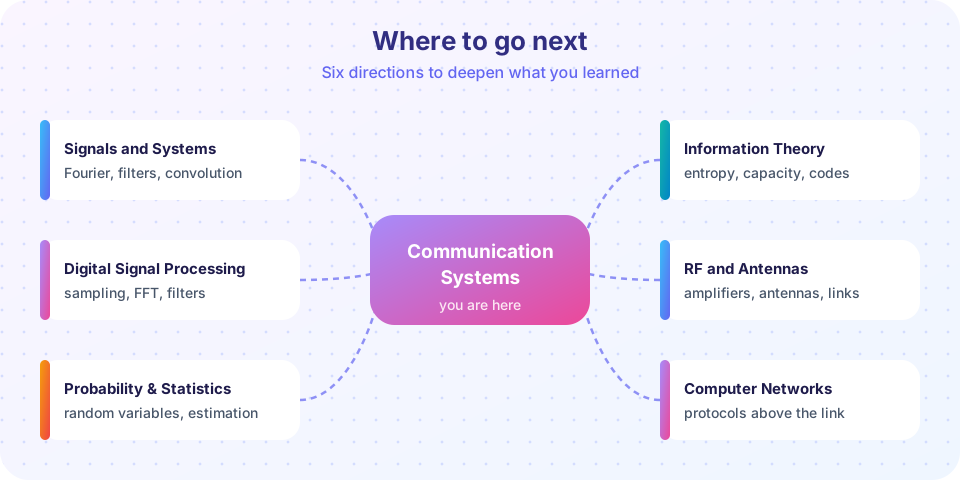
Where to go on this site
| If you want | Go to |
|---|---|
| the mathematics of signals, filters and spectra | Signals and Systems |
| sampling, FFT, filter design and software radio | Digital Signal Processing |
| random variables, estimation and hypothesis testing | Probability and Statistics |
| entropy, capacity and coding theory in depth | Information Theory |
| amplifiers, antennas and RF design | RF and Antennas |
| protocols that run on top of the link | Computer Networks |
A hands-on plan
The most effective way to learn is to receive a real signal. Inexpensive USB software-defined radio receivers (RTL-SDR) and the free GNU Radio toolkit let you decode FM stations, aircraft transponder messages or weather satellite images using the ideas from this course: demodulation, filtering, link margins and error detection. Start with FM broadcast, add a bit-error counter on a simulated link, then try a digital mode.
Recommended textbooks when you want depth: Digital Communications by Proakis and Salehi; Digital Communications: Fundamentals and Applications by Sklar; Fundamentals of Wireless Communication by Tse and Viswanath; and Elements of Information Theory by Cover and Thomas. Treat them as references rather than something to read from cover to cover.
Common misconceptions
- "Finishing a course means you understand the field." You now have the map; depth comes from building and measuring.
- "Theory and hardware are separate." Every link budget and every BER curve exists to predict what the hardware will do.
- "Modern systems are too complex to understand." They are built from exactly the blocks you have studied: modulation, filtering, coding, equalization.
Try it
First, a capstone: a complete QPSK link with root-raised-cosine pulse shaping, AWGN and a matched filter, compared with the theoretical BER. This is the chain of chapters 5 and 6 in about thirty lines.
Press Run (or Ctrl + Enter) to see the result here.
Program input · what you'd type while the program runs
Type the answers before you press Run, one per line. Each time the program reads a line (with input()), it gets the next line from this box.
Second, a checklist for planning your next steps. Tick the items you have done; the bar shows progress.
Check your understanding
Quick check · 4 questions
of 4 answered You scored / 4 · perfect!
-
1. Which task estimates carrier phase and symbol timing at the receiver?
Synchronization loops (such as a Costas loop and a timing detector) estimate phase, frequency and symbol timing. -
2. What do turbo, LDPC and polar codes have in common?
Modern codes use soft iterative decoding to get within a fraction of a dB of capacity. -
3. In the capstone, the matched filter and the transmit filter are both root-raised-cosine. Why?
RRC at both ends gives a raised-cosine overall response and a matched receiver. -
4. Where should you go to study the protocols that use a link like the ones in this course?
Computer networking covers the protocol layers that sit on top of physical links.
Summary
- You now have the complete chain: modulation, pulses, noise, detection, coding, link budgets, fading and fiber.
- Synchronization, equalization, modern codes, MIMO and multiple access are the natural next topics.
- Signals and Systems, DSP, Probability, Information Theory, RF and Networks extend the course in different directions.
- Build things: a simulator, a link budget tool and a software radio teach more than reading alone.
Back to the course page: Communication Systems
Track your progress
Create a free account to tick off lessons and pick up where you left off on any device.
of Communication Systems lessons completed