


















Lesson 4 of 46 · Getting Started
Bandwidth and channels
Understand bandwidth, thermal noise and SNR, then use Nyquist and Shannon to find the speed limit of a channel with worked examples.
How fast can you send data through a wire, a radio link or a fiber? The answer is not "as fast as the electronics allow". Two numbers set a hard ceiling: the bandwidth of the channel and the signal-to-noise ratio at the receiver. This lesson defines both and introduces the two classical limits, from Harry Nyquist (1924, 1928) and Claude Shannon (1948).
What you will learn
- Three common definitions of bandwidth and when to use each.
- How thermal noise power is computed from temperature and bandwidth.
- The Nyquist limit for a noiseless channel and the Shannon limit for a noisy one.
- To compute capacity in bits per second for real channels.
Key terms
- Bandwidth (B): the width, in hertz, of the band of frequencies a signal or channel occupies.
- SNR: signal power divided by noise power at the same point, often in dB.
- Thermal noise: noise from the random motion of charge carriers, with power
N = k · T · B. - Channel capacity (C): the maximum rate, in bits per second, with arbitrarily small error.
- Spectral efficiency: bits per second per hertz.
What bandwidth means
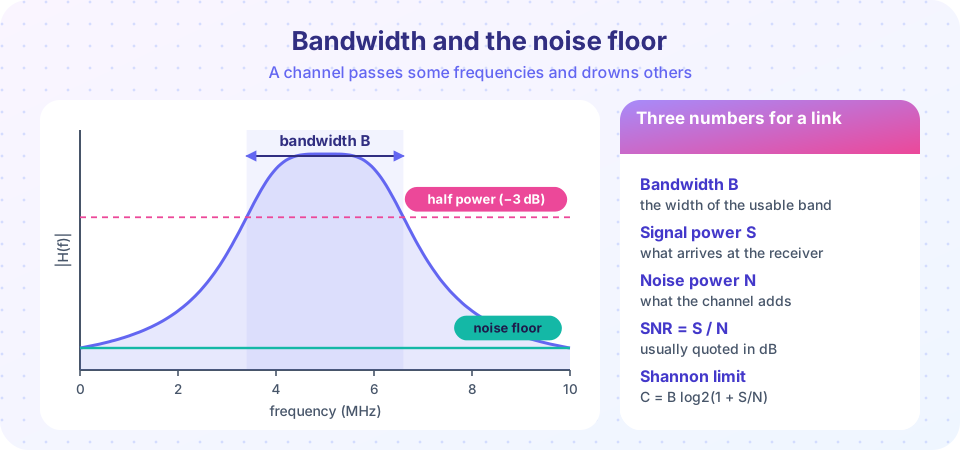
Bandwidth is a width in hertz, never a position. A channel from 88 MHz to 108 MHz has a bandwidth of 20 MHz. Because real frequency responses fall off gradually, you must say how you measure the edges.
- 3 dB bandwidth: the width between the points where power has fallen to half (−3 dB) of the maximum. Used for filters and amplifiers.
- Null-to-null bandwidth: the width of the main lobe of the spectrum, between the first zeros. Used for pulses.
- Occupied bandwidth: the width that contains a stated fraction (commonly 99 %) of the power. Used in regulation.
Whenever someone says "the bandwidth is 3 kHz", ask which definition. The idea is always the same, though: a signal that changes faster needs more bandwidth. A voice call changes at most a few thousand times a second; a video stream changes millions of times.
Noise and SNR
Every conductor at temperature T (in kelvin) produces random voltage fluctuations. The available noise power in bandwidth B is
N = k · T · B
where k = 1.380649 × 10⁻²³ J/K is Boltzmann's constant. At the standard reference temperature T0 = 290 K, the noise density is k · T0 ≈ 4.0 × 10⁻²¹ W/Hz, which is −174 dBm/Hz. For a 20 MHz channel, 10 · log10(20 × 10⁶) = 73 dB, so the noise floor is −174 + 73 = −101 dBm. Real receivers add their own noise, summarized by a noise figure (a few dB); we ignore it for now.
The signal-to-noise ratio is SNR = S / N. Written in decibels, SNR(dB) = 10 · log10(S / N), which equals the signal level in dBm minus the noise level in dBm.
Two speed limits
Nyquist: no noise, limited bandwidth
If the channel has bandwidth B and no noise, the maximum number of independent symbols per second is 2B (the Nyquist signaling rate). With M equally spaced levels per symbol, each carries log2(M) bits, so
C = 2 · B · log2(M)
Binary signaling on a 3.1 kHz line gives at most 2 × 3100 × 1 = 6.2 kb/s; using 16 levels gives 2 × 3100 × 4 = 24.8 kb/s. More levels demand a cleaner signal, which brings us to noise.
Shannon: noise sets the number of levels
Claude Shannon proved that for a channel with additive white Gaussian noise,
C = B · log2(1 + SNR)
with SNR as a plain ratio, not in dB. It is a theorem: no scheme can exceed it with vanishing error, and good codes get close. Check an example: a telephone line with B = 3.1 kHz and SNR = 30 dB = 1000. Then C = 3100 × log2(1001) ≈ 3100 × 9.97 ≈ 30.9 kb/s. This is why old analog modems topped out around 33.6 kb/s.
A Wi-Fi channel with B = 20 MHz and SNR = 25 dB ≈ 316 has C = 20 × 10⁶ × log2(317) ≈ 166 Mb/s.
Two lessons follow. At high SNR, doubling the power adds only one bit per hertz (power is expensive). At low SNR, capacity is nearly proportional to power. And doubling bandwidth at fixed SNR doubles capacity (bandwidth is valuable, but note that wider bandwidth also collects more noise, N = k T B, so SNR falls).
Common misconceptions
"Bandwidth is how fast the internet is." Everyday speech uses bandwidth to mean bit rate. In engineering, bandwidth is in hertz; bit rate is in bits per second. They are related by spectral efficiency.
"Use SNR in dB in the Shannon formula." The formula needs the plain ratio. 30 dB means 1000, not 30.
"Shannon says a given modem is limited to 30 kb/s." It says no scheme can beat the limit for that SNR and bandwidth; the actual limit changes if the line quality changes.
Try it
The first example plots spectral efficiency log2(1 + SNR) against SNR in dB. Notice the near-straight line at high SNR: each extra 3 dB (a doubling of power) adds about one more bit per second per hertz.
Press Run (or Ctrl + Enter) to see the result here.
Program input · what you'd type while the program runs
Type the answers before you press Run, one per line. Each time the program reads a line (with input()), it gets the next line from this box.
The second example builds a complete budget: thermal noise for a given bandwidth, the resulting SNR for a received level, and the Shannon capacity. Change rx_dbm and bandwidth to see which matters more.
Press Run (or Ctrl + Enter) to see the result here.
Program input · what you'd type while the program runs
Type the answers before you press Run, one per line. Each time the program reads a line (with input()), it gets the next line from this box.
Check your understanding
Quick check · 5 questions
of 5 answered You scored / 5 · perfect!
-
1. What does the 3 dB bandwidth of a channel measure?
The 3 dB points are where the power is half (−3 dB) of the peak; their separation is the 3 dB bandwidth. -
2. Thermal noise power in bandwidth B at temperature T is
N = k · T · B, so noise grows in direct proportion to bandwidth. -
3. A channel has B = 4 kHz and SNR = 15 (a plain ratio). The Shannon capacity is
C = 4000 × log2(1 + 15) = 4000 × 4 = 16,000 b/s. -
4. Which change roughly doubles Shannon capacity at high SNR?
Capacity is proportional to B, so doubling B at fixed SNR doubles it. Doubling power adds only about one bit per hertz. -
5. In the Shannon formula the SNR must be
Convert first: SNR = 10^(SNR_dB / 10).
Summary
- Bandwidth is a width in hertz; state whether it is the 3 dB, null-to-null or occupied bandwidth.
- Thermal noise is
N = k T B, about −174 dBm/Hz at 290 K. - Nyquist:
C = 2 B log2(M)without noise. - Shannon:
C = B log2(1 + SNR), with SNR as a ratio.
Next: Chapter 1 review
Track your progress
Create a free account to tick off lessons and pick up where you left off on any device.
of Communication Systems lessons completed