


















Lesson 21 of 46 · Digital Modulation
Digital Modulation: The Big Picture
Chapter 5 overview: how bits become radio waveforms with ASK, FSK, PSK and QAM, and what each choice costs in bandwidth and power.
Every phone call, video stream and Wi-Fi packet reaches you as a string of bits. Wires and the air cannot carry bits. They carry voltages, light and radio waves. Digital modulation is the step that turns a stream of bits into a waveform that fits the channel, and demodulation is the step that turns the waveform back into bits.
This chapter is about the choices inside that step. You can change the amplitude of a sinusoidal carrier, its frequency, its phase, or a mix of them. Each choice buys something (more bits per second, simpler hardware, tolerance to noise) and costs something else (more bandwidth, more power, harder timing). Learning to read that trade-off is the real skill.
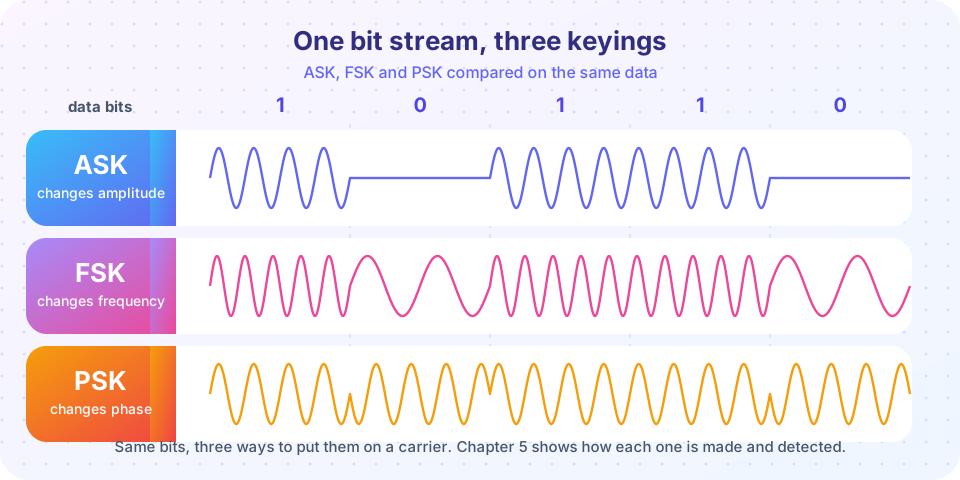
What you will learn
- The vocabulary of digital modulation: bit, symbol, baud, carrier, constellation.
- How ASK, FSK, PSK and QAM differ and when each is used.
- Why bandwidth and signal power pull against each other.
- What the five lessons of this chapter cover and how they connect.
Key terms
- Symbol: one waveform shape chosen from a fixed set; it can carry several bits.
- Baud (symbol rate, Rs): symbols sent per second. Bit rate is
Rb = Rs · log2(M)for an alphabet ofMsymbols. - Carrier: the high-frequency sinusoid
cos(2π·fc·t)that is modulated. - Constellation: a plot of the symbol points on the in-phase (I) and quadrature (Q) axes.
- Spectral efficiency: bits per second delivered per hertz of bandwidth.
From bits to symbols
A modulator takes k bits at a time and picks one of M = 2^k waveforms. With k = 1 you have binary modulation (two waveforms). With k = 2 you have four waveforms, and so on. The time one waveform lasts is the symbol time Ts, and Rs = 1/Ts.
This split matters because bandwidth follows the symbol rate, not the bit rate. If you pack 4 bits into each symbol you send symbols four times slower for the same bit rate, so the signal needs roughly a quarter of the bandwidth. The catch: with 16 different waveforms to tell apart, they sit closer together, and noise confuses them more easily.
The family at a glance
Change the amplitude
Change the frequency
Change the phase
Change both
Shape the pulses
What each lesson covers
- BPSK, ASK and FSK: the three binary schemes, coherent detection, what a phase error costs.
- QPSK and QAM: constellations, Gray coding, I/Q modulators, bits per symbol.
- Pulse shaping and ISI: the Nyquist criterion, raised-cosine pulses, eye diagrams.
- Chapter review: recap table and a ten-question quiz.
Chapter 6 then asks how often each scheme gets a bit wrong in noise, which is where the real comparison happens.
Try it
Pick a scheme and type your own bits to watch the waveform change. This is a drawing tool, not a radio: it samples a clean sinusoid for each bit.
How much bandwidth does one megabit per second need under each scheme? This calculator applies B = (1 + α) · Rs for a raised-cosine filter with roll-off α = 0.35.
Press Run (or Ctrl + Enter) to see the result here.
Program input · what you'd type while the program runs
Type the answers before you press Run, one per line. Each time the program reads a line (with input()), it gets the next line from this box.
Check your understanding
Quick check · 4 questions
of 4 answered You scored / 4 · perfect!
-
1. A modulator sends 2,400 symbols per second and each symbol carries 4 bits. What is the bit rate?
Rb = Rs · log2(M) = 2,400 × 4 = 9,600 bit/s. -
2. Which statement about bandwidth is correct?
Pack more bits into each symbol and the symbol rate falls, so the occupied bandwidth falls too. -
3. What is the price of using a denser constellation such as 64-QAM?
Closer points are easier to confuse, which means a cleaner (higher SNR) channel is required. -
4. Which scheme changes only the carrier's frequency?
Frequency shift keying selects one of several tones.
Summary
- Digital modulation maps groups of bits to waveforms;
Rb = Rs · log2(M). - ASK, FSK and PSK vary amplitude, frequency and phase; QAM varies amplitude and phase together.
- Bandwidth follows the symbol rate, so denser symbols save bandwidth but need more SNR.
- Pulse shaping controls the spectrum without smearing symbols together.
Next: BPSK, ASK and FSK
Track your progress
Create a free account to tick off lessons and pick up where you left off on any device.
of Communication Systems lessons completed