


















Lesson 22 of 46 · Digital Modulation
BPSK, ASK and FSK
Learn binary ASK, FSK and BPSK: how each is built, how a coherent receiver detects them, what a phase error costs, and where each one is used.
The simplest digital modulators send one bit per symbol. There are only two waveforms, and the receiver has one yes-or-no question to answer each symbol time: was it the first waveform or the second? Everything in later lessons, from QAM to Wi-Fi, is an extension of this binary case, so it pays to understand it well.
Binary schemes are also still everywhere. Garage-door remotes use on-off keying, many sensors use FSK, and GPS and deep-space probes use BPSK because it makes the best use of received power.
What you will learn
- Write the signal for binary ASK, FSK and BPSK and sketch each waveform.
- Explain how a coherent receiver multiplies by a carrier and integrates.
- Say why BPSK needs less power than ASK or FSK for the same error rate.
- Compute the loss caused by a carrier phase error.
- Explain what differential encoding fixes.
Key terms
- OOK (on-off keying): the simplest ASK; bit 1 sends the carrier, bit 0 sends nothing.
- Coherent detection: the receiver generates a local carrier locked in phase with the transmitter's.
- Correlator: multiplies the received signal by a reference and integrates over one symbol.
- Eb: the energy in one bit, in joules.
- DPSK: differential PSK, which encodes the bit in a phase change.
The three binary schemes
With bit time Tb and carrier frequency fc:
| Scheme | Bit 1 | Bit 0 | Changes |
|---|---|---|---|
| OOK / ASK | A·cos(2π·fc·t) |
0 |
amplitude |
| Binary FSK | A·cos(2π·f1·t) |
A·cos(2π·f0·t) |
frequency |
| BPSK | A·cos(2π·fc·t) |
-A·cos(2π·fc·t) |
phase by 180° |
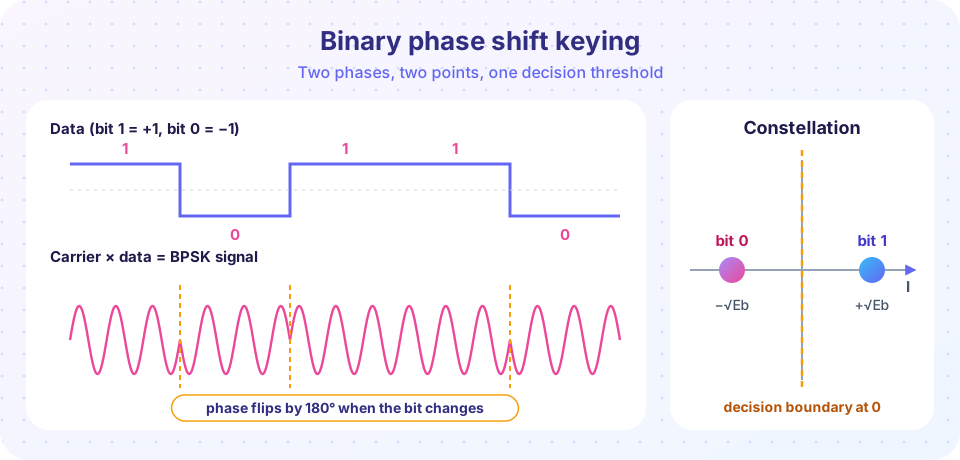
The energy per bit for a constant-amplitude signal is Eb = A²·Tb / 2. For BPSK that gives s(t) = ±√(2·Eb/Tb)·cos(2π·fc·t), which is just a cosine with a sign. A phase of 0° means one bit and 180° the other.
FSK needs the two tones to be distinguishable. The tones are orthogonal over a bit time if their spacing is a multiple of 1/(2·Tb) for coherent detection, or 1/Tb for noncoherent detection. Wider spacing makes detection easier but uses more bandwidth.
Why BPSK wins on power
Picture each scheme as points on a line, where the distance between points is what noise must overcome.
- BPSK points are at
+√Eband-√Eb: distance2·√Eb. - Orthogonal FSK points are at
(√Eb, 0)and(0, √Eb)in a two-dimensional signal space: distance√(2·Eb), about 1.41 times√Eb, which is 3 dB worse than BPSK in power. - OOK points are at 0 and
√(2·Eb), whereEbis the average energy per bit (half the symbols carry no energy at all). The distance is again√(2·Eb), so it also loses 3 dB against BPSK.
BPSK uses antipodal signals: one is the exact negative of the other. That is the largest separation possible for a given energy, so no binary scheme beats it. Chapter 6 turns the distance idea into error rates.
A coherent receiver
To recover a BPSK bit, the receiver multiplies the incoming signal by √(2/Tb)·cos(2π·fc·t) and integrates over one bit time:
z = ∫ r(t) · √(2/Tb) · cos(2π·fc·t) dt = ±√Eb + n
The noise term n is Gaussian with variance N0/2. The rule is "decide 1 if z > 0, otherwise 0". The multiplication shifts the signal to baseband and the integral averages out the noise. This is a correlator, and in the next chapter you will see it is the optimal receiver.
The carrier phase problem
The receiver's local carrier must match the transmitter's phase. If it is off by an angle φ, the correlator output shrinks:
z = ±√Eb · cos(φ) + n
A phase error of 30° costs a factor cos 30° = 0.866, which is 20·log10(0.866) = -1.25 dB of amplitude. At 90° the signal disappears entirely. Real receivers therefore use a carrier recovery loop (a Costas loop or a squaring loop) to lock the local carrier.
Those loops have a catch: BPSK looks identical after a 180° shift, so the loop can lock onto the wrong half of the cycle and every bit flips. This is the phase ambiguity. Differential encoding solves it: send bit b[k] as a change (or no change) relative to the previous symbol phase. The receiver compares each symbol with the one before. A constant 180° error cancels out, at the cost of a small increase in errors because one noisy symbol damages two decisions.
Common misconceptions
- "FSK and PSK are the same because both change something about a sine." They behave differently: FSK keeps constant amplitude and can be detected without knowing the phase; PSK needs phase knowledge but gives 3 dB better power efficiency.
- "A higher carrier frequency carries more bits." The carrier only sets where the signal sits in the spectrum. Bit rate comes from the symbol rate and the number of bits per symbol.
- "On-off keying has no noise problem because zero is zero." The receiver sees noise on both levels, and it must pick a threshold that fades with signal strength.
Try it
First, build a BPSK signal, add noise and recover the bits with a correlator. Energy per bit is set to 1 so you can see ±1 in the decision statistics. This is a baseband-sampled simulation, not a radio.
Press Run (or Ctrl + Enter) to see the result here.
Program input · what you'd type while the program runs
Type the answers before you press Run, one per line. Each time the program reads a line (with input()), it gets the next line from this box.
Second, see what a carrier phase error does to the bit error rate. The formula BER = Q(√(2·Eb/N0) · cos φ) is written below as 0.5·erfc(√(Eb/N0) · cos φ).
Press Run (or Ctrl + Enter) to see the result here.
Program input · what you'd type while the program runs
Type the answers before you press Run, one per line. Each time the program reads a line (with input()), it gets the next line from this box.
Check your understanding
Quick check · 5 questions
of 5 answered You scored / 5 · perfect!
-
1. In BPSK, how are the two bits represented?
BPSK uses +cos and -cos, which is a 180 degree phase difference. -
2. Why does BPSK need about 3 dB less power than orthogonal binary FSK for the same error rate?
Antipodal signals give the largest possible distance 2·√Eb for a given bit energy. -
3. A coherent BPSK receiver has a carrier phase error of 60 degrees. By what factor does the decision amplitude shrink?
The amplitude is multiplied by cos(60°) = 0.5, which is 6 dB lower. -
4. What problem does differential encoding solve?
By sending information in phase changes, a fixed 180° error in the recovered carrier cancels out. -
5. For coherent detection of binary FSK, the tones are orthogonal over one bit if their spacing is a multiple of:
Coherent detection allows the tighter spacing 1/(2·Tb); noncoherent detection needs 1/Tb.
Summary
- Binary ASK, FSK and BPSK change amplitude, frequency and phase respectively.
- BPSK signals are antipodal (
+sand-s), which gives the best power efficiency among binary schemes. - A coherent receiver multiplies by a local carrier and integrates over one bit; the sign of the result decides the bit.
- A carrier phase error
φmultiplies the amplitude bycos φ; differential encoding removes the 180° ambiguity.
Next: QPSK and QAM
Track your progress
Create a free account to tick off lessons and pick up where you left off on any device.
of Communication Systems lessons completed