


















Lesson 41 of 46 · Projects and Practice
Project: A Bit Error Rate Simulator
Build a Monte Carlo simulator for BPSK, QPSK and 16-QAM over AWGN, check it against theory, then extend it to phase errors to see why dense constellations are fragile.
Formulas tell you what should happen. A simulator shows you that it does, and lets you explore cases that have no formula. Every communications engineer builds one early on, because trusting a result you can verify two ways is a big step up from trusting one you cannot.
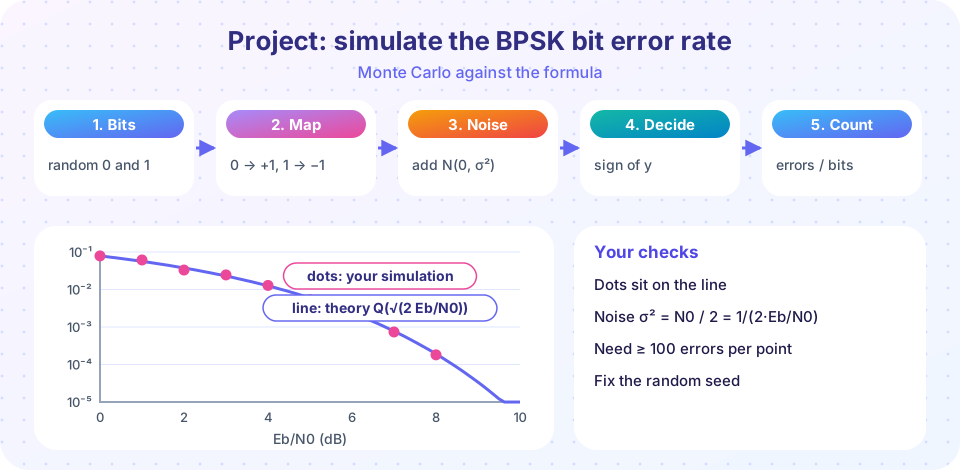
In this project you will write a small, vectorized Monte Carlo simulator in Python for BPSK, QPSK and 16-QAM over an AWGN channel, validate it against the theory of chapter 6, and then extend it with a carrier phase error.
What you will learn
- Structure a simulation as generate, modulate, add noise, demodulate, compare.
- Set the noise level from
Eb/N0correctly for each modulation. - Decide how many bits are needed for a trustworthy BER.
- Validate against theory and extend the model.
Key terms
- Monte Carlo simulation: estimate a probability by counting outcomes over many random trials.
- Confidence: with
Eobserved errors the relative uncertainty is about1/√E; use at least 100 errors per point. - Reproducibility: a fixed random seed gives the same results every run.
- Es and Eb: symbol and bit energy; set
N0 = Eb / (Eb/N0). - Phase offset: a rotation of the received constellation.
The recipe
- Fix the energy. Scale each constellation to unit average symbol energy
Es = 1. ThenEb = Es / kwithkbits per symbol:Eb = 1for BPSK,0.5for QPSK and0.25for 16-QAM. - Set the noise. For a target
Eb/N0(linearγ),N0 = Eb / γ. The noise on each real dimension has varianceN0 / 2. - Generate bits and map them. Use Gray mapping so neighbors differ in one bit.
- Add noise, decide, compare. Decide on the nearest constellation point, map back to bits and count differences.
- Check it. At each point the simulated value should be within about
1/√E(relative) of the formula. If it is consistently off by a factor of two, suspect the noise scaling; if it is off by a few dB, suspectEsversusEb.
Number of bits
If you simulate N bits and see E errors, the BER estimate is E/N with a relative standard error of about 1/√E. Hence to see a BER of 10⁻⁵ with 10 % accuracy you need around 100 errors, which means 10⁷ bits. Vectorized NumPy handles millions of bits per second; for very low BERs use importance sampling or switch to analysis.
Common misconceptions
- "If the simulation shows zero errors, the BER is zero." It only shows that the BER is below about
1/N. - "The seed does not matter." It matters for reproducibility; use several seeds to see the spread.
- "SNR and Eb/N0 can be mixed freely in code." Mixing them is the commonest cause of a curve that is wrong by exactly
10·log10(k)dB. - "A simulation proves the formula." It supports it within statistical error and under the model's assumptions.
Try it
The complete simulator is below. It runs the three schemes at several Eb/N0 values, prints a comparison table and plots dots (simulation) on lines (theory). Points with fewer than 20 observed errors are left out.
Press Run (or Ctrl + Enter) to see the result here.
Program input · what you'd type while the program runs
Type the answers before you press Run, one per line. Each time the program reads a line (with input()), it gets the next line from this box.
Now the extension. A carrier phase offset rotates the received constellation. BPSK only loses a factor cos φ of its amplitude, but 16-QAM has points whose decision boundaries are close, so rotation pushes points toward neighboring regions. The experiment applies a fixed rotation (no correction) at Eb/N0 = 12 dB.
Press Run (or Ctrl + Enter) to see the result here.
Program input · what you'd type while the program runs
Type the answers before you press Run, one per line. Each time the program reads a line (with input()), it gets the next line from this box.
Ideas to extend it
- Add the Hamming (7,4) code from chapter 7 and compare coded and uncoded curves.
- Replace AWGN by Rayleigh fading with a known channel gain, then add diversity (average two fades).
- Add a raised-cosine pulse and matched filter from chapter 5 and verify there is no loss.
- Produce a table of the
Eb/N0needed for BER10⁻³for each scheme by bisection. - Increase the constellation to 64-QAM and measure how much phase error it tolerates.
Check your understanding
Quick check · 4 questions
of 4 answered You scored / 4 · perfect!
-
1. A simulation of 10⁶ bits shows 25 errors. About how accurate is the estimated BER?
The relative standard error is about 1/√25 = 20 %. -
2. For QPSK with unit average symbol energy, what is Eb?
Eb = Es/k = 1/2 with k = 2 bits per symbol. -
3. A simulated BER curve is shifted right of the theory by about 3 dB. A likely cause is:
A factor 2 in noise variance is exactly 3 dB. -
4. Why is 16-QAM more sensitive to a carrier phase error than BPSK?
Dense constellations have little angular and amplitude room before a point crosses a boundary.
Summary
- A BER simulation is generate, map, add noise, decide, compare, with noise set from
Eb/N0and unitEs. - Use enough bits for at least 100 errors per point; zero errors only bounds the BER.
- Validate against the formula; a constant dB offset usually means an
Es/Ebor variance mistake. - Extensions such as phase errors show why dense constellations demand accurate synchronization.
Track your progress
Create a free account to tick off lessons and pick up where you left off on any device.
of Communication Systems lessons completed