


















Lesson 1 of 46 · Getting Started
Course map
Start here: what a communication system is, who this course is for, how the nine chapters fit together, and how to study them with simulations.
Every phone call, radio show, Wi-Fi page load and satellite picture rests on the same problem: move a message from one place to another through a medium that weakens it, bends it and adds noise. Communication systems is the engineering subject that solves this problem. It mixes signals, spectra, probability and a lot of practical cleverness.
This course is a guided tour of that subject. You will not memorize a catalog of acronyms. You will follow one signal from a microphone to an antenna and back, and at each stop you will ask the same question: what limits the quality of the message, and how do engineers push that limit?
What you will learn
- What this course covers and the order in which it covers it.
- The prerequisites, and how to refresh them while you go.
- How to read a lesson: the picture first, then the numbers, then the simulation.
- What each of the nine chapters will let you build or calculate.
Key terms
- Signal: a quantity (voltage, field strength, light power) that varies with time and carries information.
- Message: the information you want to deliver, such as speech or a file.
- Channel: the physical path between transmitter and receiver, such as a cable, the air or a fiber.
- Modulation: changing a property of a high-frequency carrier so that it carries the message.
- Noise: unwanted random signals added in the channel and in the receiver.
Who this course is for
The course suits three kinds of reader. If you are an upper secondary or first-year university student of electronics, computing or physics, it is your first systems course. If you are a hobbyist (amateur radio, software-defined radio, microcontrollers), it explains why the circuits you already use work. If you work in IT or data, it shows what happens below the network layer.
Prerequisites are modest: trigonometry (sine and cosine, phase), basic algebra with logarithms, and the idea of a voltage and a resistor. You do not need calculus to follow the main line, although a few derivations use integrals and we explain each result in words too. Complex numbers appear in chapter 2; we introduce them when needed. If a topic feels shaky, the site has tracks on algebra, trigonometry, circuit analysis and probability that you can open alongside.
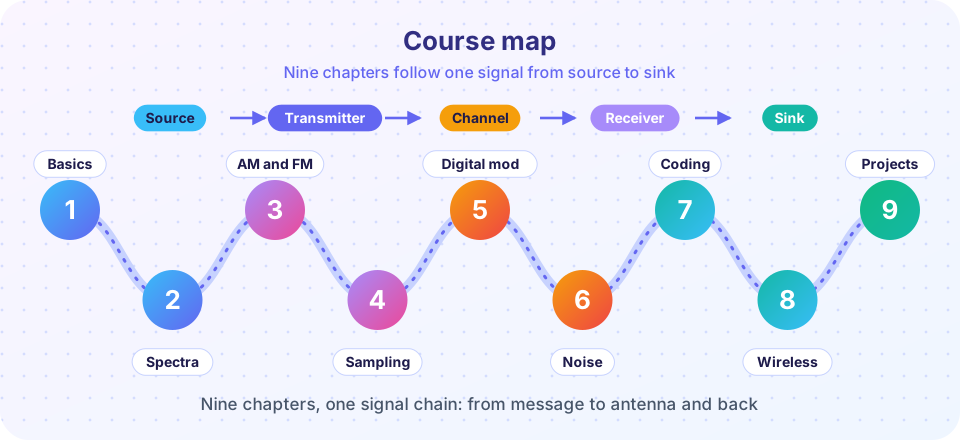
The nine chapters
The big picture
Everything in the course trades these three against each other.
Chapters 1 and 2
Chapters 3 and 4
Chapters 5 and 6
Chapters 7 and 8
Chapter 9
In plain words: chapter 1 gives you the vocabulary and the decibel. Chapter 2 gives you the main mathematical tool, the Fourier transform. Chapter 3 shows how analog messages ride on carriers (AM, FM). Chapter 4 turns waveforms into bits (sampling, quantization, pulse coding). Chapter 5 puts bits on carriers (ASK, FSK, PSK, QAM). Chapter 6 measures how noise causes errors. Chapter 7 shows how to detect and correct those errors with coding. Chapter 8 applies everything to radio and fiber links. Chapter 9 is projects and practice.
How to study each lesson
Every content lesson has the same skeleton so you always know where you are. First you meet the outcomes and the key terms. A labelled illustration shows the idea. Worked examples with numbers follow, because a formula you have not used once is a formula you do not own. A short list of common misconceptions warns about traps. The runnable examples let you change a number and watch the result. A short quiz closes each lesson.
Two habits help more than anything else. First, always attach units (hertz, volts, watts, decibels). A large share of mistakes in this field are unit mistakes. Second, change the simulation before you read the explanation: double the bandwidth, halve the noise, and predict the result first.
Common misconceptions
"Digital is better because it is perfect." Digital systems are better because errors can be detected and corrected, not because the channel stops adding noise. You will see exactly how often a bit flips, and why.
"More power always fixes a bad link." Power helps slowly (logarithmically) while bandwidth helps directly. Chapter 1 and chapter 7 explain the exchange rate.
Try it
The first example is a miniature of the whole course. It builds a message, puts it on a carrier (amplitude modulation, chapter 3), adds noise (chapter 6) and recovers the message with a very simple receiver. It is a demonstration, not a design.
Press Run (or Ctrl + Enter) to see the result here.
Program input · what you'd type while the program runs
Type the answers before you press Run, one per line. Each time the program reads a line (with input()), it gets the next line from this box.
The second example is a decibel calculator you will need all through chapter 1. Edit the numbers.
Press Run (or Ctrl + Enter) to see the console output here.
No output.
Check your understanding
Quick check · 4 questions
of 4 answered You scored / 4 · perfect!
-
1. Which block of the communication chain adds noise?
Noise enters in the channel and in the receiver's first amplifier. The source and sink are the ends of the chain. -
2. What does modulation do?
A carrier is a high-frequency sinusoid; modulation changes its amplitude, frequency or phase in step with the message. -
3. Which pair of resources trades off against each other in almost every design?
Bandwidth, power and noise set the capacity of a channel, so engineers constantly trade them. -
4. Why does the course insist on writing units?
Mixing dB and linear ratios, or Hz and rad/s, is the classic source of wrong answers.
Summary
- A communication system moves a message through a channel that attenuates it and adds noise.
- The course follows one chain through nine chapters, from basics to projects.
- Prerequisites are trigonometry, logarithms and basic circuits.
- Study by predicting, changing a number in the simulation, and comparing.
Next: The communication model
Track your progress
Create a free account to tick off lessons and pick up where you left off on any device.
of Communication Systems lessons completed