


















Lesson 23 of 46 · Digital Modulation
QPSK and QAM
Learn I/Q modulation, QPSK, 16-QAM and 64-QAM: constellations, Gray coding, bits per symbol, average energy and the SNR price of denser points.
BPSK sends one bit per symbol using one dimension: the sign of a cosine. A cosine, however, has a partner that is completely independent of it, the sine at the same frequency. Because cos and sin are orthogonal, you can put one stream of information on each and separate them again at the receiver. Doing so doubles the bit rate in the same bandwidth. This is quadrature modulation, and it is the idea underneath nearly every modern link, from DVB-S2 satellite TV to 5G.
If you also let each of the two streams take more than two levels, you get QAM (quadrature amplitude modulation) with 16, 64, 256 or more points.
What you will learn
- Describe a signal as
I·cos(ωt) − Q·sin(ωt)and read it off a constellation. - Explain why QPSK has the same bit error rate per bit as BPSK but twice the bit rate.
- Build square M-QAM constellations and compute average energy.
- Use Gray coding so neighboring points differ in a single bit.
- Quantify the SNR price of adding bits per symbol.
Key terms
- I and Q: in-phase (cosine) and quadrature (sine) components.
- Constellation: the set of
(I, Q)points the modulator may send. - Gray code: labels where adjacent points differ in exactly one bit.
- Es: average energy per symbol;
Eb = Es / log2(M). - EVM (error vector magnitude): the distance between the received point and the ideal point.
I/Q modulation
Any carrier-frequency signal with amplitude A and phase θ can be rewritten as two parts:
A·cos(ωt + θ) = I·cos(ωt) − Q·sin(ωt), with I = A·cos θ and Q = A·sin θ.
So a modulator needs just two inputs, I and Q. It multiplies I by a cosine, Q by a sine, and adds them. This is an I/Q modulator (or quadrature modulator). The receiver does the reverse: it multiplies the incoming signal by cos to recover I and by −sin to recover Q, each followed by a low-pass filter. A symbol is the pair (I, Q), which is a point on the plane, or equivalently a complex number I + jQ.
QPSK
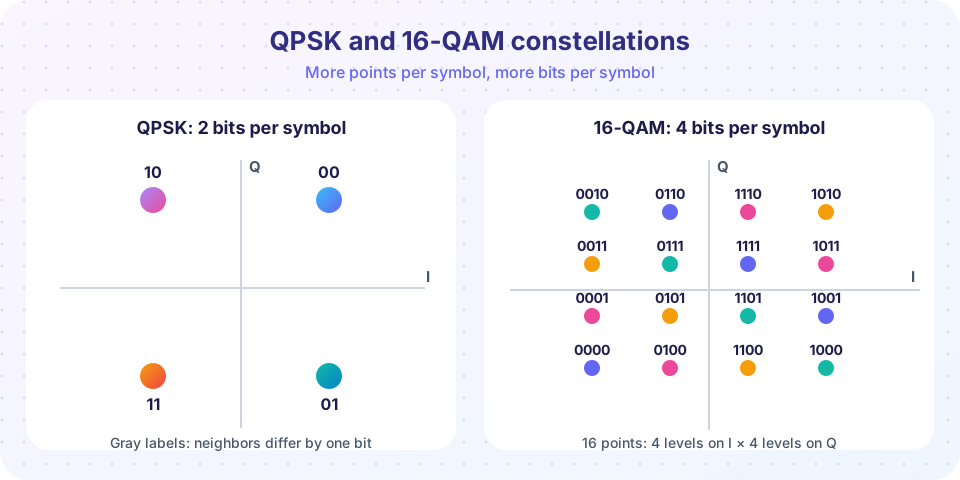
Quadrature phase-shift keying sends one BPSK bit on I and another on Q. The four points sit at (±1, ±1) scaled to the energy you want, one per quadrant, 90° apart. With the labeling in the figure, the first bit chooses the sign of I and the second the sign of Q.
Two facts follow directly:
- Rate. Two bits per symbol. For a given bit rate, QPSK needs half the symbol rate, hence half the bandwidth of BPSK.
- Error rate per bit. The
IandQbranches are independent BPSK links, each with energyEbper bit and noiseN0/2. With Gray labeling, a wrong decision onIflips one bit only. QPSK therefore has exactly the same bit error rate as BPSK at a givenEb/N0:Pb = Q(√(2·Eb/N0)). You double the speed for free in terms ofEb/N0.
Gray coding
When noise pushes a received point across a boundary, it most often lands on a neighboring point. If neighbors differ in one bit, a symbol error costs only one bit error. A binary count like 00, 01, 10, 11 does not have this property (01 → 10 flips two bits). A Gray sequence 00, 01, 11, 10 does. For one axis of square QAM, use Gray on the levels along that axis, and combine the two axes. In 16-QAM each point has a 4-bit label made of 2 bits for I and 2 bits for Q.
Square QAM
For M = 4^m, take the levels ±1, ±3, …, ±(√M − 1) on each axis. The average symbol energy (the mean of I² + Q²) is
Es = 2·(M − 1) / 3
For example M = 16 gives Es = 10, and M = 64 gives Es = 42. The minimum distance between neighbors is 2 in these units. After normalizing every constellation to unit average energy, the minimum distance dmin = 2 / √Es shrinks as M grows:
| M | bits per symbol | Es (levels ±1, ±3, …) | dmin at unit energy |
|---|---|---|---|
| 4 (QPSK) | 2 | 2 | 1.414 |
| 16 | 4 | 10 | 0.632 |
| 64 | 6 | 42 | 0.309 |
Noise has to move a point by about dmin / 2 to cause an error. So going from QPSK to 16-QAM at the same transmit power costs roughly 10·log10((1.414/0.632)²) ≈ 7 dB of extra SNR for double the bits per symbol. From 16-QAM to 64-QAM it is about another 6 dB. A useful rule: each extra bit per symbol costs about 3 dB.
Corner points of square QAM have more energy than the average. For 16-QAM, the corner energy is 18 against an average of 10, so the peak power is 1.8 times the average (2.55 dB). That matters for amplifiers, which must stay linear up to the peak.
Common misconceptions
- "QPSK is twice as noisy as BPSK because it carries twice the data." At equal
Eb/N0its bit error rate is the same. The extra speed uses bandwidth wisely rather than costing power per bit. - "More points always means a better modem." Dense constellations are only useful when the SNR is high. Real systems switch between QPSK, 16-QAM and 64-QAM as conditions change.
- "QAM and PSK are unrelated." QPSK is 4-QAM. PSK schemes keep all points on a circle (constant amplitude); QAM uses several amplitudes.
Try it
First, an I/Q explorer. Drag the I and Q sliders and see the point, its amplitude and phase, and the resulting carrier. It is a drawing of the equation above, not a transmitter.
Second, scatter plots of received symbols through the same noise. All three constellations are normalized to unit average energy, so the noise is the same in each. The code detects with the nearest constellation point and counts errors.
Press Run (or Ctrl + Enter) to see the result here.
Program input · what you'd type while the program runs
Type the answers before you press Run, one per line. Each time the program reads a line (with input()), it gets the next line from this box.
Third, Gray labels and average energies, to check the table above.
Press Run (or Ctrl + Enter) to see the result here.
Program input · what you'd type while the program runs
Type the answers before you press Run, one per line. Each time the program reads a line (with input()), it gets the next line from this box.
Check your understanding
Quick check · 5 questions
of 5 answered You scored / 5 · perfect!
-
1. At the same Eb/N0, how does the bit error rate of QPSK (Gray coded) compare with BPSK?
QPSK is two independent BPSK links on orthogonal carriers, each with the same Eb/N0 per bit. -
2. Why is Gray coding used on constellations?
Neighbors differ in a single bit, so the most likely symbol errors cause a single bit error. -
3. For square 16-QAM with levels ±1 and ±3 on each axis, what is the average symbol energy?
Es = 2(M−1)/3 = 2·15/3 = 10, the mean of I² + Q² over the 16 points. -
4. Roughly how much extra SNR does 16-QAM need compared with QPSK for the same symbol error rate?
dmin falls from 1.414 to 0.632 at unit energy, a power ratio of 5, which is 7 dB. -
5. A QPSK modulator is fed I = 1 and Q = 1. What are the amplitude and phase of the carrier?
A = √(I² + Q²) = √2 ≈ 1.41 and θ = atan2(Q, I) = 45°.
Summary
- A signal at carrier frequency is
I·cos(ωt) − Q·sin(ωt); a constellation plots(I, Q)for every allowed symbol. - QPSK doubles the bit rate of BPSK in the same bandwidth with the same bit error rate at equal
Eb/N0. - Square M-QAM has average energy
2(M−1)/3in unit-spacing levels; every extra bit per symbol costs about 3 dB. - Gray labeling turns the likeliest symbol errors into single bit errors.
Next: Pulse shaping and ISI
Track your progress
Create a free account to tick off lessons and pick up where you left off on any device.
of Communication Systems lessons completed