


















Lesson 2 of 46 · Getting Started
The communication model
Learn the five blocks of every communication system, why messages are modulated onto carriers, and how a channel damages a signal with loss and noise.
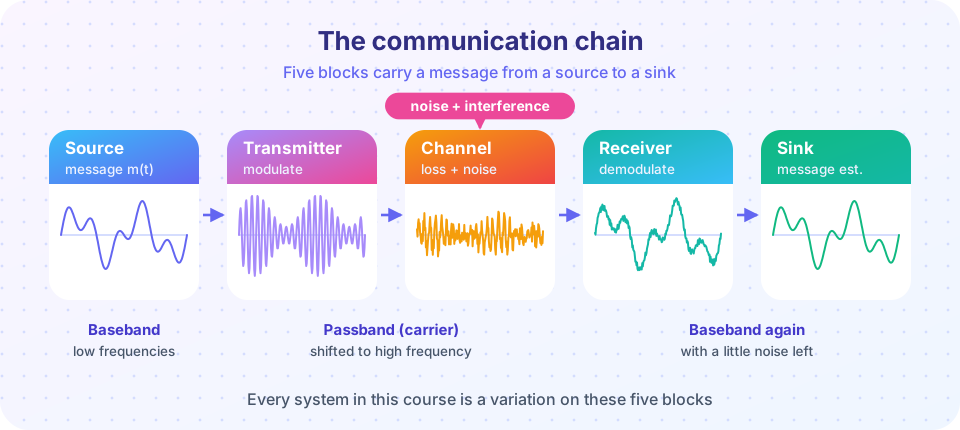
Draw any communication system, from a walkie-talkie to a deep-space probe, and you can reduce it to the same five blocks. Seeing that skeleton first makes every later chapter easier, because each chapter simply zooms into one block. In this lesson you meet the blocks, the vocabulary around them (analog, digital, baseband, passband) and the reason almost every system modulates.
What you will learn
- The role of each of the five blocks in the chain.
- The difference between analog and digital messages, and between baseband and passband signals.
- Why we modulate: antenna size and sharing the spectrum.
- Four ways a channel damages a signal.
Key terms
- Transmitter: converts the message into a signal suited to the channel.
- Receiver: reverses that conversion and estimates the message.
- Baseband: the original range of frequencies of the message, starting near 0 Hz.
- Passband: a band of frequencies around a carrier frequency
fc. - Attenuation: loss of signal power along the path.
The five blocks
The source produces the message: a microphone makes a voltage that follows air pressure, a camera makes a stream of pixel values, a keyboard produces characters. The transmitter prepares that message for the channel. Typical jobs: filter, amplify, convert to bits, add error protection and modulate onto a carrier.
The channel is the medium. It can be a twisted pair of copper wires, a coaxial cable, an optical fiber, or free space between two antennas. The receiver undoes the transmitter's work: it amplifies a very weak signal, filters out unwanted frequencies, demodulates and decodes. The sink is the destination: a loudspeaker, a screen, a file on disk.
Two features are worth remembering. First, the chain is mostly one-way; two-way communication is two chains. Second, the receiver never sees the transmitted signal exactly. It sees the transmitted signal after the channel has done its work, so the receiver's output is only an estimate of the message, written m̂(t) ("m hat").
Analog or digital?
An analog message can take any value in a continuous range at any instant: the voltage from a microphone, the temperature from a sensor. A digital message is a sequence of symbols from a finite alphabet, usually bits. Digital messages can be perfectly regenerated as long as noise does not flip a symbol, which is why digital systems dominate: a repeater can clean up a noisy signal and send a fresh copy. Analog repeaters amplify noise along with the signal.
Note the independence of two choices. The message can be analog or digital, and the transmission can be analog or digital. Speech (analog) is often converted to bits (chapter 4) for transmission. A digital file can be sent over an analog channel such as a telephone line by modulating a carrier (chapter 5).
Baseband and passband
A speech signal occupies roughly 300 Hz to 3.4 kHz. That is baseband: the frequencies sit near zero. You can send baseband signals directly down a wire, but you usually cannot send them through the air. Hence modulation: shift the information to a band around a carrier frequency fc, giving a passband signal.
There are two strong reasons.
Antenna size. An efficient antenna must be a sizable fraction of the wavelength, often a quarter wave. The wavelength is λ = c / f, with c ≈ 3 × 10⁸ m/s. For a 3 kHz audio tone, λ = 100 km, so a quarter-wave antenna would be 25 km long. For a 100 MHz carrier, λ = 3 m and the quarter-wave antenna is 0.75 m.
Sharing. If all stations used the same baseband frequencies they would overwrite each other. Moving each station to its own carrier gives frequency-division multiplexing: the radio dial.
What the channel does
Four impairments recur throughout the course.
- Attenuation. Power falls with distance. In free space it falls with the square of distance; in cables it falls exponentially with length.
- Distortion. Different frequencies are attenuated or delayed differently, so the waveform changes shape.
- Noise. Random signals are added. Thermal noise from the random motion of electrons is always present (chapter 6).
- Interference. Other transmitters, motors, microwave ovens and the like add signals that are not random but are unwanted.
The ratio that sums up the damage is the signal-to-noise ratio (SNR). The next two lessons give you the decibel and the notion of bandwidth you need to talk about it.
Common misconceptions
"The receiver gets back exactly what was sent." It gets the sent signal plus distortion and noise. Good design makes the estimate close enough.
"Modulation is only for radio." Cable television, fiber, DSL, Ethernet at high speed and even the memory bus inside a computer use modulation or its relatives.
Try it
The first example computes the length of a quarter-wave antenna for several services. The numbers explain why a phone can be small and an AM broadcast tower cannot.
Press Run (or Ctrl + Enter) to see the result here.
Program input · what you'd type while the program runs
Type the answers before you press Run, one per line. Each time the program reads a line (with input()), it gets the next line from this box.
The second example is a live noise demonstration. Drag the slider and see how a fixed sine wave looks at different signal-to-noise ratios. This is a drawing demonstration, not a measurement.
Check your understanding
Quick check · 5 questions
of 5 answered You scored / 5 · perfect!
-
1. Which block turns the message into a form suited to the channel?
The transmitter filters, encodes and modulates the message so that the channel can carry it. -
2. A baseband signal is one whose frequencies are
Baseband means the original message band, starting near 0 Hz. Passband signals sit around a carrier. -
3. What is the free-space wavelength at 100 MHz?
λ = c / f = (3 × 10⁸ m/s) / (100 × 10⁶ Hz) = 3 m. -
4. Why can a digital repeater clean up a noisy signal while an analog one cannot?
A digital repeater makes a decision among a finite alphabet and regenerates the symbol; an analog repeater can only amplify the signal together with its noise. -
5. Which is NOT a channel impairment listed in the lesson?
Modulation is something the transmitter does on purpose. The other three are things the channel does to the signal.
Summary
- Every system is source, transmitter, channel, receiver, sink.
- The receiver output is an estimate of the message, not a copy.
- Digital messages can be regenerated; analog ones accumulate noise.
- We modulate to use small antennas and to share the spectrum, using
λ = c / f. - Channels attenuate, distort, add noise and suffer interference.
Next: Decibels and power
Track your progress
Create a free account to tick off lessons and pick up where you left off on any device.
of Communication Systems lessons completed