


















Lesson 3 of 46 · Getting Started
Decibels and power
Master the decibel: power and voltage ratios, dBm and dBW, the 3 dB rule, and a worked link budget where gains and losses simply add up.
A transmitter may send 2 watts. A receiver may need only a hundred-billionth of a watt. The range is so enormous that engineers stopped writing ratios and started writing their logarithms. The decibel (dB) turns multiplication into addition, which makes a chain of amplifiers, cables and antennas as easy to analyze as a bank statement.
What you will learn
- To convert between power ratios and decibels in both directions.
- Why voltage uses 20 instead of 10, and when to use each.
- What dBm and dBW mean, and how to add gains and losses.
- To build a simple link budget and find the received power.
Key terms
- Decibel (dB): ten times the base-10 logarithm of a power ratio.
- dBm: power relative to 1 milliwatt.
- dBW: power relative to 1 watt.
- Gain / loss: a positive / negative number of dB for a stage.
- Link budget: the running total of gains and losses from transmitter to receiver.
The definition
For two powers P1 (input) and P2 (output):
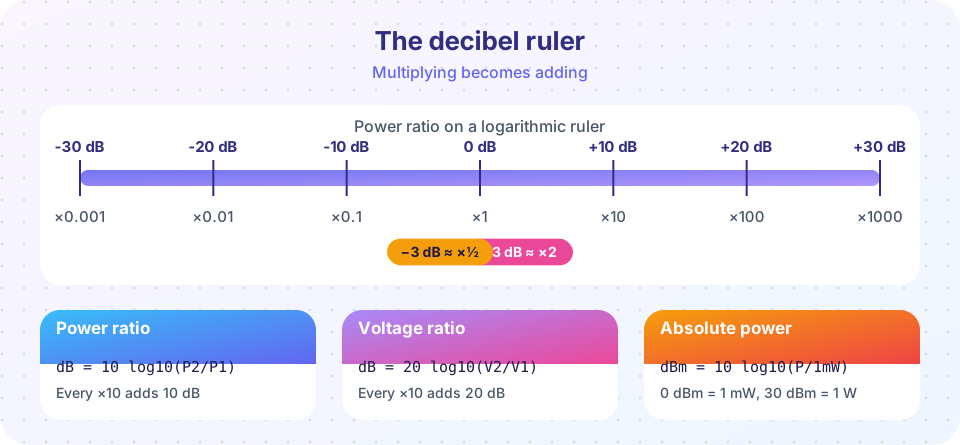
gain in dB = 10 · log10(P2 / P1)
If P2 = 100 · P1, the gain is 10 · log10(100) = 20 dB. If the output is half the input, 10 · log10(0.5) = −3.01 dB, so a half is a loss of about 3 dB. A ratio of 1 is 0 dB. A ratio below 1 is a negative number of decibels.
Memorize four anchor values: ×2 is +3 dB, ×10 is +10 dB, ×4 is +6 dB, ×100 is +20 dB. Any other value can be built by adding: ×20 is ×2 times ×10, so +3 + 10 = +13 dB. The exact value for a factor of 2 is 3.0103 dB; 3 dB is close enough for planning.
Voltage ratios use 20
Power in a resistor is P = V² / R. If a voltage doubles across the same resistance, power quadruples. So for voltages (or currents, or field strengths) measured across equal resistances:
gain in dB = 20 · log10(V2 / V1)
The factor 20 is not a different decibel; it is the same power ratio expressed through voltage. Doubling the voltage is 20 · log10(2) ≈ +6 dB. Forget this and your answers are wrong by a factor of two in dB.
Absolute levels: dBm and dBW
A pure ratio says nothing about the actual power. To express a power as a decibel number, compare with a reference.
dBm = 10 · log10(P / 1 mW). So 1 mW is 0 dBm, 1 W is 30 dBm, 2 W is 33 dBm.dBW = 10 · log10(P / 1 W). So 1 W is 0 dBW, 1 mW is −30 dBW.
Note dBm = dBW + 30. A level in dBm plus a gain in dB gives a level in dBm. Subtracting two dBm levels gives a plain dB ratio. You may never add two dBm values: that would multiply their powers. (Adding powers means converting back to watts.)
A worked link budget
A transmitter outputs 2 W (33.01 dBm). A cable to the antenna loses 3 dB. The transmit antenna has a gain of 12 dB over an isotropic radiator (written dBi). The path loses 100 dB. The receive antenna has 3 dBi gain. Received power:
33.01 − 3 + 12 − 100 + 3 = −54.99 dBm
That is about −55 dBm, which in watts is 10^(−5.5) mW, about 3.2 nanowatts. The advantage of decibels shows here: five numbers, four additions, and the answer is in hand. In watts you would multiply five factors, one of them as small as 10⁻¹⁰.
The margin of a link is the received level minus the minimum level the receiver needs. If the receiver needs −90 dBm to work, this link has 35 dB of margin to absorb fading and rain.
Common misconceptions
"A 3 dB loss means half the voltage." It means half the power. Half the power is 1/√2 ≈ 0.707 of the voltage. Half the voltage is a 6 dB loss.
"dBm values can be added." Only dB values (gains) can be added to a dBm level. Two signals of 0 dBm combined (incoherently) give about 3 dBm, not 0 dBm.
"dB is a unit of power." dB is a ratio. dBm and dBW are levels in decibels relative to a reference power.
Try it
The first example shows how the decibel compresses a huge range. Notice how the logarithm grows slowly and how the 3 dB point sits at a factor of two.
Press Run (or Ctrl + Enter) to see the result here.
Program input · what you'd type while the program runs
Type the answers before you press Run, one per line. Each time the program reads a line (with input()), it gets the next line from this box.
The second example is a link-budget calculator. Edit the numbers in the table to explore what a 6 dB better antenna would buy you.
Press Run (or Ctrl + Enter) to see the result here.
Program input · what you'd type while the program runs
Type the answers before you press Run, one per line. Each time the program reads a line (with input()), it gets the next line from this box.
Check your understanding
Quick check · 5 questions
of 5 answered You scored / 5 · perfect!
-
1. A power gain of 100 is how many decibels?
10 · log10(100) = 10 · 2 = 20 dB. -
2. A voltage is doubled across the same resistor. The change in dB is about
Doubling the voltage quadruples the power, and 10 · log10(4) ≈ 6.02 dB, which equals 20 · log10(2). -
3. What is 1 W expressed in dBm?
1 W = 1000 mW, and 10 · log10(1000) = 30 dBm. -
4. A signal at 10 dBm passes through a 25 dB attenuator. The output level is
Losses subtract: 10 dBm − 25 dB = −15 dBm. -
5. Which statement about adding dBm values is correct?
A gain in dB is a ratio and can be added to a level; two absolute levels must be converted to watts before combining.
Summary
dB = 10 log10(P2/P1)for power,20 log10(V2/V1)for voltage or current ratios.- Anchors: ×2 = +3 dB, ×10 = +10 dB, ×4 = +6 dB, ×100 = +20 dB.
dBmis relative to 1 mW,dBWto 1 W, anddBm = dBW + 30.- A link budget adds gains and subtracts losses to find the received level and the margin.
Next: Bandwidth and channels
Track your progress
Create a free account to tick off lessons and pick up where you left off on any device.
of Communication Systems lessons completed