


















Lesson 9 of 46 · Signals and Spectra
Power spectral density and filters
See where a signal's power sits in frequency, how a filter reshapes it with |H(f)|², what white noise is, and when a channel is distortionless.
The Fourier transform tells you how much of each frequency a signal contains. For random signals such as noise or a random data stream, there is no single waveform to transform. Engineers instead describe how power is spread across frequency. This description, the power spectral density (PSD), is how you size a filter, compute noise power and predict interference between neighbouring channels.
What you will learn
- The difference between energy signals and power signals.
- What PSD means and its units.
- How a linear filter changes a PSD, and how to find output noise power.
- The conditions for distortionless transmission.
Key terms
- Power spectral density
Sx(f): power per hertz, in W/Hz; its integral over all frequencies is the total power. - White noise: noise with a flat PSD,
N0 / 2watts per hertz at all frequencies. - Transfer function
H(f): how a linear system scales and shifts each frequency. - Equivalent noise bandwidth: the width of an ideal rectangle that passes the same noise power.
- Distortionless: output is a scaled, delayed copy of input.
Energy signals and power signals
A single pulse has finite energy and (averaged over all time) zero power: it is an energy signal, described by its energy spectral density |X(f)|². A sinusoid, a continuing data stream or noise lasts forever and has finite average power: it is a power signal, described by a power spectral density Sx(f) with
P = ∫ Sx(f) df (over all f, in watts if x is a voltage across 1 Ω).
The two-sided convention counts negative frequencies; the area under the positive half is half of the total. Always check which convention a formula uses.
Filters and the output PSD
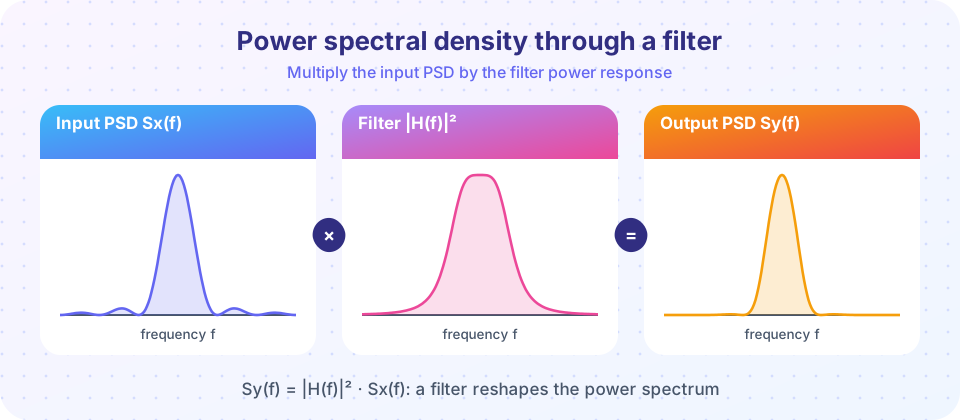
A linear time-invariant filter with transfer function H(f) scales each frequency component by |H(f)| in amplitude, so in power by |H(f)|². Therefore
Sy(f) = |H(f)|² · Sx(f).
This single line solves a large class of problems. For example, the RC low-pass filter has H(f) = 1 / (1 + j f/fc) with the corner frequency fc = 1 / (2π R C), so |H(f)|² = 1 / (1 + (f/fc)²). At f = fc the power is half (−3 dB), which is why fc is called the 3 dB frequency.
White noise through an RC filter
White noise has the same PSD at all frequencies, written N0 / 2 (two-sided, W/Hz); N0 = k T for thermal noise. Pass it through the RC filter. The output power is
Pout = ∫ (N0/2) / (1 + (f/fc)²) df = (N0/2) · π · fc = (π/2) · fc · N0.
The integral ∫ 1/(1+u²) du from −∞ to ∞ is π. Compare with N0 · B for an ideal rectangular filter of bandwidth B: the RC filter passes the same noise power as an ideal filter of width B_eq = (π/2) fc ≈ 1.57 fc. This B_eq is the equivalent noise bandwidth; it is wider than the 3 dB bandwidth because the filter rolls off slowly.
Worked numbers. With fc = 1 kHz and N0 = 10⁻⁹ W/Hz: B_eq = 1.571 kHz and Pout = 1.571 × 10⁻⁶ W.
Distortionless transmission
When is a channel harmless? The output must be a scaled, delayed copy: y(t) = K · x(t − td). Transforming, Y(f) = K e^(−j 2π f td) X(f), so the channel must have
- a flat magnitude
|H(f)| = Kover the signal band, and - a linear phase
∠H(f) = −2π f td, meaning constant group delay.
Two kinds of distortion break these rules. Amplitude distortion: |H| is not flat, so some frequencies are weakened more than others (a cable's high-frequency loss rounds off pulses). Phase (delay) distortion: components of different frequency travel at different speeds, so a pulse spreads out (dispersion in a fiber). Voice is insensitive to phase distortion, because the ear mostly ignores it; digital pulses are very sensitive to it.
Common misconceptions
"A flat magnitude response is enough." Without a linear phase, a flat-magnitude channel still distorts the waveform (an all-pass filter does exactly this).
"The 3 dB bandwidth is the noise bandwidth." For the RC filter they differ by the factor π/2; always use the equivalent noise bandwidth for noise power.
"White noise has infinite power." The ideal flat PSD would, but real noise is bandlimited by the system, so the power in any real receiver is finite.
Try it
The first example filters white noise with a first-order low-pass filter, estimates the PSD with Welch's method and compares it with the theoretical |H(f)|². It also checks the output power against (π/2) fc N0. The digital filter only approximates the analog one, so expect agreement within a few percent.
Press Run (or Ctrl + Enter) to see the result here.
Program input · what you'd type while the program runs
Type the answers before you press Run, one per line. Each time the program reads a line (with input()), it gets the next line from this box.
The second example compares two channels with the same magnitude response: one has a pure delay (distortionless), the other adds a frequency-dependent delay. The pulse keeps its shape in the first case and spreads in the second.
Press Run (or Ctrl + Enter) to see the result here.
Program input · what you'd type while the program runs
Type the answers before you press Run, one per line. Each time the program reads a line (with input()), it gets the next line from this box.
Check your understanding
Quick check · 5 questions
of 5 answered You scored / 5 · perfect!
-
1. If the input PSD is Sx(f), the output PSD of a filter H(f) is
Amplitudes are scaled by |H|, so powers are scaled by |H|². -
2. A white noise PSD is
White means flat: the same power per hertz at every frequency (in the ideal model). -
3. The total power is obtained from the PSD by
P = ∫ S(f) df. -
4. A channel is distortionless when its transfer function has
|H| = K and phase −2π f td give y(t) = K x(t − td). -
5. An RC low-pass has corner frequency 2 kHz. Its equivalent noise bandwidth is about
B_eq = (π/2) fc = 1.571 × 2 kHz ≈ 3.14 kHz.
Summary
- PSD
S(f)gives watts per hertz; integrating it gives total power. - A linear filter changes the PSD to
|H(f)|² S(f). - White noise has PSD
N0/2; through an RC filter it has power(π/2) fc N0. - Distortionless transmission needs flat magnitude and linear phase.
Next: Chapter 2 review
Track your progress
Create a free account to tick off lessons and pick up where you left off on any device.
of Communication Systems lessons completed