


















Lesson 37 of 46 · Wireless and Optical Systems
Link Budget and Path Loss
Compute received power with the Friis equation, free-space path loss, EIRP, antenna gain, noise floor, SNR and fade margin, and find the maximum range of a radio link.
Can a 100 mW Wi-Fi router cover your garden? Will a satellite 36,000 km away deliver a clean picture to a dish the size of a pizza? Answering such questions takes arithmetic, not magic: start with the transmit power, add every gain, subtract every loss, and compare what is left with the receiver's noise floor. The ledger is a link budget, and because every item is in decibels, the whole thing is a column of additions.
Link budgets are the everyday tool of radio engineers. A designer uses one to pick antennas and transmit power, to decide whether a repeater is needed, and to see how much margin is left for rain, fading and ageing.
What you will learn
- State the Friis transmission equation and free-space path loss in dB.
- Use
dBm,dBi,dBWand EIRP correctly. - Build a complete link budget and compute margin.
- Estimate maximum range, in free space and with a path loss exponent.
- Explain why higher frequency means more loss for isotropic antennas.
Key terms
- dBm / dBW: power relative to 1 mW / 1 W.
0 dBm = −30 dBW. - dBi: antenna gain in dB relative to an isotropic radiator.
- EIRP: effective isotropic radiated power,
Ptx + Gtx(minus feeder losses). - FSPL: free-space path loss.
- Link margin: received power or SNR above the minimum needed; a safety allowance for fading.
Friis and free-space loss
A transmitter radiates power Pt from an antenna of gain Gt. At distance d the power per unit area is Pt·Gt / (4π·d²). A receiving antenna of gain Gr has an effective area Gr·λ² / (4π). Multiplying gives the Friis transmission equation:
Pr = Pt · Gt · Gr · (λ / (4π·d))².
The factor (λ/(4π·d))² is the inverse of the free-space path loss. In decibels, with d in kilometers and frequency f in megahertz,
FSPL = 20·log10(d) + 20·log10(f) + 32.44 dB.
Check: at 1 km and 1 GHz it gives 0 + 60 + 32.44 = 92.44 dB. Doubling the distance adds 6 dB; doubling the frequency also adds 6 dB. The frequency dependence is a property of the antenna aperture, not of the air: a fixed-gain antenna gets physically smaller as the wavelength shrinks, so it captures less power. Directive antennas of a fixed size have gain that grows as f², which more than compensates and is why high-frequency satellite and microwave links use dishes.
The ledger
With everything in dB:
Pr(dBm) = Ptx(dBm) + Gtx(dBi) − Ltx(dB) − FSPL(dB) − Lmisc(dB) + Grx(dBi) − Lrx(dB)
and the noise at the receiver is N(dBm) = −174 + 10·log10(B) + NF. Then
SNR = Pr − N, and margin = SNR − SNR_required.
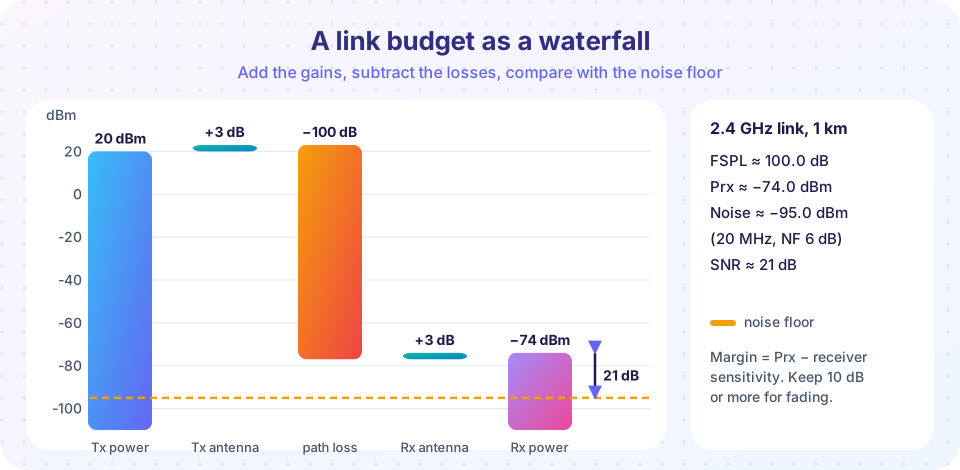
Example. A 2.4 GHz link of 1 km with 20 dBm transmit power, 3 dBi antennas at both ends, a 20 MHz channel and a 6 dB noise figure:
- FSPL:
20·log10(1) + 20·log10(2400) + 32.44 = 100.04 dB. Pr = 20 + 3 − 100.04 + 3 = −74.04 dBm.- Noise:
−174 + 73.01 + 6 = −94.99 dBm. - SNR: about
20.95 dB.
If the modulation and coding need 10 dB, the margin is about 11 dB. That is the buffer against fading, rain, misalignment and interference.
Range from the budget
Turn the equation around. The maximum allowed path loss is Lmax = Pt + Gt + Gr − Prx_min, where Prx_min = N + SNR_required is the sensitivity. In free space,
d_km = 10^((Lmax − 32.44 − 20·log10(f_MHz)) / 20).
In an environment with path loss exponent n and reference loss PL0 at d0, d = d0 · 10^((Lmax − PL0) / (10·n)). With n = 3.5, an extra 10 dB of margin multiplies range by only 10^(10/35) = 1.93, while in free space (n = 2) it would multiply range by 3.16.
Shadowing and fade margin
Real received power varies around the path-loss average. Large obstacles add shadowing, modeled as a Gaussian random variable in dB (log-normal in power) with a standard deviation of roughly 4 to 10 dB. To make the link work 99 % of the time against shadowing alone you need a margin of 2.33σ: 9.3 dB for σ = 4 dB. Fast fading needs additional margin, or diversity and coding.
Common misconceptions
- "Higher frequencies are absorbed more by free space." In vacuum nothing is absorbed. The extra loss is the smaller effective area of a fixed-gain antenna; real atmospheres add absorption (oxygen at 60 GHz, rain at 10 GHz and up).
- "dBm and dB can be added directly." A level in dBm plus a gain in dB gives a level in dBm; two levels in dBm cannot be added.
- "EIRP is the real power." EIRP is the power an isotropic antenna would need to produce the same field in the main beam; the amplifier output is much smaller.
- "A link with 0 dB margin works." It works half the time. Margins cover fading, ageing and weather.
Try it
First, a link budget tool. Change the numbers to explore different designs; the function returns the full table and the margin.
Press Run (or Ctrl + Enter) to see the result here.
Program input · what you'd type while the program runs
Type the answers before you press Run, one per line. Each time the program reads a line (with input()), it gets the next line from this box.
Second, plot received power against distance for different path loss exponents, with the sensitivity as a horizontal line. The crossing points are the ranges.
Press Run (or Ctrl + Enter) to see the result here.
Program input · what you'd type while the program runs
Type the answers before you press Run, one per line. Each time the program reads a line (with input()), it gets the next line from this box.
Check your understanding
Quick check · 5 questions
of 5 answered You scored / 5 · perfect!
-
1. What is the free-space path loss at 5 km and 900 MHz?
20·log10(5) + 20·log10(900) + 32.44 = 13.98 + 59.08 + 32.44 = 105.5 dB. -
2. A transmitter delivers 30 dBm to an antenna of 12 dBi gain through a cable with 2 dB loss. What is the EIRP?
EIRP = 30 + 12 − 2 = 40 dBm. -
3. Doubling the distance in free space changes the received power by:
Path loss goes as 20·log10(d), and doubling d adds 6 dB. -
4. A link has Pr = −82 dBm and a noise floor of −100 dBm. The modem needs 12 dB SNR. What is the margin?
SNR = −82 − (−100) = 18 dB; margin = 18 − 12 = 6 dB. -
5. Shadowing has σ = 6 dB. Roughly what fade margin gives 99 % availability against shadowing alone?
2.33 × 6 dB ≈ 14 dB.
Summary
- Friis:
Pr = Pt·Gt·Gr·(λ/4πd)²; in dB,FSPL = 20·log10(d_km) + 20·log10(f_MHz) + 32.44. - A link budget adds gains and subtracts losses; compare with
N = −174 + 10·log10(B) + NFto get SNR and margin. - Maximum range follows from the maximum allowed path loss; exponents above 2 shorten it a lot.
- Add margin for shadowing (about
2.33σ) and for fast fading.
Track your progress
Create a free account to tick off lessons and pick up where you left off on any device.
of Communication Systems lessons completed