


















Lesson 14 of 46 · Amplitude and Angle Modulation
Frequency and phase modulation
Understand angle modulation: instantaneous frequency, frequency deviation, the modulation index, Bessel sidebands and Carson's rule for FM bandwidth.
Amplitude modulation is fragile because noise adds directly to the amplitude, which is where the message lives. Angle modulation hides the message in the phase or frequency of a constant-amplitude carrier. Most noise and fading change amplitude, so a receiver can clip it away. FM radio, analog TV sound, two-way radio and early cellular systems all use it. The price is bandwidth: an FM signal is much wider than the message.
What you will learn
- The difference between phase modulation (PM) and frequency modulation (FM).
- Instantaneous frequency, deviation
Δfand modulation indexβ. - Why the FM spectrum has many sidebands, and Carson's rule for its bandwidth.
- How FM compares with AM in power and bandwidth.
Key terms
- Instantaneous frequency
fi(t): the rate of change of the total phase divided by2π. - Frequency deviation
Δf: the peak change offi(t)fromfc. - Modulation index
β(tone FM):Δf / fm. - Narrowband FM:
βwell below 1, with a spectrum like AM. - Carson's rule:
B ≈ 2(Δf + fm).
The angle-modulated signal
Write the carrier with a time-varying phase:
s(t) = Ac cos( 2π fc t + φ(t) ).
- PM:
φ(t) = kp · m(t). The phase follows the message. - FM: the frequency follows the message:
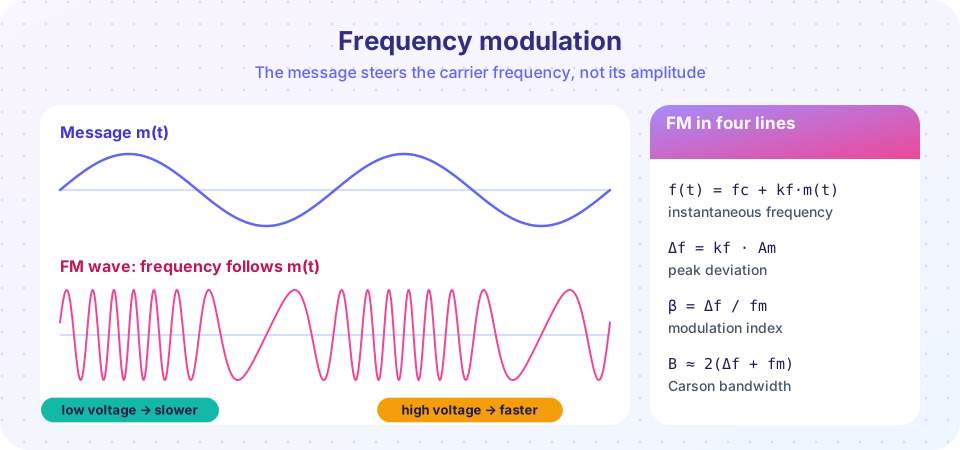
fi(t) = fc + kf · m(t), which meansφ(t) = 2π kf ∫ m(τ) dτ. The phase follows the integral of the message.
The instantaneous frequency is fi(t) = fc + (1/2π) dφ/dt. So an FM modulator is a PM modulator fed with the integral of the message, and a PM modulator is an FM modulator fed with the derivative. For a sinusoidal message the two look alike apart from a phase shift of 90°. The practical difference: for FM the frequency deviation is proportional to the message amplitude only; for PM it is proportional to amplitude times message frequency.
Constant envelope. The amplitude is exactly Ac at all times. The power is Ac²/2 whatever the message, and a transmitter can use an efficient, nonlinear amplifier. This is a second reason for FM's popularity.
Tone modulation and the modulation index
Let m(t) = Am cos(2π fm t). For FM, the frequency swings between fc − kf Am and fc + kf Am. The peak deviation is Δf = kf · Am (hertz). The modulation index is
β = Δf / fm,
which is the peak phase swing in radians: s(t) = Ac cos( 2π fc t + β sin(2π fm t) ).
Worked example: kf = 10 kHz/V, Am = 3 V, fm = 5 kHz. Then Δf = 30 kHz and β = 6.
Spectrum: Bessel sidebands
With a tone, the FM signal expands into an infinite series of sidebands spaced by fm:
s(t) = Ac Σ Jn(β) cos( 2π (fc + n fm) t ), summed over all integers n,
where Jn is the Bessel function of the first kind. A few facts follow.
- For
β ≪ 1onlyJ0 ≈ 1andJ±1 ≈ ±β/2matter: a carrier and one pair of sidebands. This is narrowband FM, with bandwidth≈ 2 fm, like AM. - As
βgrows, more sidebands appear. The carrier amplitudeJ0(β)even vanishes atβ ≈ 2.405, 5.52, .... - The total power is always
Ac²/2, sinceΣ Jn²(β) = 1: modulation only redistributes power among the lines.
Carson's rule
Strictly, the spectrum is infinite, but almost all of the power lies within
B ≈ 2 (Δf + fm) = 2 fm (β + 1).
For commercial FM broadcasting, the maximum deviation is Δf = 75 kHz and the highest audio frequency is fm = 15 kHz. Then β = 5 and B ≈ 2(75 + 15) = 180 kHz, which fits the 200 kHz channel spacing used in many countries. Compare with AM for the same 15 kHz audio: 30 kHz. FM spends six times the bandwidth, and buys a large noise advantage (derived in chapter 6, where the improvement grows with β²).
Demodulating FM
A frequency discriminator produces an output proportional to the instantaneous frequency. A simple one is a tuned circuit on the slope of its response that converts frequency variations to amplitude variations, followed by an envelope detector; practical receivers use a ratio detector, a quadrature detector or a phase-locked loop. A limiter in front removes amplitude noise first, which is the source of FM's noise rejection.
Common misconceptions
"A wider deviation always means a better signal." A wider deviation gives more noise immunity above a threshold SNR but needs more bandwidth, and below the threshold FM degrades abruptly.
"FM bandwidth is 2 fm." That is true only for narrowband FM. Use Carson's rule otherwise.
"The FM carrier disappears at high deviation." The carrier line J0(β) oscillates and is zero only at special values; total power never changes.
Try it
The first example computes the Bessel line spectrum for several modulation indices using SciPy and checks that the lines carry the full power. Notice the carrier vanishing near β = 2.405.
Press Run (or Ctrl + Enter) to see the result here.
Program input · what you'd type while the program runs
Type the answers before you press Run, one per line. Each time the program reads a line (with input()), it gets the next line from this box.
The second example compares Carson's rule with the bandwidth that holds 98 % of the power (counting sidebands), for the broadcast case and two others.
Press Run (or Ctrl + Enter) to see the result here.
Program input · what you'd type while the program runs
Type the answers before you press Run, one per line. Each time the program reads a line (with input()), it gets the next line from this box.
Check your understanding
Quick check · 5 questions
of 5 answered You scored / 5 · perfect!
-
1. Which quantity does FM make proportional to the message?
FM sets fi(t) = fc + kf m(t); the phase follows the integral of the message. -
2. kf = 5 kHz/V, Am = 2 V and fm = 2 kHz. The modulation index β is
Δf = kf Am = 10 kHz and β = Δf / fm = 10/2 = 5. -
3. Carson's rule for the previous signal gives a bandwidth of about
B ≈ 2(Δf + fm) = 2(10 + 2) = 24 kHz. -
4. The power of an FM signal with carrier amplitude Ac is
The envelope is constant, and the Bessel coefficients always satisfy ΣJn² = 1. -
5. Why does FM resist amplitude noise better than AM?
A limiter removes amplitude variations without touching the frequency information.
Summary
- Angle modulation puts the message into the phase (PM) or frequency (FM) of a constant-amplitude carrier.
- FM:
fi = fc + kf m(t),Δf = kf Am,β = Δf/fm. - The spectrum has Bessel-weighted sidebands at
fc + n fm; power is constant. - Carson's rule:
B ≈ 2(Δf + fm); broadcast FM uses about 180 kHz.
Next: Chapter 3 review
Track your progress
Create a free account to tick off lessons and pick up where you left off on any device.
of Communication Systems lessons completed