


















Lesson 39 of 46 · Wireless and Optical Systems
Optical Fiber Links
Learn how optical fiber guides light by total internal reflection, numerical aperture, attenuation windows, modal and chromatic dispersion, and compute a fiber power budget.
Almost every long-distance bit you send or receive spends part of its journey as a pulse of light in a strand of glass thinner than a human hair. Undersea cables link continents with fibers; metropolitan rings link cities; data centers link racks. A fiber carries more information with less loss than any other practical medium, and a single strand can carry many terabits per second.
The physics is lovely and short. Light stays inside the glass core because it bounces off the boundary with the lower-index cladding at shallow angles. It loses very little power per kilometer. And it spreads in time, which is what limits the bit rate. This lesson walks through those three facts and then builds the optical link budget, a cousin of the radio link budget from the previous lessons.
What you will learn
- Explain total internal reflection and compute critical angle and numerical aperture.
- Compare single-mode and multimode fibers.
- Name the main attenuation mechanisms and the three transmission windows.
- Estimate pulse broadening from modal and chromatic dispersion.
- Compute an optical power budget and maximum reach.
Key terms
- Core and cladding: the central glass with refractive index
n1, and the surrounding glass with a slightly lowern2. - Numerical aperture NA:
√(n1² − n2²); the sine of the acceptance half-angle. - Single-mode fiber (SMF): core about 9 µm, supports one mode; multimode fiber (MMF): core 50 or 62.5 µm.
- Attenuation α: loss in dB per km.
- Dispersion: pulse spreading because different parts of the light travel at different speeds.
Guiding light
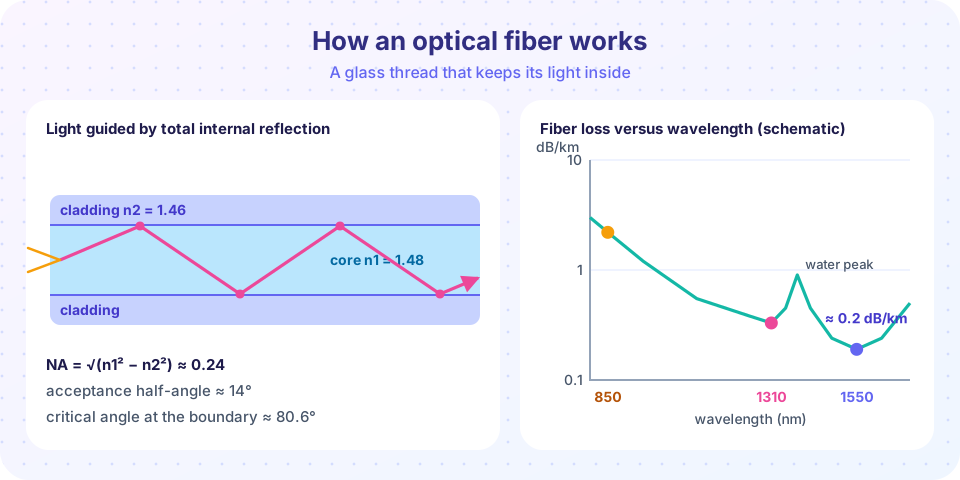
When light goes from glass with index n1 into glass of lower index n2, Snell's law says it bends away from the normal. Beyond the critical angle θc = arcsin(n2/n1) (measured from the normal) it cannot enter at all and reflects completely: total internal reflection. In a fiber the core has n1 slightly above the cladding's n2, so rays that hit the boundary at a shallow enough angle are trapped and zigzag down the core with essentially no loss at each bounce.
For n1 = 1.48 and n2 = 1.46, θc = arcsin(1.46/1.48) = 80.6°. Light must also enter the fiber within a cone to reach the boundary at that angle. The cone's half-angle in air is arcsin(NA) with NA = √(n1² − n2²) = 0.24, about 14°.
Because the speed of light in glass is c/n ≈ 2 × 10⁸ m/s, the delay is about 5 µs per kilometer, a floor on latency that no amount of electronics removes.
Single-mode and multimode
A multimode core is wide enough to support many ray paths (modes) with different path lengths. That makes coupling light in easy and is cheap to build, ideal inside buildings and data centers with LED or VCSEL sources at 850 nm. A single-mode core, about 9 µm across at 1310 and 1550 nm, supports only one path. There is no modal spreading, so single-mode fiber covers metro, long-haul and undersea links.
Attenuation
The loss of silica fiber has a characteristic shape (figure, right):
- Rayleigh scattering from microscopic density fluctuations scales as
1/λ⁴, so loss falls as wavelength grows. - Absorption by the infrared tail of the glass dominates beyond about 1600 nm, and a hydroxyl (water) absorption peak sits near 1383 nm.
- Bending and imperfect connectors add extra loss.
Hence three low-loss windows: 850 nm (about 2.5 to 3 dB/km in multimode fiber), 1310 nm (about 0.35 dB/km) and 1550 nm (about 0.2 dB/km in typical single-mode fiber). The 1550 nm window is the one used for long distances, and it is also where erbium-doped fiber amplifiers (EDFAs) work.
Dispersion
A pulse launched into the fiber comes out wider. Two dominant causes:
- Modal dispersion in multimode fiber: rays on longer zigzag paths arrive later. For a step-index fiber the broadening per length is about
Δτ/L ≈ n1·(n1 − n2) / (n2·c), which is 67.6 ns/km for the indices above. (Graded-index fiber, whose index falls smoothly from the center, reduces this by a factor of a hundred or more.) - Chromatic dispersion in single-mode fiber: different wavelengths in the source's spectrum travel at different speeds. The broadening is
Δτ = D · L · Δλ, whereDis about 17 ps/(nm·km) at 1550 nm and nearly zero near 1310 nm for standard SMF.
A rule of thumb asks that broadening stay below about a quarter of the bit time. For 10 Gbit/s (bit time 100 ps) a laser with Δλ = 0.1 nm over 80 km spreads by 17 × 80 × 0.1 = 136 ps, so such links need dispersion compensation or coherent detection with digital signal processing.
Receivers, noise and modulation
The receiver is a photodiode (PIN or avalanche photodiode) that turns light into current. Its noise is shot noise from the random arrival of photons plus thermal noise in the amplifier. Short-reach systems use intensity modulation with direct detection (simple on-off keying of the laser). Long-haul systems use coherent transmission with QPSK or 16-QAM on two polarizations, recovered with a laser at the receiver and heavy digital signal processing, the same constellations you met in chapter 5. Wavelength-division multiplexing (WDM) sends many wavelengths down the same fiber, for example 80 channels on a 50 GHz grid.
Optical power budget
The budget has the same form as the radio one, in dB:
Ptx(dBm) − Σ losses = Prx(dBm) ≥ sensitivity + margin
with losses α·L for the fiber, about 0.5 dB per connector pair, and about 0.1 dB per fusion splice. The maximum reach follows by solving for L.
Common misconceptions
- "Light travels faster in fiber than in air." It travels about 1.5 times slower than in vacuum.
- "Fiber loses nothing." At 0.2 dB/km it still loses about 4.5 % of the power every kilometer, so long links need amplifiers.
- "Single-mode fiber has no dispersion." It has no modal dispersion, but chromatic dispersion limits bit rate and distance.
- "A wider core always helps." A wider core supports more modes and so spreads pulses more.
Try it
First, compute the optics numbers and a link budget for a 1550 nm single-mode link, and solve for its maximum reach.
Press Run (or Ctrl + Enter) to see the result here.
Program input · what you'd type while the program runs
Type the answers before you press Run, one per line. Each time the program reads a line (with input()), it gets the next line from this box.
Second, pulse broadening from modal dispersion in a step-index multimode fiber and from chromatic dispersion in a single-mode fiber, with the quarter-bit rule of thumb marked for 10 Gbit/s.
Press Run (or Ctrl + Enter) to see the result here.
Program input · what you'd type while the program runs
Type the answers before you press Run, one per line. Each time the program reads a line (with input()), it gets the next line from this box.
Check your understanding
Quick check · 5 questions
of 5 answered You scored / 5 · perfect!
-
1. Why does light stay inside an optical fiber's core?
Beyond the critical angle, light cannot cross into the lower-index cladding and reflects back. -
2. A fiber has n1 = 1.50 and n2 = 1.46. What is its numerical aperture?
NA = √(1.50² − 1.46²) = √(2.25 − 2.1316) = √0.1184 = 0.344. -
3. Which window is used for most long-haul single-mode links, and why?
1550 nm has about 0.2 dB/km loss and erbium-doped fiber amplifiers work there. -
4. A 50 km single-mode link at 1550 nm uses a source of 0.2 nm spectral width. What is the chromatic broadening (D = 17 ps/(nm·km))?
Δτ = D·L·Δλ = 17 × 50 × 0.2 = 170 ps. -
5. A link has Ptx = 0 dBm, sensitivity −28 dBm, 3 dB margin, 1 dB of connector loss and 0.25 dB/km total fiber loss. What is the maximum reach?
(0 + 28 − 3 − 1) / 0.25 = 24 / 0.25 = 96 km.
Summary
- Light is trapped in the core by total internal reflection;
NA = √(n1² − n2²)sets the acceptance cone. - Silica fiber has loss windows at 850, 1310 and 1550 nm; typical single-mode loss at 1550 nm is about 0.2 dB/km.
- Multimode fibers suffer modal dispersion; single-mode fibers suffer chromatic dispersion
Δτ = D·L·Δλ. - An optical power budget subtracts fiber, connector and splice losses and a margin from the available transmit-to-sensitivity span.
Next: Chapter 8 review
Track your progress
Create a free account to tick off lessons and pick up where you left off on any device.
of Communication Systems lessons completed