


















Lesson 45 of 46 · Projects and Practice
Cheat Sheet: Communication Systems Formulas
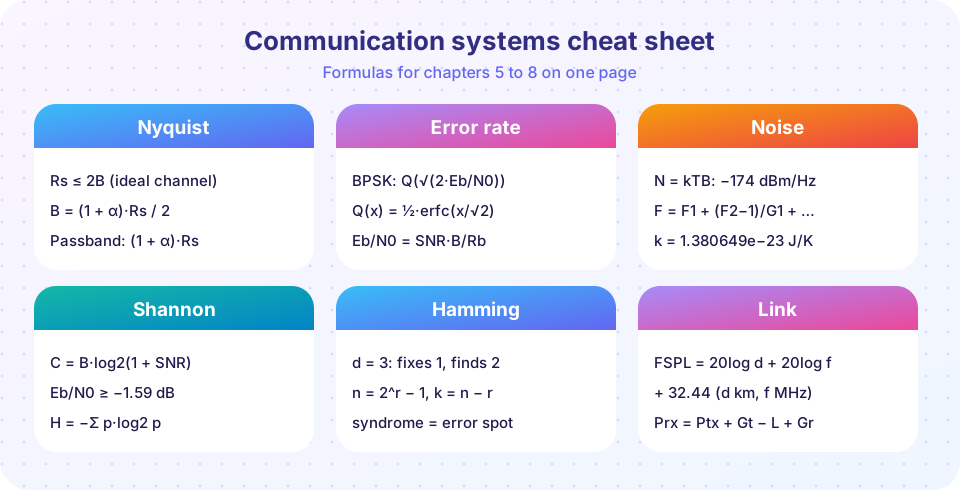
A one-page recap of the key formulas for modulation, noise, error rates, coding, link budgets, fading and fiber, with a worked end-to-end design and a modulation chooser.
Keep this page open while you solve problems. It lists the formulas of chapters 5 to 8 with their units and the rules of thumb that make quick estimates possible, plus a few facts from the earlier chapters of the course. Below the tables you will find an end-to-end worked design and a small tool for choosing a modulation.
What you will learn
- Find any key formula quickly, with its units.
- Run a complete design from bit rate to transmit power.
- Choose a modulation from an
Eb/N0target.
Key terms
- Rb, Rs: bit rate and symbol rate.
- γ = Eb/N0: energy per bit over noise density, linear.
- η: spectral efficiency in bit/s/Hz.
- Q(x): Gaussian tail,
½·erfc(x/√2).
Modulation and pulses
| Item | Formula |
|---|---|
| Bit rate | Rb = Rs · log2(M) |
| Raised-cosine bandwidth | B = (1 + α) · Rs (passband); Rs/2·(1 + α) baseband |
| Nyquist limit | Rs ≤ 2B for ISI-free baseband signaling |
| BPSK / QPSK signal | s(t) = I·cos(ωt) − Q·sin(ωt), I, Q = ±√Eb |
| Square QAM energy | Es = 2(M − 1)/3 for levels ±1, ±3, … |
| Phase error | amplitude falls by cos φ |
Noise and error rates
| Item | Formula |
|---|---|
| Thermal noise | N = kTB; −174 dBm/Hz + 10·log10(B) at 290 K |
| Noise figure | NF = 10·log10(F), Te = T0·(F − 1) |
| Cascade | F = F1 + (F2 − 1)/G1 + (F3 − 1)/(G1·G2) |
| Ratios | Eb/N0 = SNR · B/Rb; Es/N0 = k · Eb/N0 |
| Matched filter | peak SNR 2E/N0 |
| BPSK, QPSK | Pb = Q(√(2γ)); 6.8 dB for 10⁻³, 9.6 dB for 10⁻⁵ |
| 16-QAM | Pb ≈ 0.75 · Q(√(0.8γ)) |
| DPSK, noncoherent FSK | ½e^(−γ), ½e^(−γ/2) |
| Rayleigh BPSK | ½(1 − √(γ/(1 + γ))) ≈ 1/(4γ) |
Information and coding
| Item | Formula |
|---|---|
| Entropy | H = −Σ p·log2 p |
| BSC capacity | C = 1 − H(p) |
| AWGN capacity | C = B·log2(1 + SNR) |
| Shannon limit | Eb/N0 ≥ (2^η − 1)/η → −1.59 dB |
| Block code | rate k/n; detects dmin − 1; corrects ⌊(dmin − 1)/2⌋ |
| Hamming | n = 2^r − 1, k = n − r, dmin = 3; syndrome = column of H |
| Convolutional | states 2^(K−1); Viterbi keeps one survivor per state; soft decisions gain about 2 dB |
Wireless and optical
| Item | Formula |
|---|---|
| Friis | Pr = Pt·Gt·Gr·(λ/4πd)² |
| Free-space loss | 20·log10(d_km) + 20·log10(f_MHz) + 32.44 dB |
| Log-distance | PL = PL0 + 10·n·log10(d/d0) |
| Link budget | Pr = Ptx + Gtx − L + Grx (dBm); margin = SNR − required |
| Fade margin | shadowing 2.33σ for 99 %; Rayleigh 20 dB for 99 % |
| Doppler, coherence | fd = v·f/c; Tc ≈ 0.423/fd; Bc ≈ 1/(5·τrms) |
| OFDM | Δf = 1/Tu; cyclic prefix longer than the delay spread |
| Fiber | NA = √(n1² − n2²); 0.2 dB/km at 1550 nm; Δτ = D·L·Δλ, D = 17 ps/(nm·km) |
A few facts from earlier chapters
| Item | Fact |
|---|---|
| AM bandwidth | 2·fm |
| FM bandwidth (Carson) | B ≈ 2(Δf + fm) |
| Sampling | fs ≥ 2·fmax |
| PCM | bit rate fs·n; SQNR about 6.02·n + 1.76 dB for a full-scale sine |
Common misconceptions
- "One formula fits all BER curves." Each scheme has its own; always check coherent versus noncoherent.
- "The cheat sheet replaces understanding." It saves lookup time but cannot tell you which ratio (SNR,
Es/N0,Eb/N0) to use. - "dB values add for power sums." Only gains and losses add; powers must be converted to linear first.
Try it
First, a complete design. Given a data rate, choose a modulation and bandwidth, find the required Eb/N0 for BER 10⁻⁵, convert to SNR, compute the noise floor and finally the transmit power needed for a 2.4 GHz, 500 m link with a 10 dB fade margin.
Press Run (or Ctrl + Enter) to see the result here.
Program input · what you'd type while the program runs
Type the answers before you press Run, one per line. Each time the program reads a line (with input()), it gets the next line from this box.
Second, a modulation chooser. Slide the available Eb/N0 and see which modulations reach a BER of 10⁻⁵. Denser ones need more energy per bit, but you saw they use less bandwidth.
Check your understanding
Quick check · 5 questions
of 5 answered You scored / 5 · perfect!
-
1. A link needs Eb/N0 = 10 dB. Its bit rate is 2 Mbit/s and its bandwidth is 1 MHz. What SNR does it need?
SNR = Eb/N0 · Rb/B = 10 dB + 10·log10(2) = 13 dB. -
2. Which formula gives the available thermal noise power?
N = kTB; 4kTRB is the mean-square open-circuit voltage. -
3. What is the Carson bandwidth of an FM signal with peak deviation 75 kHz and a 15 kHz message?
B ≈ 2(75 + 15) = 180 kHz. -
4. How many bits does an 8-bit PCM system send per second at 8,000 samples/s?
8,000 × 8 = 64,000 bit/s. -
5. Which statement about Hamming (7,4) is correct?
k/n = 4/7 and t = ⌊(3 − 1)/2⌋ = 1.
Summary
- Keep the ratio chain straight: SNR,
Es/N0,Eb/N0, BER. - Free-space loss needs km and MHz; thermal noise needs dBm/Hz plus
10·log10(B). - The Shannon limit is
−1.59 dB; real schemes need several dB more, and coding closes the gap. - Denser modulation saves bandwidth at the cost of energy per bit.
Next: Further study
Track your progress
Create a free account to tick off lessons and pick up where you left off on any device.
of Communication Systems lessons completed