


















Lesson 15 of 46 · Amplitude and Angle Modulation
Chapter 3 review: Amplitude and angle modulation
Compare AM, DSB-SC, SSB and FM on bandwidth, power efficiency, detection and uses, then test yourself with a ten-question mixed quiz.
Chapter 3 introduced four ways of putting an analog message on a carrier. Each is a different answer to the same question: how much bandwidth, power and receiver complexity are you willing to pay for a given quality? This review puts the four side by side and tests whether you can pick the right tool and do the numbers.
What you will learn
- The key formulas of each scheme at a glance.
- How to choose a scheme from requirements.
- Whether you can apply them in a mixed set of questions.
Comparison table
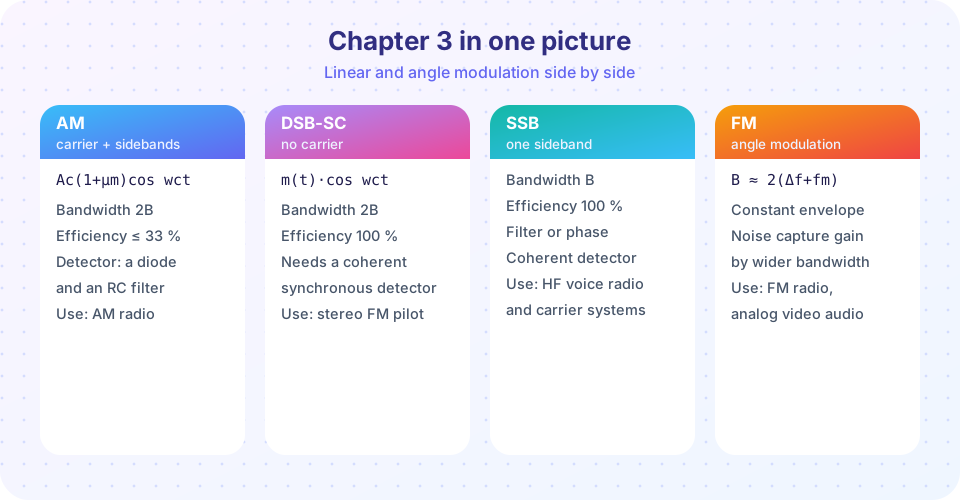
| Scheme | Bandwidth | Power efficiency | Receiver | Typical use |
|---|---|---|---|---|
| AM | 2B |
μ²/(2+μ²), at most 1/3 for tone |
Envelope detector (very cheap) | Broadcast on LW/MW/SW |
| DSB-SC | 2B |
100 % | Coherent, needs carrier recovery | Subcarriers, stereo difference signal |
| SSB | B |
100 % | Coherent, accurate oscillator | HF voice, trunk telephony |
| FM | 2(Δf + fm) |
Constant envelope, efficient amplifiers | Discriminator or PLL, with limiter | VHF broadcast, two-way radio |
Rule of thumb. Cheap receivers and many listeners: AM. Narrow spectrum and long range: SSB. Quality in noise and plenty of spectrum: FM. Each rule reappears in digital form in chapter 5.
Try it
The first example is a calculator that gives bandwidth and efficiency for a message of bandwidth B through all four schemes. Change the numbers to see how the choice of deviation drives FM bandwidth.
Press Run (or Ctrl + Enter) to see the result here.
Program input · what you'd type while the program runs
Type the answers before you press Run, one per line. Each time the program reads a line (with input()), it gets the next line from this box.
The second example sketches how the four spectra look for a 2 kHz message tone; the sketch is a diagram, not a measurement.
Press Run (or Ctrl + Enter) to see the result here.
Program input · what you'd type while the program runs
Type the answers before you press Run, one per line. Each time the program reads a line (with input()), it gets the next line from this box.
Check your understanding
Quick check · 9 questions
of 9 answered You scored / 9 · perfect!
-
1. Which scheme needs the narrowest bandwidth for a message of bandwidth B?
SSB uses B; AM and DSB-SC need 2B; wideband FM needs much more. -
2. AM with μ = 0.6 has an efficiency of about
η = μ² / (2 + μ²) = 0.36 / 2.36 ≈ 0.153, about 15 %. -
3. Which receiver is used for conventional AM broadcast?
Because the envelope follows the message when μ ≤ 1, a diode and an RC network are enough. -
4. FM with Δf = 50 kHz and fm = 10 kHz has a Carson bandwidth of
B = 2(Δf + fm) = 2(50 + 10) = 120 kHz. -
5. The modulation index of that FM signal is
β = Δf / fm = 50/10 = 5. -
6. What does a phase error θ do to a coherent DSB-SC detector's output?
The output is (Ac/2) m(t) cos θ. -
7. Which scheme keeps a constant envelope?
FM's amplitude is Ac at all times, so nonlinear amplifiers can be used. -
8. An AM signal's carrier amplitude is 8 V and the envelope minimum is 2 V. The modulation index is
Amax = 8 + μ·8, Amin = 8 − μ·8 = 2 gives μ = 0.75. -
9. Which pair describes SSB correctly?
SSB sends one sideband, with no carrier.
Summary
- AM: simple receiver,
2B, efficiency at most 1/3. DSB-SC:2B, 100 % efficient, coherent. - SSB:
B, 100 % efficient, best for narrow spectrum. - FM:
2(Δf + fm), constant envelope, trades bandwidth for noise performance. - Chapter 4 turns analog messages into bits.
Track your progress
Create a free account to tick off lessons and pick up where you left off on any device.
of Communication Systems lessons completed