


















Lesson 38 of 46 · Wireless and Optical Systems
Fading, Multipath and OFDM
Understand Rayleigh fading, delay spread, coherence bandwidth, Doppler and coherence time, and how OFDM with a cyclic prefix turns a hostile channel into easy subchannels.
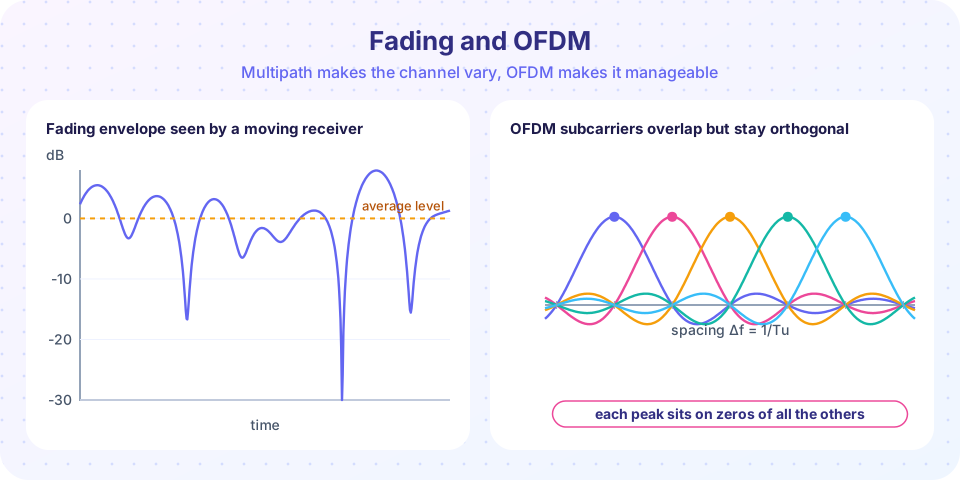
Stand still in a room with a Wi-Fi router and the signal is steady. Take one step and it can change by 20 dB. Nothing about the distance changed; what changed is how the reflected copies of the signal add up at your antenna. Where copies are in phase, the signal is strong; where they are out of phase, it nearly vanishes. This is multipath fading, and it is the central headache of mobile and indoor radio.
Multipath also smears the signal in time, because the copies arrive at different instants. At high symbol rates that smearing becomes intersymbol interference, as in pulse shaping and ISI, but worse. The answer used by 4G, 5G, Wi-Fi and digital TV is OFDM: split the fast data stream into many slow parallel ones so that each barely notices the smearing.
What you will learn
- Explain Rayleigh fading and compute the probability of a fade of given depth.
- Define delay spread, coherence bandwidth, Doppler spread and coherence time.
- Distinguish flat from frequency-selective fading.
- Explain how OFDM works, including the IFFT, the cyclic prefix and one-tap equalization.
- Quote real OFDM parameters from Wi-Fi and LTE.
Key terms
- Rayleigh fading: envelope statistics when there are many scattered paths and no dominant one.
- Delay spread τrms: the RMS spread of path delays.
- Coherence bandwidth Bc ≈ 1 / (5·τrms): the bandwidth over which the channel looks flat.
- Coherence time Tc ≈ 0.423 / fd: how long the channel stays about the same.
- Cyclic prefix (CP): a copy of the end of each OFDM symbol placed in front of it.
Rayleigh fading
With many scattered paths and no line of sight, the channel gain h is a complex Gaussian number, and its power |h|² follows an exponential distribution. The probability that the instantaneous power falls below a fraction x of its average is
P(|h|² < x · average) = 1 − e^(−x) ≈ x for small x.
So a fade 10 dB below the average (x = 0.1) happens about 9.5 % of the time, 20 dB (x = 0.01) about 1 %, and 30 dB about 0.1 %. If a Rician channel has a strong direct path, fades are shallower.
The damage to error rates is dramatic. At high SNR, BPSK over a Rayleigh channel has Pb ≈ 1 / (4·γ), an error rate that falls only inversely with Eb/N0, instead of exponentially as in AWGN. At 10 dB, AWGN gives 4 × 10⁻⁶; Rayleigh gives about 2 × 10⁻². Fading must therefore be fought with diversity (several antennas, frequencies or times), coding and interleaving, not just power.
Time spread and frequency selectivity
Each path has its own delay. The delay spread τrms is a few tens of nanoseconds in a room, 1 to 3 µs in a city and up to 10 µs in hilly terrain. Two consequences follow:
- If the symbol time is much longer than
τrms, the copies overlap almost entirely and the channel is flat: all frequencies fade together. - If the signal bandwidth exceeds the coherence bandwidth
Bc ≈ 1/(5·τrms), the channel is frequency selective: some frequencies fade deeply while others do not, and symbols smear into each other.
For τrms = 1 µs, Bc ≈ 200 kHz, so a 5 MHz signal is strongly frequency-selective.
Motion and Doppler
A receiver moving at speed v sees frequency shifts up to fd = v·f/c. At 100 km/h (27.8 m/s) and 2 GHz, fd ≈ 185 Hz. The channel then changes every Tc ≈ 0.423/fd ≈ 2.3 ms, which sets how often the receiver must retrain its channel estimate. A signal whose symbols last much less than Tc sees a slowly fading channel; one that is longer sees time-selective fading.
OFDM
Orthogonal frequency-division multiplexing divides the available bandwidth into N narrow subcarriers spaced by Δf = 1/Tu, where Tu is the useful symbol duration. Each subcarrier carries its own QPSK or QAM symbol. Because the spacing is exactly the inverse of the symbol time, the subcarriers are orthogonal: each peak sits on the zeros of all the others (right side of the figure), so they can overlap without interference.
Implementation is the beauty: the transmitter takes N data symbols X[k], computes an inverse FFT to get N time samples, and sends them. The receiver takes an FFT. No bank of oscillators is needed.
Because each subcarrier is narrow (it is 1/N of the bandwidth), its symbol duration Tu is long compared with the delay spread, so each subcarrier sees a flat fade. The wideband problem has become N simple narrowband problems.
Cyclic prefix. To remove the remaining ISI between successive OFDM symbols, the transmitter copies the last Ng samples of each symbol and puts them in front. If Ng is at least as long as the channel's delay spread, the channel acts on each symbol as a circular convolution, which the FFT turns into a plain multiplication per subcarrier: Y[k] = H[k]·X[k] + noise. Equalization is then one complex division per subcarrier.
Real parameters:
| System | Subcarrier spacing | Useful symbol | Guard interval | FFT size (typical) |
|---|---|---|---|---|
| Wi-Fi (802.11a/g/n, 20 MHz) | 312.5 kHz | 3.2 µs | 0.8 µs | 64 |
| LTE (4G) | 15 kHz | 66.7 µs | 4.7 µs (normal CP) | 128 to 2048 |
Costs: the prefix wastes a few percent of capacity, a high peak-to-average power ratio makes amplifiers work hard, and OFDM is sensitive to carrier frequency offset, which destroys orthogonality.
Common misconceptions
- "Fading is the same as noise." Fading changes the signal strength, multiplicatively; noise adds. More transmit power helps against noise much more than against fades.
- "OFDM removes fading." It makes each subcarrier see a flat fade, but deep fades still hit some subcarriers. Coding across subcarriers fixes that.
- "The cyclic prefix carries extra data." It repeats existing samples to make the channel look circular.
- "Subcarriers cannot overlap." They do overlap, and that is exactly what orthogonality allows.
Try it
First, simulate Rayleigh fading. The code checks the fade probabilities against the formula and compares the BPSK error rate over AWGN and Rayleigh channels.
Press Run (or Ctrl + Enter) to see the result here.
Program input · what you'd type while the program runs
Type the answers before you press Run, one per line. Each time the program reads a line (with input()), it gets the next line from this box.
Second, a complete OFDM link with 64 subcarriers, QPSK on each, a three-path channel with delay spread of 6 samples, noise at 25 dB, and one-tap equalization. The run is repeated without and with a 16-sample cyclic prefix.
Press Run (or Ctrl + Enter) to see the result here.
Program input · what you'd type while the program runs
Type the answers before you press Run, one per line. Each time the program reads a line (with input()), it gets the next line from this box.
Check your understanding
Quick check · 5 questions
of 5 answered You scored / 5 · perfect!
-
1. In Rayleigh fading, roughly how often is the received power more than 20 dB below its average?
P = 1 − e^(−0.01) ≈ 1 %. -
2. A channel has an RMS delay spread of 2 µs. Roughly what is its coherence bandwidth?
Bc ≈ 1/(5 · 2 µs) = 100 kHz. -
3. OFDM subcarriers are orthogonal because:
With Δf = 1/Tu each subcarrier's spectrum is zero at all the other subcarrier frequencies. -
4. What condition must the cyclic prefix length satisfy?
A prefix longer than the delay spread keeps ISI out of the FFT window and makes the convolution circular. -
5. A vehicle moves at 54 km/h (15 m/s) with a 3 GHz carrier. What is its maximum Doppler shift? (c = 3×10⁸ m/s)
fd = v·f/c = 15 × 3×10⁹ / 3×10⁸ = 150 Hz.
Summary
- Many paths give Rayleigh fading: deep fades are common and BPSK's error rate falls only like
1/(4·γ). - Delay spread sets the coherence bandwidth
≈ 1/(5·τrms); Doppler sets the coherence time≈ 0.423/fd. - OFDM sends data on
Northogonal subcarriers with spacing1/Tu, generated by an IFFT. - A cyclic prefix longer than the delay spread makes the channel a per-subcarrier multiplication, fixed by one-tap equalization.
Next: Optical fiber links
Track your progress
Create a free account to tick off lessons and pick up where you left off on any device.
of Communication Systems lessons completed