


















Lesson 11 of 46 · Amplitude and Angle Modulation
Chapter 3 overview: Amplitude and angle modulation
Preview chapter 3: how a message rides on a carrier through AM, DSB-SC, SSB, FM and PM, and what each choice costs in bandwidth, power and complexity.
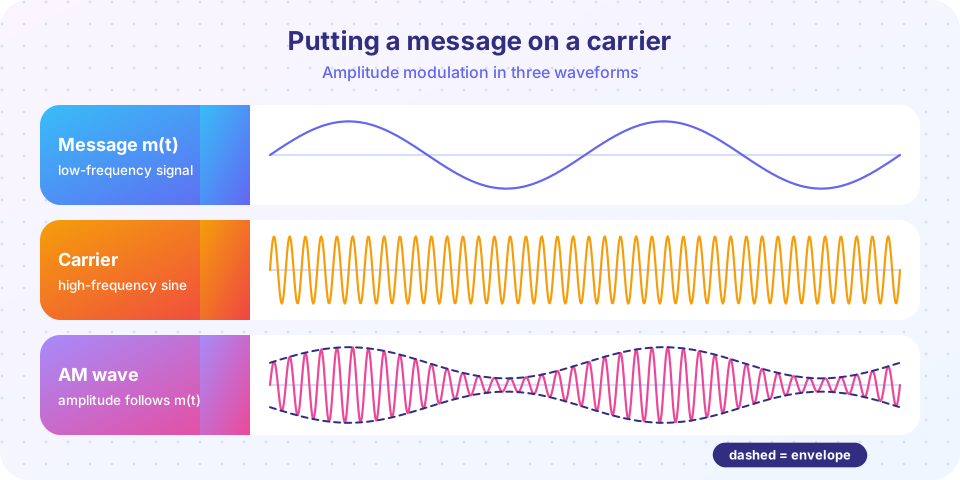
You now know that multiplying a message by a cosine shifts its spectrum to a carrier frequency. Chapter 3 makes that idea practical. A carrier is a sinusoid Ac cos(2π fc t + φ) with three adjustable properties: its amplitude Ac, its frequency fc and its phase φ. Change the amplitude in step with the message and you have amplitude modulation; change the frequency or phase and you have angle modulation. Each choice has a different price in bandwidth, power efficiency and receiver complexity, and engineers have built entire industries on each.
What you will learn
- The three knobs of a carrier and what changing each one does.
- How the lessons of this chapter fit together.
- How to generate and look at an AM wave yourself.
Key terms
- Carrier: a high-frequency sinusoid that is changed (modulated) by the message.
- Message (modulating) signal
m(t): the baseband signal being sent. - Envelope: the curve that outlines the peaks of a modulated carrier.
- Sideband: the copy of the message spectrum above (upper) or below (lower) the carrier.
- Demodulation: recovering the message from the modulated signal.
The chapter in slides
Modulating a carrier
What AM gives you
Saving bandwidth
Buying noise immunity
The lessons in this chapter
- Amplitude modulation: the AM equation, modulation index, spectrum, power and efficiency.
- DSB-SC, SSB and demodulation: saving power and bandwidth; envelope and coherent detectors.
- Frequency and phase modulation: instantaneous frequency, modulation index, Carson's rule.
- Chapter 3 review: comparison sheet and ten-question quiz.
Why so many schemes?
There is no best modulation, only trade-offs among the three resources of chapter 1: bandwidth, power and complexity. AM broadcast radio, introduced in the early 1920s, survives because receivers are almost free. Single sideband gives long-distance voice in a thin slice of spectrum. FM, developed by Edwin Armstrong in the 1930s, spends extra bandwidth to buy better sound in noise. The same trade appears again in digital modulation (chapter 5), which is why this chapter pays off later.
Common misconceptions
"The carrier contains the message." In plain AM the carrier is a fixed sinusoid; the information lives in the sidebands, or equivalently in the changes of the envelope.
"FM is amplitude modulation at a different frequency." FM keeps the amplitude constant and changes the instantaneous frequency; its spectrum and noise behavior are very different.
Try it
The first example builds an AM wave with a message of two tones, and shows both the signal and its spectrum, where the message appears as sidebands around the carrier.
Press Run (or Ctrl + Enter) to see the result here.
Program input · what you'd type while the program runs
Type the answers before you press Run, one per line. Each time the program reads a line (with input()), it gets the next line from this box.
The second example is an interactive AM generator. Drag the sliders for the modulation index and the message frequency and watch the envelope. This is a drawing demo built from the AM equation.
Check your understanding
Quick check · 4 questions
of 4 answered You scored / 4 · perfect!
-
1. Which carrier property does FM vary?
FM changes the carrier's frequency in step with the message and keeps the amplitude constant. -
2. In plain AM, where is the information carried?
The carrier is a constant sinusoid; the sidebands, equivalently the envelope, carry the message. -
3. Which scheme saves bandwidth by sending only one copy of the message spectrum?
Single sideband transmits only the upper or the lower sideband, so its bandwidth is B. -
4. Who developed wideband FM in the 1930s?
Edwin Howard Armstrong demonstrated wideband FM, which trades bandwidth for noise performance.
Summary
- A carrier has three knobs: amplitude, frequency, phase.
- AM, DSB-SC and SSB are linear (amplitude) schemes; FM and PM are angle schemes.
- The schemes trade bandwidth, power and receiver complexity.
- The next lesson derives AM in detail.
Next: Amplitude modulation
Track your progress
Create a free account to tick off lessons and pick up where you left off on any device.
of Communication Systems lessons completed