


















Lesson 24 of 46 · Digital Modulation
Pulse Shaping and Intersymbol Interference
Understand intersymbol interference, the Nyquist criterion, raised-cosine and root-raised-cosine filters, roll-off, bandwidth and how to read an eye diagram.
So far each symbol was a clean block with a sharp start and end. A sharp edge in time is a wide spread in frequency, so rectangular pulses occupy far more spectrum than the symbol rate requires. Real channels and regulators do not allow that. Filter the pulses to save bandwidth, and a new problem appears: each pulse now leaks into its neighbors. This overlap is intersymbol interference (ISI).
Harry Nyquist worked out in 1928 exactly which pulse shapes avoid ISI at the sampling instants while staying band-limited. The raised-cosine pulse is the practical answer, and you will find it, or its square root, in most digital modems.
What you will learn
- Explain what ISI is and why a band-limited pulse can still be ISI-free.
- State the Nyquist criterion and the minimum bandwidth
Rs/2. - Use the raised-cosine bandwidth formula with roll-off
α. - Explain why transmitter and receiver each use a root-raised-cosine filter.
- Read an eye diagram.
Key terms
- ISI: tails of earlier or later symbols adding to the sample of the current symbol.
- Nyquist criterion: a pulse
p(t)withp(0) = 1andp(nT) = 0forn ≠ 0causes no ISI at the sample times. - Roll-off factor α: the excess bandwidth, between 0 and 1.
- Root-raised-cosine (RRC): a filter whose frequency response is the square root of the raised-cosine response.
- Eye diagram: many symbol intervals of the filtered waveform drawn on top of each other.
Where ISI comes from
The received signal is a sum of shifted pulses: y(t) = Σ a[k] · p(t − kT). To decide symbol a[n], you sample at t = nT:
y(nT) = a[n]·p(0) + Σ over k ≠ n of a[k]·p(nT − kT)
The second term is ISI. It vanishes for every possible data pattern only if p(mT) = 0 for all nonzero integers m. That is the Nyquist criterion for zero ISI. It constrains the pulse only at the sample instants; between them the pulse may do anything.
The sinc pulse and the minimum bandwidth
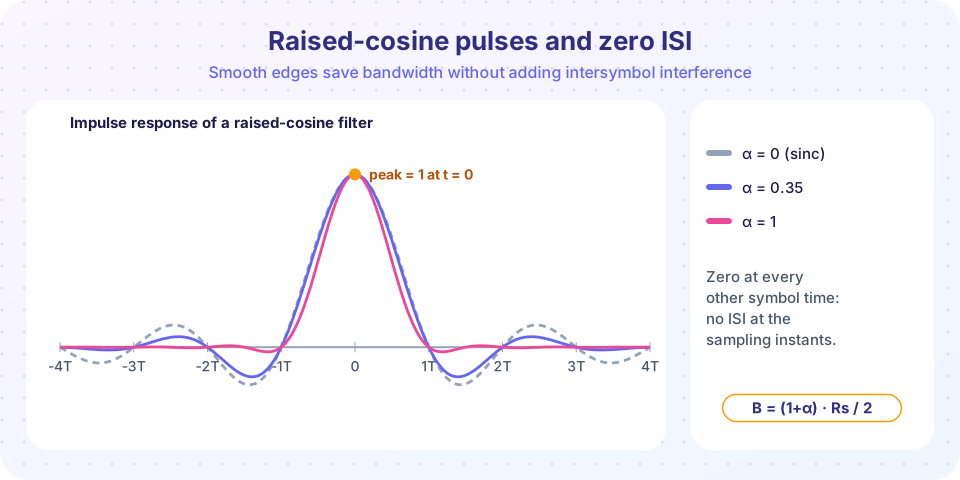
The pulse p(t) = sin(πt/T) / (πt/T) is exactly zero at every nonzero multiple of T. Its spectrum is a perfect rectangle of width 1/T centered at zero, from −1/(2T) to +1/(2T). So a baseband system can send Rs = 1/T symbols per second in a bandwidth Rs/2, the famous Nyquist rate Rs = 2B. It is the best possible, and no ISI-free scheme can beat it.
You cannot build it, though. The pulse is infinitely long, and any timing error Δt brings back a long, slowly decaying tail (it falls only as 1/t) from many neighbors.
The raised-cosine pulse
The cure is to allow a bit of extra bandwidth. A raised-cosine spectrum is flat up to (1−α)/(2T), then rolls off smoothly like half a cosine until (1+α)/(2T). Its time response is
p(t) = sinc(t/T) · cos(πα·t/T) / (1 − (2α·t/T)²)
The first factor gives the zero crossings at t = nT. The second makes the tails fall like 1/t³, so the pulse dies out fast and timing errors are far less harmful. The price is bandwidth:
B (baseband, one side) = (1 + α) / (2T) = (1 + α) · Rs / 2
B (passband, total) = (1 + α) · Rs
Roll-off α = 0 is the sinc pulse. α = 1 doubles the bandwidth. Common values are 0.2 to 0.35; satellite television standards use values such as 0.35, 0.25 and 0.2. A symbol rate of 1 Mbaud with α = 0.35 occupies a passband bandwidth of 1.35 MHz.
Splitting the filter: root raised cosine
The receiver needs a matched filter to maximize SNR (next chapter), and the combined response of transmitter plus receiver must still be a Nyquist pulse. The standard solution is to use an RRC filter on each side: H_tx(f) = H_rx(f) = √(H_RC(f)). Their product is the raised cosine, so there is no ISI, and the receive filter is also matched to the transmit pulse. Noise passing through the receive filter is then filtered optimally.
Reading an eye diagram
Slice the filtered waveform into windows two symbols wide and overlay them. With no ISI and no noise, all traces pass through the same two points at the sampling time and the "eye" is wide open. ISI scatters the traces and closes the eye vertically (less noise margin) and horizontally (less timing tolerance). The vertical opening at the sampling instant tells you how much noise margin remains.
Common misconceptions
- "A band-limited pulse must always cause ISI." Not so: the raised cosine is band-limited and has zero ISI at the sampling instants.
- "Roll-off α only changes the pulse shape, not the bandwidth." Bandwidth grows linearly with
α. - "The ideal sinc pulse is the best choice in practice." It is the narrowest in frequency, but it needs perfect timing and infinitely long filters. A modest
αis worth the bandwidth. - "ISI means the channel added noise." ISI is deterministic self-interference; it exists even with no noise.
Try it
First, compute raised-cosine pulses and spectra and check the zero crossings numerically.
Press Run (or Ctrl + Enter) to see the result here.
Program input · what you'd type while the program runs
Type the answers before you press Run, one per line. Each time the program reads a line (with input()), it gets the next line from this box.
Second, eye diagrams. Random plus and minus symbols pass through a raised-cosine pulse and, for comparison, through a sluggish channel that smears each rectangular pulse.
Press Run (or Ctrl + Enter) to see the result here.
Program input · what you'd type while the program runs
Type the answers before you press Run, one per line. Each time the program reads a line (with input()), it gets the next line from this box.
Check your understanding
Quick check · 5 questions
of 5 answered You scored / 5 · perfect!
-
1. What does the Nyquist criterion for zero ISI require of the pulse p(t)?
At the sampling times, only the current symbol's pulse may be nonzero. -
2. A system sends 2 Msymbol/s with a raised-cosine pulse of roll-off 0.25. What is the passband bandwidth?
B = (1 + α) · Rs = 1.25 × 2 MHz = 2.5 MHz. -
3. What is the minimum baseband bandwidth for ISI-free signaling at symbol rate Rs?
The sinc pulse achieves the Nyquist limit B = Rs/2; no ISI-free pulse can use less. -
4. Why do transmitter and receiver each use a root-raised-cosine filter?
RRC at both ends gives zero ISI overall and a matched filter that maximizes SNR. -
5. What does a closing eye in an eye diagram indicate?
Scattering of the traces reduces the vertical opening, which is the noise margin.
Summary
- ISI is the leakage of neighboring pulses into the sample of the current symbol.
- Nyquist's zero-ISI condition:
p(0) = 1,p(nT) = 0; the minimum baseband bandwidth isRs/2. - The raised cosine adds excess bandwidth
αfor fast-decaying tails; passbandB = (1 + α)·Rs. - RRC filters at both ends give zero ISI and a matched receiver; the eye diagram shows the margin left.
Track your progress
Create a free account to tick off lessons and pick up where you left off on any device.
of Communication Systems lessons completed