


















Lesson 16 of 46 · Sampling and Digital Transmission
Chapter 4 overview: Sampling and digital transmission
Preview chapter 4: sampling, quantization, pulse code modulation and line codes, the steps that turn a voice or sensor signal into a stream of bits.
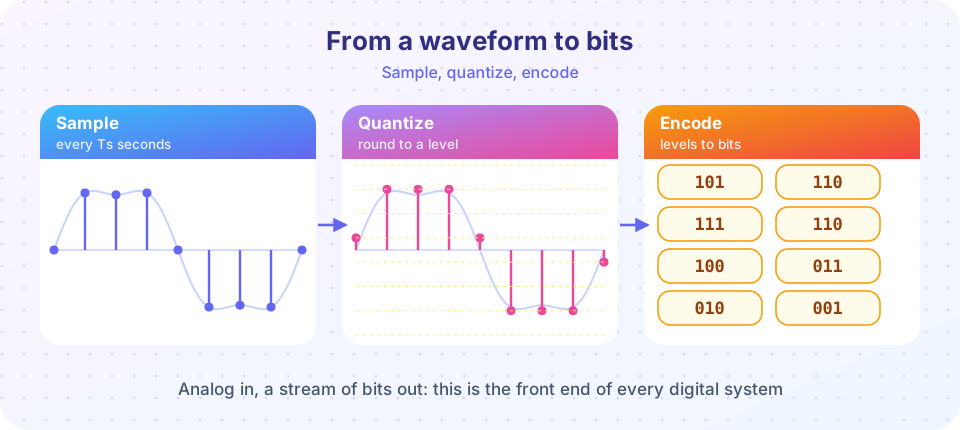
Chapter 3 sent analog messages on carriers. Chapter 4 changes the message itself: it turns a continuous waveform into numbers, and the numbers into bits. This conversion is the reason a phone call can be carried over the same network as a web page, and the reason music can be copied a million times without degradation. Three steps do the job: sampling in time, quantization in amplitude and encoding into bits. A fourth step, the line code, decides which voltages carry the bits on the wire.
What you will learn
- The three steps of analog-to-digital conversion and what each loses or keeps.
- How the lessons of the chapter fit together.
- The bit-rate arithmetic of real systems.
Key terms
- Sampling: measuring the signal at regular instants
Ts = 1/fs. - Quantization: rounding each sample to one of a finite set of levels.
- PCM (pulse code modulation): sampling, quantization and binary coding together.
- Bit rate
Rb: bits transmitted per second. - Line code: the rule that maps bits to voltage pulses.
The chapter in slides
Analog to digital in three steps
Sampling theorem
Quantization
Onto the wire
The lessons in this chapter
- Sampling theorem: how fast to sample, and aliasing.
- Quantization and PCM: levels, quantization noise, SQNR, bit rates.
- Line codes and pulse shaping: NRZ, RZ, Manchester, AMI, Nyquist pulses and ISI.
- Chapter 4 review.
Why bother with digital?
Three reasons, each of which returns in the rest of the course. Regeneration: a repeater decides which bit was sent and transmits a clean copy, so noise does not accumulate. Processing: once a signal is numbers, you can compress, encrypt, multiplex and error-correct it. Universality: voice, video and data are all just bits, so one network carries everything.
The costs are bandwidth (a digitized voice needs about 64 kb/s, which needs more spectrum than the analog 4 kHz) and an irreversible quantization error. The rest of the chapter measures both costs.
Common misconceptions
"Digitizing loses nothing." Sampling at a sufficient rate loses nothing in theory, but quantization always discards a little. You choose how much by choosing the number of bits.
"More samples than necessary make quality worse." Oversampling costs bit rate or memory, but it never harms quality; it often helps by relaxing the anti-aliasing filter.
Try it
The first example performs the full chain on a short waveform: sample, quantize to 3 bits, write out codewords and reconstruct. You can change bits and watch the error shrink.
Press Run (or Ctrl + Enter) to see the result here.
Program input · what you'd type while the program runs
Type the answers before you press Run, one per line. Each time the program reads a line (with input()), it gets the next line from this box.
The second example computes bit rates for four real systems. The arithmetic is the same each time: samples per second times bits per sample times channels.
Press Run (or Ctrl + Enter) to see the console output here.
No output.
Check your understanding
Quick check · 4 questions
of 4 answered You scored / 4 · perfect!
-
1. In which order does analog-to-digital conversion proceed?
The signal is first measured at discrete times, then each value is rounded to a level, then the level is written as bits. -
2. Which step of PCM always loses a little information?
Rounding to a finite number of levels discards the exact value. -
3. A telephone call samples at 8 kHz with 8 bits. The bit rate is
8000 × 8 = 64,000 b/s. -
4. Why can a digital repeater avoid accumulating noise?
As long as the decision is correct, the noise is discarded rather than carried on.
Summary
- ADC = sample, quantize, encode; PCM does all three.
- Sampling is lossless if
fs ≥ 2B; quantization always loses a little. - Bit rate = samples/s × bits/sample × channels.
- Line codes then turn bits into voltages for transmission.
Next: Sampling theorem
Track your progress
Create a free account to tick off lessons and pick up where you left off on any device.
of Communication Systems lessons completed