


















Lesson 13 of 46 · Amplitude and Angle Modulation
DSB-SC, SSB and demodulation
Drop the carrier and a sideband to save power and bandwidth, and learn how coherent and envelope detectors recover the message, including phase errors.
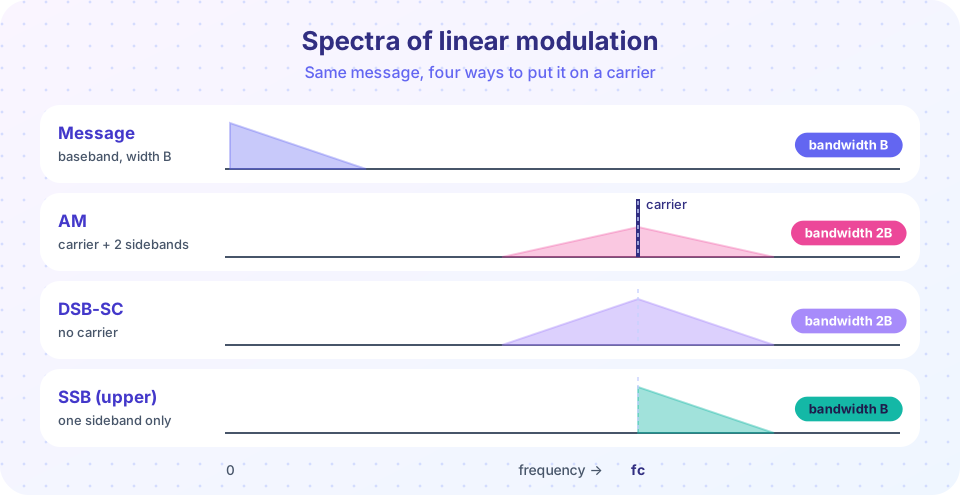
In plain AM, two thirds of the power goes into a carrier that carries nothing, and the two sidebands repeat the same information. Both wastes can be removed. Remove the carrier and you get double-sideband suppressed carrier (DSB-SC); remove a sideband too and you get single sideband (SSB). The price is a more demanding receiver. This lesson shows the savings, the cost and the two detectors that matter: the diode envelope detector and the coherent (synchronous) detector.
What you will learn
- The DSB-SC and SSB signals, their spectra and bandwidths.
- How a coherent detector works and what a phase error does to it.
- The design rule for an envelope detector.
- How SSB is generated by a filter or by the phase method.
Key terms
- DSB-SC:
s(t) = Ac m(t) cos(2π fc t); no carrier component. - SSB: only the upper (USB) or the lower (LSB) sideband is sent.
- Coherent (synchronous) detection: multiply by a local carrier of the same frequency and phase, then low-pass filter.
- Envelope detection: diode, capacitor and resistor following the outline of the wave.
- Hilbert transform
m̂(t): the message with every frequency shifted by −90° in phase.
DSB-SC
Multiply the message by the carrier and do not add the constant:
s(t) = Ac · m(t) · cos(2π fc t).
By the frequency-shift property the spectrum is two half-height copies of M(f) at ±fc; there is no carrier line. All power is in the sidebands (efficiency 100 %), but the bandwidth is still 2B. Because the envelope |m(t)| is not the message (it flips phase whenever m changes sign), an envelope detector cannot recover it.
Coherent detection
Multiply the received signal by a local cosine with the same frequency and phase:
s(t) cos(2π fc t) = Ac m(t) cos²(2π fc t) = (Ac / 2) m(t) + (Ac / 2) m(t) cos(4π fc t).
A low-pass filter removes the term at 2fc and leaves (Ac/2) m(t). This works, but the local oscillator must match. If it has a phase error θ, the output is (Ac/2) m(t) cos θ: the amplitude drops, and at θ = 90° it vanishes completely. If the oscillator frequency is off by Δf, the output is multiplied by cos(2π Δf t), so the message fades in and out at the beat rate. Practical receivers send a weak pilot tone or use a phase-locked loop to recover the carrier (the stereo FM multiplex uses a 19 kHz pilot to regenerate the 38 kHz subcarrier).
SSB
Since the two sidebands of a real message are mirror images, one is enough. SSB keeps only one of them:
- bandwidth
B(half of DSB-SC or AM), - no carrier, so all the transmitted power is useful,
- and, for the same message power, a better SNR at the receiver because the receiver bandwidth is smaller.
There are two classic ways to generate it. The filter method makes DSB-SC and applies a sharp band-pass filter that keeps one sideband; this is hard when the message has low-frequency content, which is why speech SSB first removes components below about 300 Hz. The phase method uses the Hilbert transform:
s_SSB(t) = (Ac / 2) [ m(t) cos(2π fc t) ∓ m̂(t) sin(2π fc t) ]
with the minus sign for the upper sideband and the plus sign for the lower. SSB is used for long-distance voice on the HF bands, on aircraft and maritime radio, and in the frequency-division multiplexing of telephone trunks. Demodulation is coherent; a small frequency error shifts the pitch of a voice ("Donald Duck" speech), which is why SSB radios are tuned carefully.
Envelope detection of AM
The diode envelope detector is a rectifier feeding an RC network. The capacitor charges quickly through the diode on a peak and discharges slowly through the resistor. For the output to follow the envelope but not the carrier, the time constant must satisfy
1 / fc ≪ R C ≪ 1 / W
where W is the highest message frequency. For fc = 1 MHz and W = 5 kHz, RC must lie between 1 µs and 200 µs; something near the geometric mean (about 14 µs) is a good choice, for example R = 10 kΩ and C = 1.4 nF. Too small an RC leaves carrier ripple; too large an RC cannot follow falling parts of the envelope (diagonal clipping). A capacitor then blocks the DC component.
Common misconceptions
"DSB-SC can be detected with an envelope detector." Its envelope is |m(t)|, which loses the sign. You need coherent detection.
"SSB needs less power only because of the missing carrier." The saving also comes from a narrower bandwidth, hence less noise admitted at the receiver.
"A phase error just makes the signal a little quieter." Mild errors do; at 90° the output is zero, and a drifting phase makes the output fluctuate.
Try it
The first example demonstrates coherent detection of DSB-SC with several local-oscillator phase errors. The measured amplitudes follow cos θ.
Press Run (or Ctrl + Enter) to see the result here.
Program input · what you'd type while the program runs
Type the answers before you press Run, one per line. Each time the program reads a line (with input()), it gets the next line from this box.
The second example builds an upper-sideband SSB signal with the phase method and compares its spectrum with DSB-SC. Only the sum frequencies remain.
Press Run (or Ctrl + Enter) to see the result here.
Program input · what you'd type while the program runs
Type the answers before you press Run, one per line. Each time the program reads a line (with input()), it gets the next line from this box.
Check your understanding
Quick check · 5 questions
of 5 answered You scored / 5 · perfect!
-
1. What is the bandwidth of an SSB signal carrying a 4 kHz message?
SSB keeps one sideband, so its bandwidth equals the message bandwidth B. -
2. A coherent detector has a local oscillator with a 60° phase error. The output amplitude is multiplied by
cos 60° = 0.5. -
3. Which detector can recover a DSB-SC message?
The DSB-SC envelope is |m(t)|, so the sign is lost; you must multiply by a synchronized carrier. -
4. For an envelope detector with fc = 1 MHz and W = 5 kHz, a suitable RC lies
The rule is 1/fc ≪ RC ≪ 1/W, i.e. between 1 µs and 200 µs. -
5. Why is a pilot tone sent with stereo FM and some DSB-SC systems?
The pilot gives the receiver the reference needed for coherent detection.
Summary
- DSB-SC
= Ac m(t) cos(2π fc t): no carrier, bandwidth2B, needs coherent detection. - SSB keeps one sideband: bandwidth
B, no wasted carrier power. - Coherent detection output scales as
cos θ; frequency error causes beating. - Envelope detector rule:
1/fc ≪ RC ≪ 1/W.
Track your progress
Create a free account to tick off lessons and pick up where you left off on any device.
of Communication Systems lessons completed