


















Lesson 5 of 46 · Getting Started
Chapter 1 review: Getting started
Review the communication chain, decibels, bandwidth, noise and Shannon capacity with a one-page summary, a recap table and a ten-question quiz.
Chapter 1 gave you three tools that you will use in every later chapter: the five-block chain, the decibel, and the pair of bandwidth and signal-to-noise ratio. Before moving on to spectra, make sure the vocabulary is automatic. This lesson collects the key ideas on one page, gives a recap table and finishes with a longer quiz.
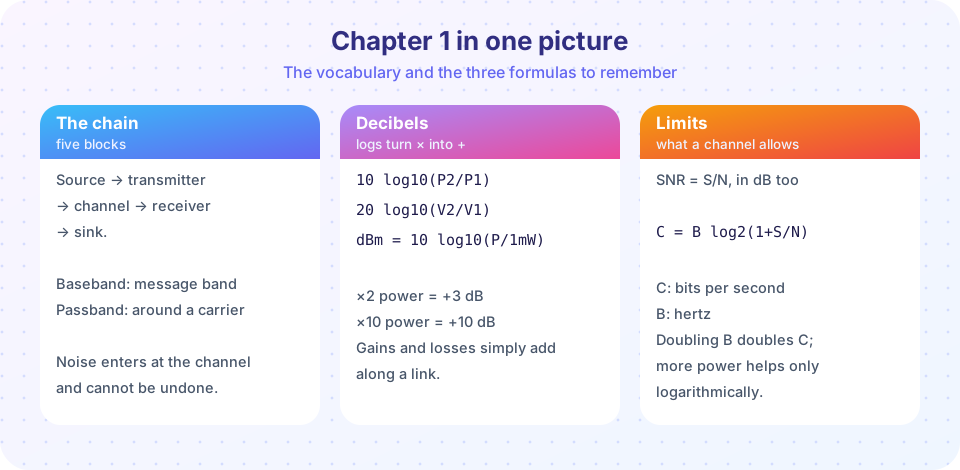
What you will learn
- How the chapter's lessons fit together.
- Which formulas to know without looking.
- Where you are still shaky, through a ten-question check.
Recap table
| Idea | Formula or statement | Lesson |
|---|---|---|
| Chain | source → transmitter → channel → receiver → sink | The communication model |
| Wavelength | λ = c / f, c ≈ 3 × 10⁸ m/s |
The communication model |
| Power ratio | dB = 10 log10(P2/P1) |
Decibels and power |
| Voltage ratio | dB = 20 log10(V2/V1) |
Decibels and power |
| Absolute level | dBm = 10 log10(P / 1 mW) |
Decibels and power |
| Thermal noise | N = k T B, −174 dBm/Hz at 290 K |
Bandwidth and channels |
| Nyquist | C = 2 B log2(M) |
Bandwidth and channels |
| Shannon | C = B log2(1 + SNR) |
Bandwidth and channels |
Study tip. Cover the middle column and try to recall each formula from its name. Then do it the other way round: cover the name and say what the formula is for.
Try it
Here is a stretch example that combines everything in chapter 1. The free-space path loss between two isotropic antennas is FSPL = 20 log10(4π d f / c). Combine it with a transmit level and noise floor to predict the SNR of a Wi-Fi link at several distances.
Press Run (or Ctrl + Enter) to see the result here.
Program input · what you'd type while the program runs
Type the answers before you press Run, one per line. Each time the program reads a line (with input()), it gets the next line from this box.
The second example is a two-way converter for quick checks in your own work.
Press Run (or Ctrl + Enter) to see the console output here.
No output.
Check your understanding
Quick check · 9 questions
of 9 answered You scored / 9 · perfect!
-
1. Which block is the only one that adds the random disturbance we call noise?
Noise enters in the channel and in the receiver's first stages. -
2. Why is a 3 kHz audio signal rarely sent directly as radio?
λ = c/f = 100 km, so a quarter-wave antenna is 25 km. Modulating onto a high carrier shrinks the antenna. -
3. A power ratio of 0.1 is
10 log10(0.1) = −10 dB. -
4. Doubling the voltage across a fixed resistor changes the level by
Voltage ratio 2 → 20 log10(2) ≈ 6.02 dB. -
5. A transmitter of 100 mW is how many dBm?
10 log10(100 mW / 1 mW) = 20 dBm. -
6. Which is the noise power in 1 MHz at 290 K, approximately?
−174 dBm/Hz + 10 log10(10⁶) = −174 + 60 = −114 dBm. -
7. The Shannon capacity of a 10 kHz channel at an SNR of 7 (ratio) is
C = 10,000 · log2(1 + 7) = 10,000 · 3 = 30,000 b/s. -
8. At high SNR, what does doubling the signal power (+3 dB) buy you?
At high SNR, log2(1 + SNR) is about log2(SNR), so doubling SNR adds log2(2) = 1 bit/s/Hz. -
9. Which pair is a definition of bandwidth (not a measure of bit rate)?
Bandwidth is a width in hertz.
Summary
- The chain has five blocks; the receiver outputs an estimate.
- Decibels turn multiplication into addition; use 10 for power and 20 for voltage.
- Noise
N = k T Band SNR set the channel capacity together with B. - Next stop: the mathematical tools for looking at signals in frequency.
Track your progress
Create a free account to tick off lessons and pick up where you left off on any device.
of Communication Systems lessons completed