


















Lesson 26 of 46 · Noise and Error Performance
Noise and Error Performance: The Big Picture
Chapter 6 overview: where noise comes from, the AWGN model, signal-to-noise ratio in dB and why noise sets the limit of every communication link.
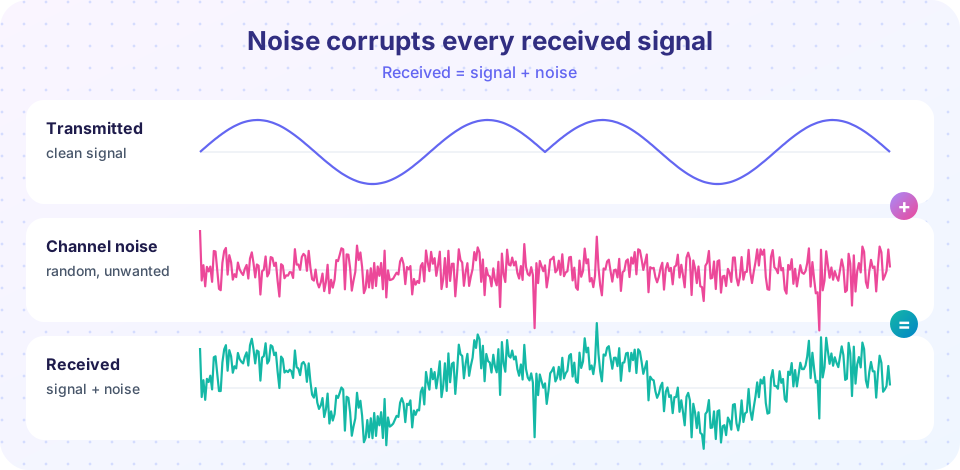
Take away noise and communication would be easy: amplify the signal until it is as strong as you like and decode it perfectly. Noise is why that fails. Every receiver adds randomness to what it hears, and the whole of this chapter is about how much that randomness hurts and what you can do about it.
The good news is that noise in most links follows one tidy model, additive white Gaussian noise (AWGN), and that model leads to exact, simple formulas for the error rate. By the end of the chapter you will be able to go from a received power in dBm to a bit error rate on a single sheet of paper.
What you will learn
- Name the main sources of noise and say which one dominates in a typical receiver.
- State the AWGN model and its single parameter
N0. - Convert between linear ratios and decibels for SNR.
- Preview the chain
SNR → Eb/N0 → BERused for the rest of the chapter.
Key terms
- AWGN: additive white Gaussian noise; independent Gaussian samples with a flat power spectrum.
- N0: one-sided noise power spectral density in W/Hz; the power in a bandwidth
BisN0·B. - SNR: signal power divided by noise power, usually quoted in dB.
- Eb/N0: energy per bit divided by noise density; the fair way to compare schemes.
- BER: bit error rate, the fraction of received bits that are wrong.
Where noise comes from
| Source | Cause | When it matters |
|---|---|---|
| Thermal noise | random motion of charge carriers in any resistive part at temperature T |
always; sets the floor kTB |
| Shot noise | discrete arrival of electrons or photons | photodiodes, optical receivers, diodes |
| Flicker (1/f) noise | slow trapping effects in devices | low frequencies, oscillators |
| Interference | other transmitters, switching supplies, motors | crowded bands, unlicensed spectrum |
| Quantization noise | rounding in converters | digital stages (chapter 4) |
Thermal noise is the one you can never remove. It exists at any temperature above absolute zero, and it is the foundation for the rest of the chapter. Interference is not random in the same way and is handled by planning, filtering and coding rather than by the AWGN formulas.
The AWGN model
The received signal is r(t) = s(t) + n(t). The noise n(t):
- is additive: it is added to the signal, not multiplied by it;
- is white: its power spectral density is flat at
N0/2per hertz on a two-sided spectrum (orN0one-sided) across the band you care about; - is Gaussian: at any instant its value follows a bell curve with zero mean.
Why Gaussian? Noise is the sum of countless tiny independent contributions, and the central limit theorem says such sums approach a Gaussian distribution. Why white? Over the bandwidth of a communication channel, thermal noise is flat to an excellent approximation. The model has just one parameter, N0, so a lot of the theory reduces to comparing symbol energy with N0.
SNR in decibels
The signal-to-noise ratio is SNR = S / N, where N = N0·B. Because ratios in communications span many orders of magnitude, you work in decibels: SNR(dB) = 10·log10(S/N). A few anchor values:
| SNR (linear) | SNR (dB) |
|---|---|
| 1 | 0 |
| 2 | 3 |
| 10 | 10 |
| 100 | 20 |
| 1,000 | 30 |
Chapter 6 adds one more ratio, Eb/N0, which divides by the bit rate instead of the bandwidth: Eb/N0 = SNR · B / Rb. It lets you compare a BPSK link with a 64-QAM link fairly, because the bandwidth and the bit rate drop out.
The road ahead
- Thermal noise and noise figure:
kTB, noise figure and cascades. - Matched filter and detection: the best receiver and the Q-function.
- Bit error rate curves: BER formulas and what a waterfall plot tells you.
- Chapter review.
Noise is unavoidable
One model fits
Measure the damage
Fight back
Try it
Move the slider to change the SNR and watch a sine wave drown in noise. The noise samples are fixed random numbers scaled by the slider, so you can see the same noise get larger or smaller. This is an illustration, not a measurement.
Now generate AWGN at chosen SNRs and measure the result. The histogram of the noise should follow a bell curve.
Press Run (or Ctrl + Enter) to see the result here.
Program input · what you'd type while the program runs
Type the answers before you press Run, one per line. Each time the program reads a line (with input()), it gets the next line from this box.
Check your understanding
Quick check · 4 questions
of 4 answered You scored / 4 · perfect!
-
1. What does the 'white' in additive white Gaussian noise mean?
White noise has equal power in every equal-width slice of the spectrum. -
2. A signal of 1 mW is received with 10 microwatts of noise in the bandwidth. What is the SNR?
SNR = 1 mW / 10 µW = 100, which is 20 dB. -
3. Which source of noise can never be eliminated, even in perfect electronics?
Thermal noise exists at any temperature above absolute zero. -
4. Why is Eb/N0 used to compare modulation schemes instead of SNR?
Eb/N0 normalizes by the bit rate, so schemes with different bandwidths can be compared fairly.
Summary
- Noise limits every receiver; thermal noise is the unavoidable floor.
- The AWGN model has one parameter,
N0; noise power in a bandwidthBisN0·B. - SNR is quoted in dB;
Eb/N0 = SNR · B / Rbnormalizes for fair comparison. - The rest of the chapter takes you from the noise floor to the matched filter to BER curves.
Track your progress
Create a free account to tick off lessons and pick up where you left off on any device.
of Communication Systems lessons completed