


















Lesson 35 of 46 · Information and Channel Coding
Chapter 7 Review: Information and Channel Coding
Review chapter 7: entropy, Shannon capacity, Hamming and convolutional codes in one picture and table, a code-parameter checker, a CRC demo and a ten-question quiz.
Chapter 7 had a simple message: noise cannot be beaten by brute force alone, but it can be beaten by redundancy, up to a limit that Shannon computed. You met the limit (entropy and capacity), a short block code (Hamming) and a stream code with a famous decoder (convolutional with Viterbi). This page collects them.
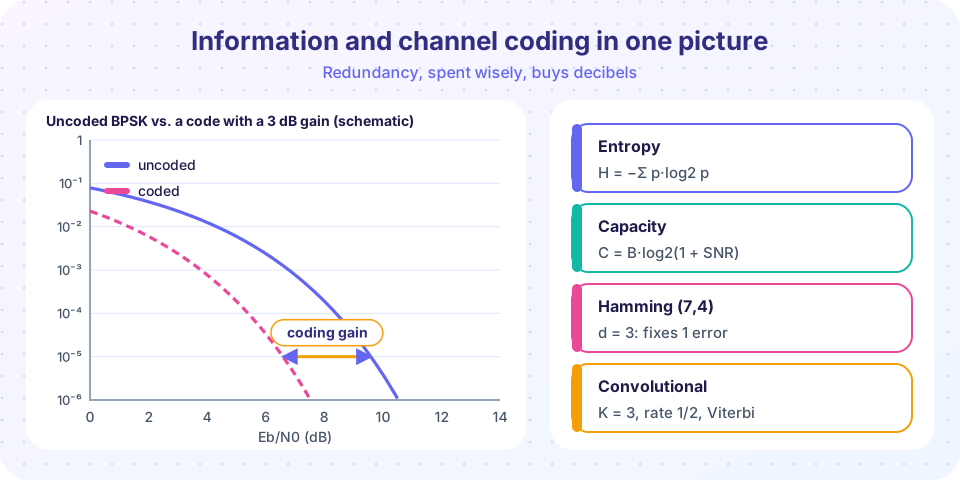
Chapter in one table
| Idea | Key formula or fact | Example |
|---|---|---|
| Entropy | H = −Σ p·log2 p |
fair coin 1 bit; p = 0.11 gives 0.5 bit |
| Source coding | average length ≥ H; Huffman within 1 bit |
0.4, 0.3, 0.2, 0.1 gives 1.9 vs 1.846 |
| BSC capacity | C = 1 − H(p) |
0.5 bit per use at p = 0.11 |
| AWGN capacity | C = B·log2(1 + SNR) |
3 kHz, 30 dB gives about 29.9 kbit/s |
| Shannon limit | Eb/N0 ≥ (2^η − 1)/η → −1.59 dB |
real modulations sit 7 to 10 dB above |
| Block code | (n, k), rate k/n, detect dmin − 1, correct ⌊(dmin − 1)/2⌋ |
Hamming (7,4), dmin = 3 |
| Convolutional | K, rate, generators; Viterbi keeps 2^(K−1) survivors |
(7, 5) code, dfree = 5 |
| Soft decisions | Euclidean metric on analog samples | about 2 dB better than hard |
| FEC vs ARQ | correct at receiver vs detect and retransmit | HARQ combines both |
Mistakes to avoid
- Comparing coded and uncoded systems at equal
Es/N0instead of equalEb/N0. Coding lowers the energy per transmitted bit by the rate. - Treating Shannon capacity as something a specific modulation can reach. It is the ceiling for any scheme.
- Forgetting that a code with
dmin = 3can either correct one error or detect two, not both at once. - Using a CRC to correct errors. It detects them; correction needs a different code.
Try it
First, a code-parameter checker. For each code it computes the rate, how many errors it detects and corrects, and whether it is perfect, meaning the decoding spheres of radius t around the codewords fill the whole space of 2ⁿ words.
Press Run (or Ctrl + Enter) to see the result here.
Program input · what you'd type while the program runs
Type the answers before you press Run, one per line. Each time the program reads a line (with input()), it gets the next line from this box.
Second, a CRC. The CRC-8 below uses the polynomial x⁸ + x² + x + 1 (0x07); the standard check value for the ASCII message 123456789 is 0xF4. The code then flips every bit of a message one at a time and counts how many corruptions the CRC catches.
Press Run (or Ctrl + Enter) to see the result here.
Program input · what you'd type while the program runs
Type the answers before you press Run, one per line. Each time the program reads a line (with input()), it gets the next line from this box.
Check your understanding
Quick check · 10 questions
of 10 answered You scored / 10 · perfect!
-
1. What is the entropy of a source with two symbols of probability 0.25 and 0.75?
H = −0.25·log2(0.25) − 0.75·log2(0.75) = 0.5 + 0.311 = 0.811 bits. -
2. A channel has B = 4 kHz and SNR = 255. What is its capacity?
C = 4000 · log2(256) = 4000 · 8 = 32 kbit/s. -
3. What is the lowest Eb/N0 at which reliable communication is possible at all?
As spectral efficiency tends to zero the bound is ln 2, which is −1.59 dB. -
4. A block code has dmin = 7. How many errors can it correct, and how many can it detect?
t = ⌊(7 − 1)/2⌋ = 3 and detection reaches dmin − 1 = 6 errors. -
5. In Hamming (7,4), what is the code rate and what does a nonzero syndrome tell the decoder?
R = 4/7 and the syndrome equals the column of H at the flipped bit. -
6. Why does the Viterbi algorithm need to keep only one survivor per state?
Merging paths have identical continuations, so the one with the lower metric dominates. -
7. Which is the best description of soft-decision decoding?
Soft decoding keeps the confidence information and gains about 2 dB over hard decisions. -
8. A system must work with no return channel and long delays. Which approach fits?
Without a return path, errors must be corrected at the receiver. -
9. A coded system with rate 1/2 is compared with uncoded BPSK. The fair comparison is at equal:
Coding spreads the energy over more transmitted bits; the comparison must use energy per information bit. -
10. Huffman coding of probabilities 1/2, 1/4, 1/8, 1/8 gives an average length of:
Lengths 1, 2, 3, 3 give 0.5 + 0.5 + 0.375 + 0.375 = 1.75 bits, which equals the entropy.
Summary
- Entropy gives the compression limit and capacity the reliability limit; Shannon's theorems say both can be approached.
- Block codes are described by
(n, k, dmin); Hamming (7,4) corrects one error with rate 4/7. - Convolutional codes are decoded with the Viterbi algorithm; soft decisions add about 2 dB.
- Compare coded and uncoded systems at equal
Eb/N0, withEbthe energy per information bit.
Track your progress
Create a free account to tick off lessons and pick up where you left off on any device.
of Communication Systems lessons completed