


















Lesson 30 of 46 · Noise and Error Performance
Chapter 6 Review: Noise and Error Performance
Review chapter 6: a one-page picture linking SNR, Eb/N0 and BER, a recap table, two decibel tools in code and a ten-question mixed quiz.
This chapter followed one thread: from the thermal noise floor kTB, through the noise figure of the receiver, to the best possible detector, and finally to the error rate. The review brings the formulas together and gives you two small tools for everyday decibel work.
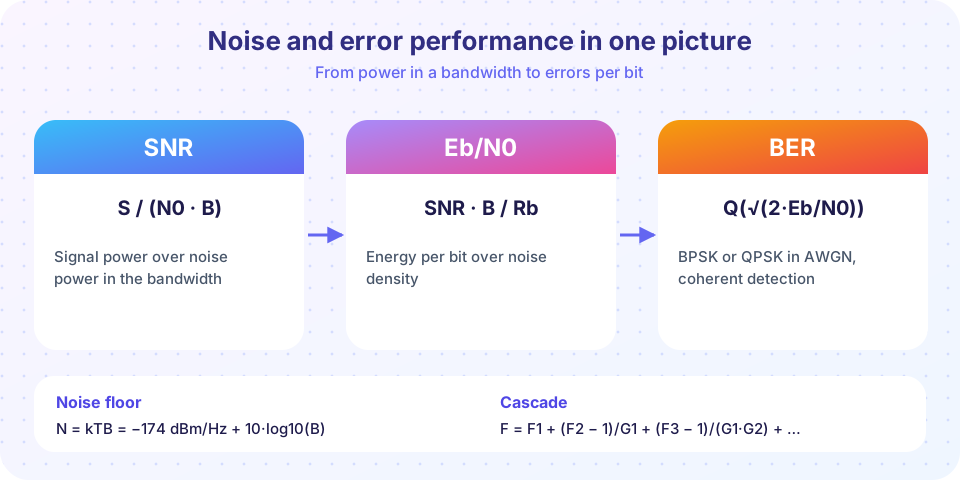
Chapter in one table
| Quantity | Formula | Remember |
|---|---|---|
| Noise floor | N = k·T·B; −174 dBm/Hz + 10·log10(B) |
290 K; add NF for a real receiver |
| Noise figure | NF = 10·log10(F); Te = T0·(F − 1) |
F ≥ 1; passive loss gives F = L |
| Cascade | F = F1 + (F2 − 1)/G1 + … |
first stage dominates |
| SNR | S / (N0·B) |
what a spectrum analyzer shows |
| Eb/N0 | SNR · B / Rb |
fair comparison between schemes |
| Matched filter | h(t) = s(T − t); peak SNR 2E/N0 |
depends only on energy |
| BPSK / QPSK BER | Q(√(2·Eb/N0)) = ½·erfc(√(Eb/N0)) |
6.8 dB for 10⁻³, 9.6 dB for 10⁻⁵ |
| Square 16-QAM BER | 0.75 · Q(√(0.8·Eb/N0)) |
about 3.8 dB worse than BPSK at 10⁻⁵ |
Common mistakes to avoid
- Adding dB values that are really powers. Two noise sources of −100 dBm each give −97 dBm, not −200 dBm.
- Forgetting the noise figure when you compute the real noise floor.
- Using
Es/N0where the formula wantsEb/N0, or the reverse. - Mixing dB (a ratio) with dBm (power relative to 1 mW).
Try it
First, a conversion tool that takes you from a measured SNR to Eb/N0 and the BPSK error rate for a given bandwidth and bit rate.
Press Run (or Ctrl + Enter) to see the result here.
Program input · what you'd type while the program runs
Type the answers before you press Run, one per line. Each time the program reads a line (with input()), it gets the next line from this box.
Second, adding noise powers the right way. Never add dBm; convert to watts, add, and convert back.
Press Run (or Ctrl + Enter) to see the result here.
Program input · what you'd type while the program runs
Type the answers before you press Run, one per line. Each time the program reads a line (with input()), it gets the next line from this box.
Check your understanding
Quick check · 10 questions
of 10 answered You scored / 10 · perfect!
-
1. What is the thermal noise floor of a receiver with noise figure 6 dB in a 4 MHz bandwidth?
−174 + 10·log10(4×10⁶) + 6 = −174 + 66 + 6 = −102 dBm. -
2. Two uncorrelated noise sources of −90 dBm each are added. What is the total?
Doubling the power adds 3 dB. -
3. In a cascade, why should the LNA come before a lossy cable if possible?
A loss before the LNA adds to NF dB for dB; a loss after the LNA is divided by the LNA's gain. -
4. The peak output SNR of a matched filter is:
Peak SNR = 2E/N0. -
5. A link has SNR = 12 dB, B = 2 MHz and Rb = 1 Mbit/s. What is Eb/N0?
Eb/N0 = SNR · B/Rb = 12 dB + 10·log10(2) = 15 dB. -
6. Which expression gives the BPSK bit error rate?
BPSK in AWGN with coherent detection has Pb = Q(√(2·Eb/N0)). -
7. A BPSK link reaches a BER of 10⁻³ at about 6.8 dB. What do you expect for QPSK at the same Eb/N0?
Gray-coded QPSK has the same BER as BPSK at equal Eb/N0. -
8. Which source of noise sets the unavoidable floor of a receiver at 290 K?
Thermal noise is present in any resistive component above absolute zero. -
9. Which statement about the Friis formula is correct?
F = F1 + (F2 − 1)/G1 + …, all in linear units. -
10. Doubling the pulse energy at fixed N0 changes the matched-filter peak SNR by:
SNR = 2E/N0 is proportional to E; doubling power is +3 dB.
Summary
- Thermal noise sets the floor
−174 dBm/Hz + 10·log10(B) + NF. - The first stage of a cascade dominates the noise figure.
- The matched filter gives
2E/N0; BPSK and QPSK havePb = Q(√(2·Eb/N0)). - Convert carefully between SNR,
Es/N0andEb/N0, and add noise powers in linear units.
Track your progress
Create a free account to tick off lessons and pick up where you left off on any device.
of Communication Systems lessons completed