


















Lesson 36 of 46 · Wireless and Optical Systems
Wireless and Optical Systems: The Big Picture
Chapter 8 overview: how radio waves and light carry signals, path loss, shadowing, multipath fading, Doppler, and where cellular, Wi-Fi, satellite and fiber fit.
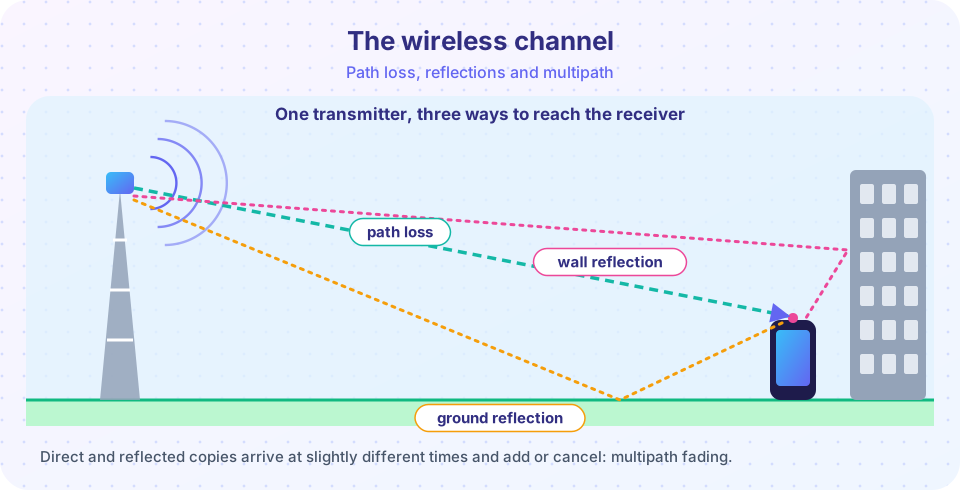
Up to now the channel was an abstract box that adds noise. Real channels have a physical personality. A radio wave spreads out as it travels, so it arrives weaker. It bounces off walls, the ground and vehicles, so several copies arrive at slightly different times. The receiver may be moving, which shifts frequencies. A light pulse in a glass fiber has its own rules: it is guided, it loses little power per kilometer, and it spreads in time.
This chapter turns those physical effects into numbers you can use: decibels of loss, margins, delay spreads and bandwidths. The tool that ties it all together is the link budget, a ledger of gains and losses from the transmitter to the decision circuit.
What you will learn
- Name the large-scale and small-scale effects of a wireless channel.
- Say where cellular, Wi-Fi, satellite and fiber systems differ.
- Preview the link budget and the tools of the next four lessons.
Key terms
- Path loss: the average drop in signal power with distance.
- Shadowing: slow variation caused by obstacles such as buildings and hills.
- Multipath fading: fast variation caused by copies of the signal adding with different phases.
- Doppler shift: frequency change
fd = v·f/ccaused by relative motion. - Link budget: a sum in dB of all gains and losses between transmit power and received power.
Large-scale and small-scale effects
| Effect | Scale | Cause | Typical size | Handled by |
|---|---|---|---|---|
| Path loss | kilometers | spreading of the wave | tens of dB over a link | link budget, antenna gain |
| Shadowing | tens of meters | obstacles | log-normal, 4 to 10 dB spread | fade margin |
| Multipath fading | half a wavelength | reflections and phase | 20 to 30 dB deep fades | diversity, OFDM, coding |
| Delay spread | microseconds | path length differences | 0.1 to 10 µs outdoors | equalizers, cyclic prefix |
| Doppler | with speed | motion | v·f/c: 185 Hz at 100 km/h and 2 GHz |
tracking loops |
A good habit is to separate the problem into scales. First compute the average power with the link budget. Then add a margin for shadowing. Then choose modulation, coding and diversity to survive the fast fades.
The four systems you will meet
Cellular
Wi-Fi
Satellite
Optical fiber
The road ahead
- Link budget and path loss: Friis, free-space loss, fade margin, maximum range.
- Fading, multipath and OFDM: delay spread, Doppler, subcarriers and the cyclic prefix.
- Optical fiber links: total internal reflection, attenuation windows, dispersion, power budget.
- Chapter review.
Try it
Explore free-space loss. Pick a carrier frequency, slide the distance and see the path loss and the received power for a 20 dBm transmitter with isotropic antennas (0 dBi). The sliders are a calculator for the formula FSPL = 20·log10(d) + 20·log10(f) + 32.44 with d in km and f in MHz.
Real environments lose power faster than free space. A common model is the log-distance law PL(d) = PL(d0) + 10·n·log10(d/d0), where the path loss exponent n is 2 in free space, 2.7 to 3.5 in urban areas and 4 to 6 inside buildings with many walls. The plot compares exponents at 2.4 GHz.
Press Run (or Ctrl + Enter) to see the result here.
Program input · what you'd type while the program runs
Type the answers before you press Run, one per line. Each time the program reads a line (with input()), it gets the next line from this box.
Check your understanding
Quick check · 4 questions
of 4 answered You scored / 4 · perfect!
-
1. Which effect varies over distances of about half a wavelength?
Copies of the signal change from adding to cancelling over roughly half a wavelength of movement. -
2. A receiver moves at 30 m/s (108 km/h) with a 2 GHz carrier. What is the maximum Doppler shift? (c = 3×10⁸ m/s)
fd = v·f/c = 30 × 2×10⁹ / 3×10⁸ = 200 Hz. -
3. Free-space path loss at 2.4 GHz for a 1 km distance is about:
20·log10(1) + 20·log10(2400) + 32.44 = 0 + 67.6 + 32.44 = 100 dB. -
4. A typical urban environment has a path loss exponent of about:
Urban exponents of 2.7 to 3.5 are common, with higher values indoors.
Summary
- A wireless link suffers path loss, shadowing, multipath fading, delay spread and Doppler, each on its own scale.
- The link budget handles the average; margins, diversity, OFDM and coding handle the variation.
- Free-space loss is
20·log10(d) + 20·log10(f) + 32.44dB (km, MHz); real environments use a path loss exponentnbetween 2 and 6. - Cellular, Wi-Fi, satellite and fiber differ mainly in distance, mobility and how much loss they must overcome.
Track your progress
Create a free account to tick off lessons and pick up where you left off on any device.
of Communication Systems lessons completed