


















Lesson 12 of 46 · Amplitude and Angle Modulation
Amplitude modulation (AM)
Derive the AM signal, find the modulation index from an envelope, compute sideband power and efficiency, and see why over-modulation distorts.
Conventional amplitude modulation (AM) is the oldest broadcast technique and the cleanest example of a linear modulation. The transmitter adds the message to a constant, multiplies by a carrier, and the receiver can be a diode, a capacitor and a resistor. In this lesson you derive the AM spectrum, learn how to measure the modulation index, and see exactly how little of the transmitted power carries information.
What you will learn
- The AM equation and the meaning of the modulation index
μ. - How to read
μfrom a waveform withAmaxandAmin. - The spectrum, bandwidth and power of an AM wave.
- Why efficiency is at most 1/3 for tone modulation.
Key terms
- Modulation index (depth)
μ: the ratio of the peak message amplitude to the carrier amplitude. - Over-modulation:
μ > 1; the envelope no longer follows the message. - Carrier power
Pc: the part of the power in the unmodulated carrier. - Sideband power: the power in the upper and lower sidebands.
- Efficiency
η: the fraction of total power that is in the sidebands.
The AM signal
Let m(t) be the message, normalized so that its largest magnitude is 1 (|mn(t)| ≤ 1). The AM signal is
s(t) = Ac · [ 1 + μ · mn(t) ] · cos(2π fc t)
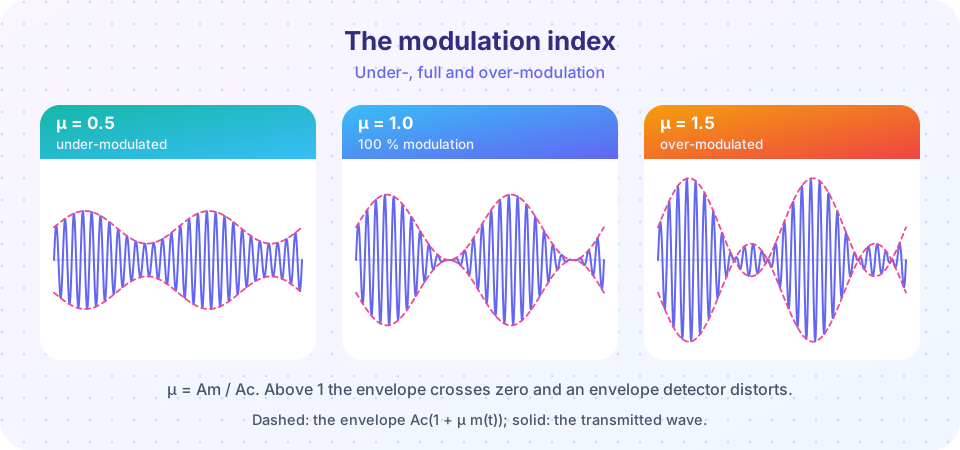
with carrier amplitude Ac. The factor in brackets is the envelope. As long as μ ≤ 1 it stays non-negative, and its shape is a scaled copy of the message. For a single tone mn(t) = cos(2π fm t), a product-to-sum identity gives
s(t) = Ac cos(2π fc t) + (μ Ac / 2) cos(2π (fc + fm) t) + (μ Ac / 2) cos(2π (fc − fm) t).
So a tone produces a carrier plus two sidebands, at fc ± fm, each of amplitude μ Ac / 2. For a general message with bandwidth B, the spectrum is the carrier line plus a copy of the message spectrum on each side, with total bandwidth
B_AM = 2B.
For a voice signal of 4 kHz bandwidth, an AM signal occupies 8 kHz, roughly consistent with broadcast channel spacings of 9 or 10 kHz (depending on the region).
Measuring the modulation index
On an oscilloscope, read the largest and smallest envelope values:
μ = (Amax − Amin) / (Amax + Amin).
Worked example: the envelope peaks at 12 V and dips to 4 V. Then μ = (12 − 4) / (12 + 4) = 0.5, and the carrier amplitude is (12 + 4)/2 = 8 V.
If μ > 1 the bracket 1 + μ mn(t) goes negative. The carrier then flips phase by 180° during those intervals. A receiver that tracks the envelope sees the absolute value, which is not the message, so the output is badly distorted. That is why transmitters limit the modulation depth, usually to less than 100 %.
Power and efficiency
Across a 1 Ω resistor, the unmodulated carrier has power Pc = Ac² / 2. For tone modulation each sideband has amplitude μ Ac / 2 and power μ² Ac² / 8 = (μ² / 4) Pc. Total power:
Pt = Pc · (1 + μ² / 2).
The sidebands hold Pc μ² / 2, which is the only part that carries information, so the efficiency is
η = (μ² / 2) / (1 + μ² / 2) = μ² / (2 + μ²).
At μ = 1, η = 1/3: two thirds of the power is wasted in the carrier. At μ = 0.5, η = 0.25/2.25 ≈ 11 %. Real speech has a high peak-to-average ratio, so average modulation depth is much lower than the peak, and efficiency is worse still.
Worked example: carrier Ac = 10 V across 1 Ω, so Pc = 50 W. With μ = 0.8: Pt = 50 × (1 + 0.32) = 66 W, the sidebands hold 16 W and η = 0.64 / 2.64 ≈ 24.2 %.
So why use AM at all? Because the receiver is trivial, and a broadcaster serving millions of cheap radios is happy to pay for transmit power. Receivers do not pay for it.
Common misconceptions
"A modulation index above 1 means a stronger signal." It only distorts the envelope. A signal above 100 % modulation spills energy into harmonics and neighbouring channels.
"AM changes the carrier frequency a little." The carrier frequency is exactly constant; the sidebands are added components, not a shift of the carrier.
"Efficiency is the same as modulation depth." Efficiency is μ² / (2 + μ²), much less than μ (for example 11 % at μ = 0.5).
Try it
The first example generates AM waves, recovers the index from the envelope with the (Amax − Amin)/(Amax + Amin) rule and compares measured power with the formula. The measured power values come from the signal itself.
Press Run (or Ctrl + Enter) to see the result here.
Program input · what you'd type while the program runs
Type the answers before you press Run, one per line. Each time the program reads a line (with input()), it gets the next line from this box.
The second example plots efficiency against the modulation index and marks the practical operating points.
Press Run (or Ctrl + Enter) to see the result here.
Program input · what you'd type while the program runs
Type the answers before you press Run, one per line. Each time the program reads a line (with input()), it gets the next line from this box.
Check your understanding
Quick check · 5 questions
of 5 answered You scored / 5 · perfect!
-
1. An AM envelope has a maximum of 9 V and a minimum of 3 V. The modulation index is
μ = (9 − 3) / (9 + 3) = 6/12 = 0.5. -
2. A 5 kHz message is amplitude modulated on a carrier. The bandwidth is about
B_AM = 2B = 10 kHz because there are two sidebands. -
3. What is the maximum efficiency of tone-modulated AM (μ = 1)?
η = μ² / (2 + μ²) = 1/3. -
4. Why does over-modulation (μ > 1) cause distortion in an envelope detector?
When 1 + μ m(t) goes negative the carrier flips phase; an envelope detector follows |1 + μ m(t)|, not the message. -
5. A carrier of 8 V peak across 1 Ω has power
Pc = Ac² / 2 = 64 / 2 = 32 W.
Summary
s(t) = Ac [1 + μ mn(t)] cos(2π fc t); forμ ≤ 1the envelope copies the message.- Spectrum: carrier plus two sidebands, bandwidth
2B. μ = (Amax − Amin)/(Amax + Amin);Pt = Pc (1 + μ²/2);η = μ²/(2 + μ²) ≤ 1/3.- Simple receivers are the reason AM survives despite wasted power.
Track your progress
Create a free account to tick off lessons and pick up where you left off on any device.
of Communication Systems lessons completed