


















Lesson 29 of 46 · Noise and Error Performance
Bit Error Rate Curves
Read and compute bit error rate curves: formulas for BPSK, QPSK, DPSK, FSK and M-QAM versus Eb/N0, how SNR relates to Eb/N0, and how to find the required Eb/N0.
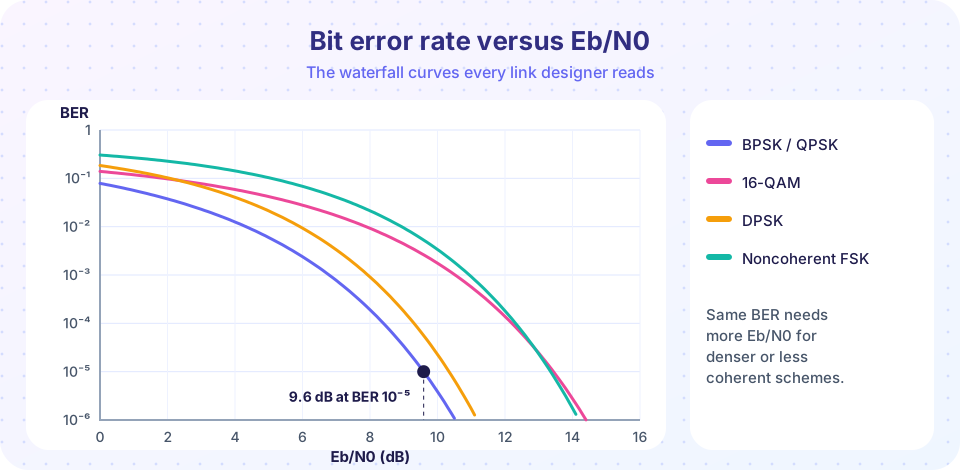
A bit error rate curve is the most important picture in digital communications. It plots, for one modulation scheme, how often bits go wrong (vertical axis, logarithmic) against how much energy per bit you spend compared with the noise (horizontal axis, in dB). Every modem datasheet and every standards document has these curves, and a link designer's day often starts with the question "what Eb/N0 do I need for a BER of one in a hundred thousand?"
In this lesson you collect the formulas for the schemes from chapter 5, learn to convert between SNR, Es/N0 and Eb/N0, and compute the required Eb/N0 for a target BER.
What you will learn
- Write the BER formulas of BPSK, QPSK, DPSK, FSK and square QAM.
- Convert among SNR,
Es/N0andEb/N0. - Read a "waterfall" curve and find the
Eb/N0for a given BER. - Explain why the curves are so steep.
- Distinguish symbol error rate from bit error rate.
Key terms
- Eb/N0 (γ): bit energy over noise density; dimensionless, usually in dB.
- Es/N0: symbol energy over noise density;
Es/N0 = Eb/N0 · log2(M). - Waterfall curve: BER falling rapidly as
Eb/N0rises. - Ps and Pb: symbol error probability and bit error probability.
- Error floor: a BER that stops improving, caused by something other than thermal noise.
Three ratios, one conversion
The same link can be described by three signal-to-noise numbers.
| Name | Definition | Use |
|---|---|---|
| SNR | S / (N0·B) |
what a spectrum analyzer shows |
Es/N0 |
SNR · B / Rs |
symbol decisions |
Eb/N0 |
SNR · B / Rb |
fair comparison between schemes |
They differ only by the ratios of the bandwidth to the symbol or bit rate. For a modulation with k = log2(M) bits per symbol, Es/N0 = k · Eb/N0. In dB, add 10·log10(k): for 16-QAM that is 6 dB. If the signal occupies bandwidth B = Rs (ideal Nyquist), SNR = Es/N0.
The formulas
Let γ = Eb/N0 (linear), and Q(x) = ½·erfc(x/√2).
| Scheme | Bit error probability |
|---|---|
| BPSK, coherent | Q(√(2γ)) |
| QPSK, Gray, coherent | Q(√(2γ)) (same as BPSK) |
| DPSK | ½ · e^(−γ) |
| Coherent orthogonal binary FSK | Q(√γ) |
| Noncoherent orthogonal binary FSK | ½ · e^(−γ/2) |
| Square M-QAM, Gray (approximation) | (4/log2 M) · (1 − 1/√M) · Q(√(3·log2(M)·γ / (M − 1))) |
For 16-QAM the last row becomes 0.75 · Q(√(0.8·γ)). For 64-QAM it is 0.583 · Q(√(0.286·γ)). The QAM expression counts only the nearest-neighbor errors and assumes Gray coding, which is accurate at the BERs of interest.
What the table says: BPSK and QPSK are the best in this list. Coherent FSK needs 3 dB more. DPSK is only about 0.7 dB worse than BPSK and avoids phase recovery. Noncoherent FSK pays another small penalty for needing no phase information at all. QAM needs more Eb/N0 as M grows, but uses less bandwidth per bit.
Why the waterfall is so steep
Errors come from the Gaussian tail, and the Gaussian tail shrinks like e^(−x²/2). For BPSK at Eb/N0 = 4 dB the BER is about 1.3 × 10⁻²; at 8 dB it is about 1.9 × 10⁻⁴; at 10 dB, 3.9 × 10⁻⁶. Going from 4 dB to 8 dB cuts the error rate by a factor of about 65, and two more decibels cut it by about 50 again. That sensitivity is the lever of every link budget: a small improvement in antenna gain or noise figure is worth a lot of reliability.
Two practical targets to remember for BPSK or QPSK: BER 10⁻³ needs Eb/N0 ≈ 6.8 dB; BER 10⁻⁵ needs about 9.6 dB.
Symbol errors versus bit errors
Constellation analysis first gives the symbol error probability Ps. With Gray coding the likeliest symbol error flips one bit among k, so Pb ≈ Ps / k. Without Gray coding, an error can flip several bits and Pb is larger. Always check which of the two a plotted curve shows.
Beyond thermal noise: error floors
Real curves can level off. Phase noise, quantization noise, nonlinear distortion and interference scale with the signal, so increasing power does not shrink them. Their effect appears as a BER floor, and the cure is not more power but a better component or algorithm.
Common misconceptions
- "A lower BER means a better modulation." Only at equal
Eb/N0and with the same bandwidth considerations. 64-QAM has a higher BER than BPSK at the sameEb/N0but delivers 6 times the data per symbol. - "BER is the same as SNR." SNR is an input condition; BER is the consequence.
- "Adding 3 dB always halves the errors." The drop is far larger because the curve is a steep waterfall, not a straight line on a linear axis.
- "QPSK at the same Eb/N0 has twice the BER." With Gray coding it is identical to BPSK.
Try it
First, a BER calculator. It plots all curves and computes the Eb/N0 each scheme needs for BER 10⁻⁵.
Press Run (or Ctrl + Enter) to see the result here.
Program input · what you'd type while the program runs
Type the answers before you press Run, one per line. Each time the program reads a line (with input()), it gets the next line from this box.
Second, test the 16-QAM formula with a Monte Carlo simulation using Gray-coded levels −3, −1, +1, +3 on each axis.
Press Run (or Ctrl + Enter) to see the result here.
Program input · what you'd type while the program runs
Type the answers before you press Run, one per line. Each time the program reads a line (with input()), it gets the next line from this box.
Check your understanding
Quick check · 5 questions
of 5 answered You scored / 5 · perfect!
-
1. A 16-QAM link has Eb/N0 = 8 dB. What is its Es/N0?
Es/N0 = Eb/N0 · log2(16) = 8 dB + 10·log10(4) = 8 + 6 = 14 dB. -
2. Which scheme has the same Gray-coded bit error rate as BPSK at the same Eb/N0?
QPSK is two independent BPSK streams on orthogonal carriers. -
3. Roughly what Eb/N0 does BPSK need for a bit error rate of 10^-5?
Q(√(2γ)) = 10⁻⁵ at γ ≈ 9.1, i.e. about 9.6 dB. -
4. Why does a Gray-coded system have Pb ≈ Ps / k?
With Gray labeling, nearest-neighbor symbol errors flip a single bit. -
5. A BER curve flattens at 10^-6 no matter how much power is added. What is the likely cause?
Impairments that scale with the signal cannot be beaten by more power.
Summary
Es/N0 = k · Eb/N0andSNR = (Eb/N0) · Rb/Bconvert between the three ratios.- BPSK and QPSK:
Pb = Q(√(2·Eb/N0)); coherent FSK needs 3 dB more; DPSK is within about 1 dB of BPSK. - Square M-QAM needs more
Eb/N0asMgrows in exchange for spectral efficiency. - BER curves are steep waterfalls; floors reveal impairments beyond thermal noise.
Next: Chapter 6 review
Track your progress
Create a free account to tick off lessons and pick up where you left off on any device.
of Communication Systems lessons completed