


















Lesson 25 of 46 · Digital Modulation
Chapter 5 Review: Digital Modulation
Review chapter 5: a one-page picture, a recap table of BPSK, QPSK and QAM, two checks in code and a ten-question mixed quiz on digital modulation.
You now know how bits become waveforms. This review pulls the chapter into one picture and one table, lets you check two key claims in code, and ends with a ten-question quiz that mixes all four lessons.
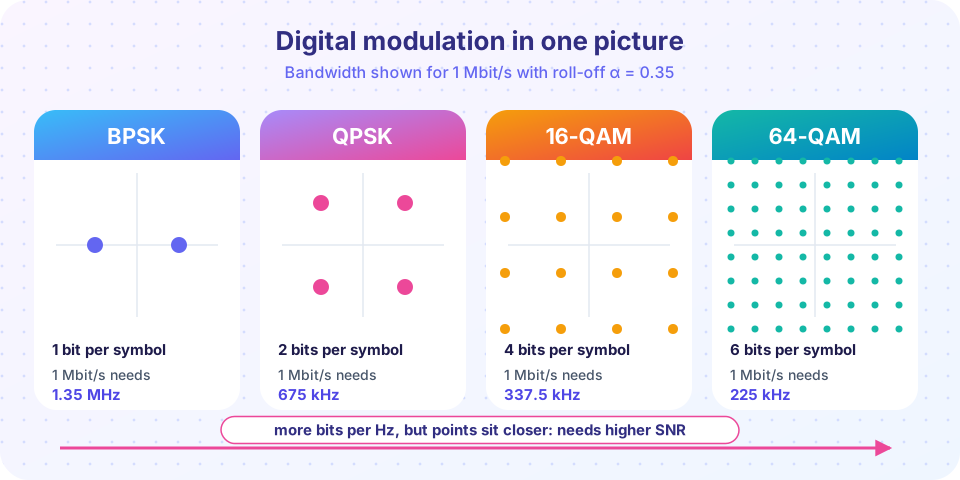
Chapter in one table
| Scheme | Bits per symbol | Changes | Strength | Weakness |
|---|---|---|---|---|
| OOK / ASK | 1 | amplitude | trivial receiver | poor noise and fading behavior |
| Binary FSK | 1 | frequency | constant amplitude; noncoherent detection works | wide spectrum |
| BPSK | 1 | phase (0°/180°) | best binary power efficiency | needs carrier phase; 180° ambiguity |
| QPSK | 2 | phase (4 points) | double the rate of BPSK at the same Eb/N0 |
needs linear amplifier for filtered signals |
| 16-QAM | 4 | amplitude + phase | high spectral efficiency | about 7 dB more SNR than QPSK |
| 64-QAM | 6 | amplitude + phase | very high spectral efficiency | about 6 dB more again; sensitive to phase noise |
Key formulas to remember:
Rb = Rs · log2(M)- Passband bandwidth with raised-cosine pulses:
B = (1 + α) · Rs - BPSK or QPSK signal:
s(t) = I·cos(ωt) − Q·sin(ωt)withI, Q = ±√Eb - Square QAM average energy:
Es = 2(M − 1)/3in unit-spaced odd levels - Nyquist: no ISI if
p(0) = 1andp(nT) = 0; minimum baseband bandwidthRs/2
Common misconceptions to leave behind
- Bandwidth does not follow the bit rate alone; it follows the symbol rate times
(1 + α). - QPSK is not worse than BPSK per bit; it is the same, and twice as fast.
- Zero ISI does not require infinite bandwidth; the raised cosine achieves it with
(1 + α)·Rs/2.
Try it
First, a small design helper. Given a target bit rate, it lists the symbol rate and passband bandwidth for each scheme at three roll-off values.
Press Run (or Ctrl + Enter) to see the result here.
Program input · what you'd type while the program runs
Type the answers before you press Run, one per line. Each time the program reads a line (with input()), it gets the next line from this box.
Second, check the claim that QPSK has the same bit error rate as BPSK at equal Eb/N0, by Monte Carlo simulation against the formula Q(√(2·Eb/N0)) = ½·erfc(√(Eb/N0)).
Press Run (or Ctrl + Enter) to see the result here.
Program input · what you'd type while the program runs
Type the answers before you press Run, one per line. Each time the program reads a line (with input()), it gets the next line from this box.
Check your understanding
Quick check · 10 questions
of 10 answered You scored / 10 · perfect!
-
1. A link sends 12 Mbit/s using 16-QAM. What is the symbol rate?
Rs = Rb / log2(16) = 12 / 4 = 3 Mbaud. -
2. With raised-cosine pulses of roll-off 0.5, what passband bandwidth does a 3 Mbaud signal need?
B = (1 + α) · Rs = 1.5 × 3 MHz = 4.5 MHz. -
3. Why does BPSK outperform binary FSK in power efficiency?
Antipodal signals maximize the distance between the two symbols for a given Eb. -
4. A carrier-recovery loop locks 180 degrees off. What happens to a BPSK stream without differential encoding?
BPSK looks the same after a 180° shift, so the decisions flip; differential encoding removes this ambiguity. -
5. Which pair of statements about QPSK is correct?
QPSK is two independent BPSK links on orthogonal carriers. -
6. What is the average symbol energy of square 64-QAM with levels ±1, ±3, ±5, ±7 on each axis?
Es = 2(M − 1)/3 = 2 · 63 / 3 = 42. -
7. Gray coding makes the most likely symbol error cost:
Neighboring constellation points differ in exactly one bit. -
8. A raised-cosine pulse with roll-off α = 0 is the same as:
α = 0 gives a rectangular spectrum of width Rs, which is the sinc pulse in time. -
9. An eye diagram that is almost closed vertically at the sampling time means:
The vertical opening at the sampling instant is the margin against noise. -
10. Going from QPSK to 16-QAM at constant average power costs roughly how much SNR for the same symbol error rate?
dmin² falls by a factor of 5, which is about 7 dB.
Summary
- Digital modulation maps bits to symbols; bandwidth follows the symbol rate, not the bit rate.
- BPSK is the most power-efficient binary scheme; QPSK doubles the rate at the same
Eb/N0. - Square QAM trades SNR for spectral efficiency, roughly 3 dB per extra bit per symbol.
- Raised-cosine pulses with roll-off
αgive zero ISI in bandwidth(1 + α)·Rs.
Next: Noise: the Big Picture
Track your progress
Create a free account to tick off lessons and pick up where you left off on any device.
of Communication Systems lessons completed