


















Lesson 43 of 46 · Projects and Practice
Practice Problems: Chapters 5 to 8
Ten worked-out practice problems on modulation, noise, coding, link budgets, fading and fiber, a decibel calculator and a quiz to check your numbers.
Concepts become skills only when you put numbers through them. This page gives ten problems that mix the ideas of chapters 5 to 8. Try each on paper first, with a calculator, writing every step in decibels where you can. Then run the solution code to check, and read the commentary on the ones that surprised you.
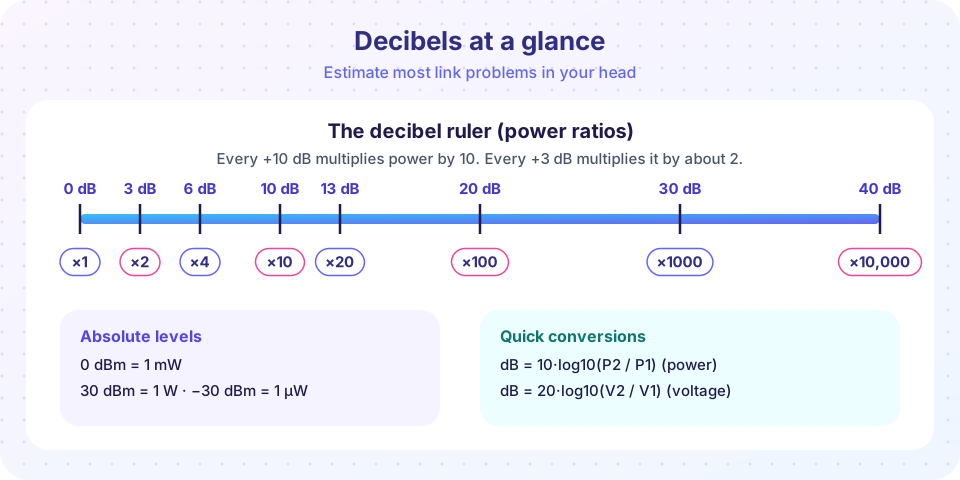
The decibel ruler below is the one tool that makes many of these problems feel easy: a power ratio of 2 is about 3 dB, 10 is 10 dB, and ratios multiply by adding dB.
What you will learn
- Apply the formulas of chapters 5 to 8 to realistic numbers.
- Work in decibels and check results by estimation.
- Combine ideas: modulation, noise, coding and link budgets in single problems.
Key terms
- dB:
10·log10of a power ratio (20·log10of an amplitude ratio). - dBm: power relative to 1 mW;
P(dBm) = 10·log10(P / 1 mW). - Margin: result minus requirement.
- Sanity check: an estimate that tells you whether an answer is plausible.
The problems
- Bandwidth. A modem sends 24 Mbit/s using 16-QAM with raised-cosine pulses of roll-off 0.25. What are the symbol rate and the passband bandwidth?
- Eb/N0 and BER. A link has an SNR of 14 dB in a 5 MHz bandwidth and carries 10 Mbit/s with QPSK. What is
Eb/N0, and what is the approximate bit error rate? - Noise floor. What is the thermal noise floor of a receiver with a 4 dB noise figure in an 8 MHz bandwidth?
- Cascade. A receiver front end has a 3 dB cable loss, then an LNA (gain 25 dB, noise figure 1 dB), then a mixer (noise figure 9 dB). What is the total noise figure?
- Block code. A Hamming (15,11) code is used. What are its rate and error-correcting capability? What happens with two errors in a block?
- Capacity. A 10 MHz channel has an SNR of 20 dB. What is the Shannon capacity?
- Link budget. A 5.8 GHz point-to-point link over 2 km uses 27 dBm transmit power and 23 dBi dishes at both ends, a 20 MHz bandwidth, a 5 dB receiver noise figure, and needs 18 dB SNR. What is the margin?
- Doppler. A train at 120 km/h receives a 2.6 GHz signal. What is the maximum Doppler shift and the coherence time?
- Fiber. A 60 km link has 0.21 dB/km loss, two connectors of 0.5 dB each and five splices of 0.1 dB. The transmitter delivers 0 dBm and the receiver needs −24 dBm. What is the margin?
- Modulation choice. At BER
10⁻⁵, how many more dB ofEb/N0does 16-QAM need than QPSK?
Hints
- Problem 1:
Rb = Rs·log2(M), thenB = (1 + α)·Rs. - Problem 2:
Eb/N0 = SNR · B/Rb; QPSK hasPb = ½·erfc(√(Eb/N0)). - Problem 4: convert to linear numbers; a lossy cable has
F = Land gain1/L. - Problem 7: free-space loss with
din km andfin MHz. - Problem 8:
fd = v·f/c,Tc ≈ 0.423/fd.
Common misconceptions
- "Add the noise figures in dB." A cascade needs the Friis formula in linear units.
- "SNR equals Eb/N0." They differ by the factor
B/Rb. - "A code that corrects one error also copes with two." Past its capability it can make things worse.
- "Positive margin means certain success." It means success on average conditions.
Try it
Run the solutions to check your answers. Each line prints the result with the intermediate numbers.
Press Run (or Ctrl + Enter) to see the result here.
Program input · what you'd type while the program runs
Type the answers before you press Run, one per line. Each time the program reads a line (with input()), it gets the next line from this box.
For the decibel conversions that run through all these problems, here is a calculator. Enter a value in any box.
Check your understanding
Quick check · 6 questions
of 6 answered You scored / 6 · perfect!
-
1. A signal is amplified from 2 mW to 200 mW. What is the gain?
200/2 = 100, which is 20 dB. -
2. Problem 3: what is the thermal noise floor of a 4 dB NF receiver in 8 MHz?
−174 + 69 + 4 = −101 dBm. -
3. Problem 6: the Shannon capacity of 10 MHz at 20 dB SNR is about:
10 × log2(101) = 66.6 Mbit/s. -
4. Problem 8: the maximum Doppler shift of a 120 km/h train at 2.6 GHz is about:
fd = 33.3 × 2.6×10⁹ / 3×10⁸ ≈ 289 Hz. -
5. Problem 9: what is the fiber link margin?
Losses total 14.1 dB, so the margin is 24 − 14.1 = 9.9 dB. -
6. Problem 10: roughly how much more Eb/N0 does 16-QAM need than QPSK at BER 10⁻⁵?
13.4 dB versus 9.6 dB is a difference of about 3.8 dB.
Summary
- Convert everything to decibels early; adding replaces multiplying.
- Keep track of which ratio you hold: SNR,
Es/N0orEb/N0. - Cascades need linear noise factors; budgets need consistent units (km and MHz in the free-space formula).
- Check every answer by estimation: 3 dB is a factor 2, 10 dB a factor 10.
Next: Glossary
Track your progress
Create a free account to tick off lessons and pick up where you left off on any device.
of Communication Systems lessons completed