


















Lesson 10 of 46 · Signals and Spectra
Chapter 2 review: Signals and spectra
Review the Fourier series, the Fourier transform, power spectral density and distortionless transmission with a recap table and a ten-question quiz.
Chapter 2 gave you the language of the rest of the course. Whenever a later lesson says "the spectrum of the modulated signal", "the bandwidth of the pulse" or "the noise passed by the filter", it relies on what you learned here. Use this page to check that the tools are sharp.
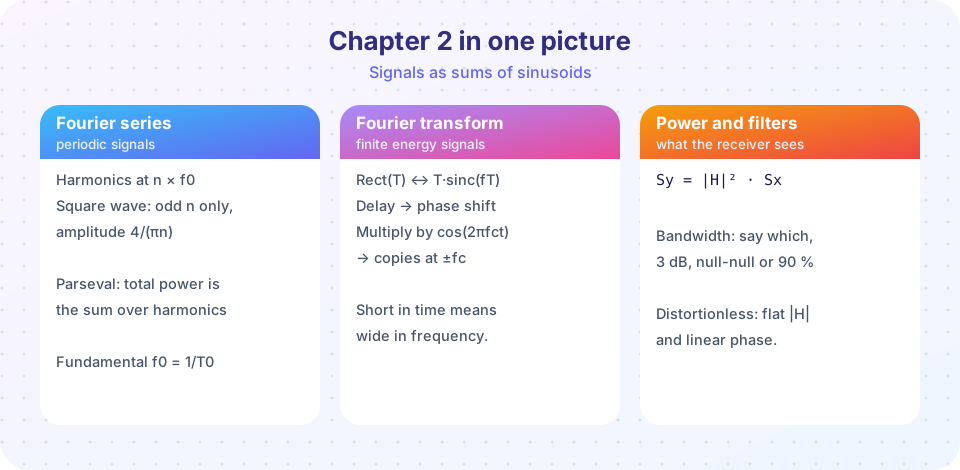
What you will learn
- How the three main tools relate to each other.
- Which results you will reuse in chapters 3 to 6.
- Whether you can apply them in a short calculation.
Recap table
| Tool | Describes | Key result | Lesson |
|---|---|---|---|
| Fourier series | Periodic signals | Harmonics at n f0; square wave amplitudes 4A/(πn) |
Fourier series |
| Parseval | Power | P = Σ |cn|² |
Fourier series |
| Fourier transform | Finite-energy signals | Rect(T) ↔ A T sinc(fT) |
Fourier transform |
| Time scaling | Narrow ↔ wide | x(at) ↔ X(f/a)/|a| |
Fourier transform |
| Frequency shift | Modulation | x cos(2π fc t) ↔ ½X(f−fc) + ½X(f+fc) |
Fourier transform |
| PSD | Random signals | Sy = |H|² Sx; white noise N0/2 |
Power spectral density |
| Distortionless | Channels | Flat |H|, linear phase |
Power spectral density |
What to carry forward. Three sentences: (1) a pulse of duration T needs about 1/T hertz; (2) multiplying by a cosine copies the spectrum to ±fc; (3) noise power is the PSD integrated through the filter.
Try it
The first example finds how much of a rectangular pulse's energy sits in its main lobe. This is the origin of the "90 % bandwidth" rule of thumb: the first-null bandwidth 1/T holds about 90 % of the energy.
Press Run (or Ctrl + Enter) to see the result here.
Program input · what you'd type while the program runs
Type the answers before you press Run, one per line. Each time the program reads a line (with input()), it gets the next line from this box.
The second example is a quick helper: give it a pulse or bit duration and it prints the null-to-null bandwidth and a power-of-ten sanity check.
Press Run (or Ctrl + Enter) to see the console output here.
No output.
Check your understanding
Quick check · 10 questions
of 10 answered You scored / 10 · perfect!
-
1. A periodic signal repeats every 0.25 ms. Its harmonics lie at
f0 = 1 / 0.25 ms = 4 kHz, and harmonics sit at n × 4 kHz. -
2. Which harmonics are present in an odd square wave?
The square wave has half-wave symmetry, which removes the even harmonics. -
3. A pulse of duration 20 µs has first spectral nulls at
1/T = 1 / 20 µs = 50 kHz. -
4. Halving a pulse's duration does what to its spectrum?
Time scaling: x(2t) ↔ ½ X(f/2). -
5. Multiplying a message by cos(2π·1 MHz·t) places its spectrum around
The frequency-shift property gives two half-height copies at ±fc. -
6. The output PSD of a filter equals
Power scales by the squared magnitude response. -
7. White noise of two-sided density N0/2 passes through an ideal filter of bandwidth B (positive frequencies). The output power is
The filter passes (N0/2) over −B to +B, which totals N0 B. -
8. A flat magnitude response and a linear phase mean the channel is
These are exactly the conditions for y(t) = K x(t − td). -
9. The main lobe of a rectangular pulse contains roughly what fraction of the energy?
About 90.3 % of the energy sits between the first nulls. -
10. Which pair of concepts connects Parseval's relation with Rayleigh's energy theorem?
Parseval is for periodic signals and Rayleigh for finite-energy signals; both state that the two domains give the same total.
Summary
- Fourier series (periodic) and transform (finite energy) are two sides of one idea.
- Pulse duration
Timplies bandwidth about1/T; scaling shows narrow means wide. - Frequency shift is modulation; PSD with filters gives noise power.
- Chapter 3 now uses these tools to put messages on carriers.
Track your progress
Create a free account to tick off lessons and pick up where you left off on any device.
of Communication Systems lessons completed