


















Lesson 40 of 46 · Wireless and Optical Systems
Chapter 8 Review: Wireless and Optical Systems
Review chapter 8 with a one-page picture, recap table, a comparison of Wi-Fi, LTE, satellite and fiber losses, a fade-margin tool and a ten-question quiz.
Chapter 8 moved from abstract noise to physical channels. Radio has path loss, shadowing, multipath fading and Doppler; fiber has attenuation and dispersion. All of them reduce to the same ledger, the link budget, plus a few tricks (OFDM, diversity, coding) for the variable parts.
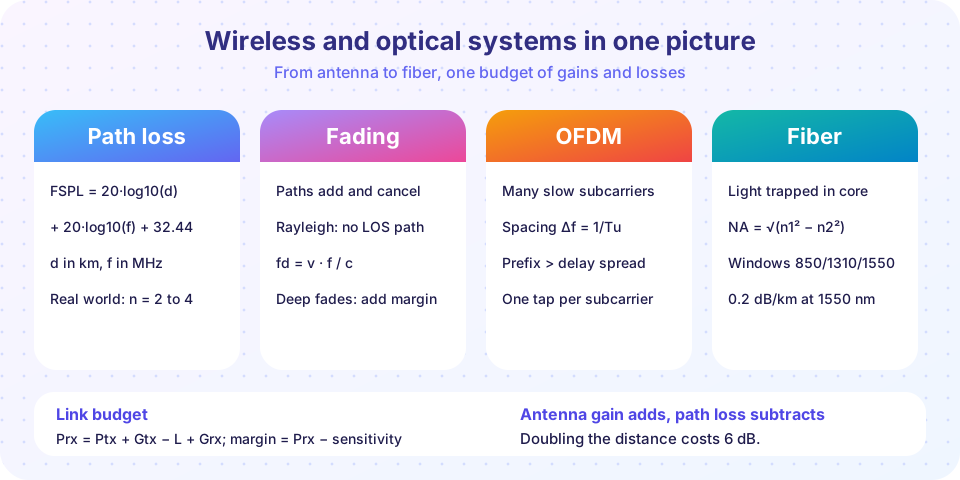
Chapter in one table
| Topic | Key formula | Rule of thumb |
|---|---|---|
| Free-space loss | 20·log10(d_km) + 20·log10(f_MHz) + 32.44 |
doubling distance or frequency: +6 dB |
| Log-distance model | PL = PL0 + 10·n·log10(d/d0) |
n is 2 in free space, 3 to 4 in cities |
| Received power | Pr = Ptx + Gtx + Grx − L (dB) |
0 dBm = 1 mW; −174 dBm/Hz at 290 K |
| Margin | SNR − SNR_required |
shadowing 2.33σ for 99 % |
| Rayleigh fading | `P( | h |
| Doppler | fd = v·f/c |
185 Hz at 100 km/h and 2 GHz |
| Coherence bandwidth | Bc ≈ 1/(5·τrms) |
200 kHz for 1 µs |
| OFDM | Δf = 1/Tu; prefix > delay spread |
Wi-Fi 312.5 kHz; LTE 15 kHz |
| Fiber | NA = √(n1² − n2²); α ≈ 0.2 dB/km at 1550 nm |
5 µs/km delay |
| Chromatic dispersion | Δτ = D·L·Δλ |
D = 17 ps/(nm·km) |
Mistakes to avoid
- Using the wrong units in the free-space formula (kilometers and megahertz, not meters and hertz).
- Adding dBm values together.
- Forgetting that a path loss exponent above 2 shortens range much more than the free-space formula suggests.
- Believing OFDM removes fading; it only makes fading simple to equalize.
Try it
First, compare typical systems: how much path loss does each have to overcome? The fiber figure counts attenuation only.
Press Run (or Ctrl + Enter) to see the result here.
Program input · what you'd type while the program runs
Type the answers before you press Run, one per line. Each time the program reads a line (with input()), it gets the next line from this box.
Second, a fade-margin tool. For a Rayleigh channel, the probability that the received power is lower than M dB below its average is 1 − e^(−10^(−M/10)). For shadowing with standard deviation σ, the margin for a target availability follows from the Gaussian.
Press Run (or Ctrl + Enter) to see the result here.
Program input · what you'd type while the program runs
Type the answers before you press Run, one per line. Each time the program reads a line (with input()), it gets the next line from this box.
Check your understanding
Quick check · 9 questions
of 9 answered You scored / 9 · perfect!
-
1. A free-space link at 3 GHz and 10 km. What is the path loss?
20·log10(10) + 20·log10(3000) + 32.44 = 20 + 69.54 + 32.44 = 122 dB. -
2. The distance of a free-space link is doubled. The path loss changes by:
20·log10(2) = 6.02 dB. -
3. What does the cyclic prefix do in OFDM?
The prefix is a copy of the symbol's tail that absorbs the delay spread. -
4. In Rayleigh fading, how often is the signal at least 30 dB below average?
1 − e^(−0.001) ≈ 0.1 %. -
5. A fiber has loss 0.2 dB/km. After 50 km, what fraction of the launched power remains?
50 × 0.2 = 10 dB, which is a factor of 10, so 10 % remains. -
6. Which environment has the largest path loss exponent?
Indoor obstructed paths can reach exponents of 4 to 6. -
7. Chromatic dispersion of 17 ps/(nm·km) with a 0.1 nm source over 20 km gives:
17 × 20 × 0.1 = 34 ps. -
8. Doppler shift at 108 km/h (30 m/s) and 900 MHz is:
fd = 30 × 9×10⁸ / 3×10⁸ = 90 Hz. -
9. A link has Prx = −70 dBm, noise floor −92 dBm and the modem needs 15 dB SNR. What is the margin?
SNR = 22 dB; margin = 22 − 15 = 7 dB.
Summary
- Free-space loss follows
20·log10(d) + 20·log10(f) + 32.44(km, MHz); real environments use an exponentn. - Link budget: add gains, subtract losses, compare with the noise floor, keep margin for shadowing and fading.
- Fading is multiplicative and heavy-tailed; OFDM and coding make it manageable.
- Fiber trades tiny attenuation for dispersion; budgets follow the same ledger logic as radio.
Track your progress
Create a free account to tick off lessons and pick up where you left off on any device.
of Communication Systems lessons completed