


















Lesson 15 of 44 · Calculus of Variations
Chapter 3 Review: Calculus of Variations
Review functionals, the Euler-Lagrange equation, the brachistochrone, the catenary and Lagrange multipliers with a one-page poster, recap table and ten-question quiz.
Chapter 3 gave you the mathematical engine behind Lagrangian mechanics. You derived the Euler-Lagrange equation, used its first integrals, solved the brachistochrone and the hanging chain, and met Lagrange multipliers for constrained problems. The poster below is a one-page summary; the table links each idea to its lesson; the quiz mixes all four lessons.
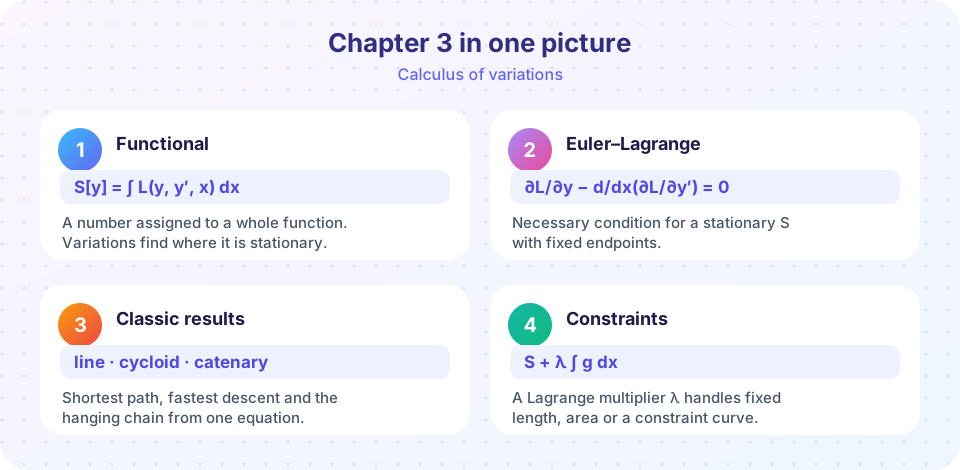
Recap table
| Idea | Statement | Lesson |
|---|---|---|
| Functional | S[y] = ∫ L(y, y′, x) dx, a number from a function |
Overview |
| Euler-Lagrange | ∂L/∂y − d/dx(∂L/∂y′) = 0 |
Euler-Lagrange |
| First integrals | no y in L: ∂L/∂y′ constant; no x: L − y′ ∂L/∂y′ constant |
Euler-Lagrange |
| Brachistochrone | y(1 + y′²) = 2R, cycloid x = R(t − sin t), y = R(1 − cos t) |
Brachistochrone |
| Multipliers | extremize L + λG for a fixed ∫G |
Constraints and multipliers |
| Catenary | y = a cosh(x/a), ℓ = 2a sinh(d/a) |
Constraints and multipliers |
Try it
Press Run (or Ctrl + Enter) to see the result here.
Program input · what you'd type while the program runs
Type the answers before you press Run, one per line. Each time the program reads a line (with input()), it gets the next line from this box.
Press Run (or Ctrl + Enter) to see the result here.
Program input · what you'd type while the program runs
Type the answers before you press Run, one per line. Each time the program reads a line (with input()), it gets the next line from this box.
Check your understanding
Quick check · 10 questions
of 10 answered You scored / 10 · perfect!
-
1. A functional is:
S[y] assigns a number to each admissible function y. -
2. What is the Euler-Lagrange equation?
Vary the path, integrate by parts and apply the fundamental lemma. -
3. If L = y′² − y² (no explicit x), which combination is constant on an extremal?
L − y′∂L/∂y′ = (y′² − y²) − 2y′² = −(y′² + y²), so y′² + y² is constant. -
4. The straight line minimizes length. Which curve minimizes the descent time between two points under gravity?
The brachistochrone is the cycloid. -
5. For a chain of length ℓ between supports at x = ±d, the equation that fixes a is:
∫ cosh(x/a) dx over [−d, d] = 2a sinh(d/a). -
6. In the rectangle problem, what does the multiplier λ represent?
λ = d(max f)/d(constraint constant). -
7. Why must the variation η vanish at both endpoints?
Fixed endpoints give a vanishing boundary term. -
8. If L does not depend on y, which quantity is conserved?
The EL equation becomes d/dx(∂L/∂y′) = 0. -
9. Which statement is true about stationary paths?
The EL equation finds stationary paths; extra tests decide whether they are minima. -
10. Which functional has a hanging chain as its extremal under a length constraint?
The chain settles in the lowest-energy shape with its length fixed.
Summary
- A functional is made stationary by solving the Euler-Lagrange equation with fixed endpoints.
- First integrals follow when
Llacksyor explicitx. - The brachistochrone is a cycloid; the hanging chain is a catenary.
- Constraints enter with Lagrange multipliers.
- Next: use all of this with
x → tto obtain the equations of motion of mechanics.
Track your progress
Create a free account to tick off lessons and pick up where you left off on any device.
of Classical Mechanics: Lagrangian and Hamiltonian lessons completed