


















Lesson 42 of 44 · Projects and Practice
Glossary of Lagrangian and Hamiltonian Mechanics
Short definitions of the key terms of Lagrangian and Hamiltonian mechanics, from action and constraints to Poisson brackets, normal modes and the inertia tensor.
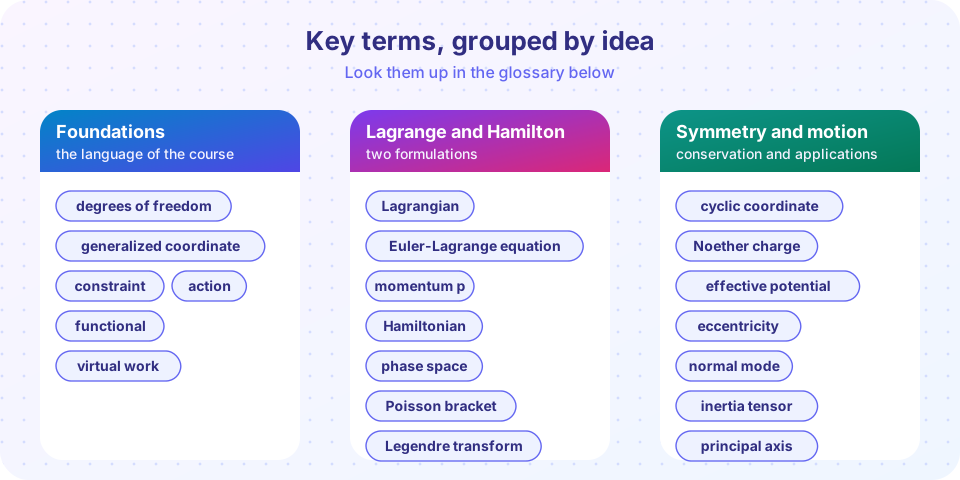
Mechanics has a lot of vocabulary, and many terms look alike (momentum, conjugate momentum, canonical momentum). This glossary gives a one-line meaning and the typical symbol for each term in the course, grouped by the three zones of the map below. Use the interactive lookup after the table to search it or to quiz yourself.
What you will learn
- The precise meaning of the course's key terms.
- Which terms belong together (for example
action,functional,Euler-Lagrange equation). - How to test yourself on definitions.
The terms
| Term | Meaning |
|---|---|
Action S |
the number S = ∫ L dt assigned to a path; real motion makes it stationary |
Angular momentum ℓ, L |
r × p; for a central force it is constant, ℓ = μr²θ̇ |
| Canonical transformation | a change (q, p) → (Q, P) that keeps {Q, P} = 1 and the form of Hamilton's equations |
| Center of mass | the weighted mean position R = Σ mᵢrᵢ/M; it moves as if all mass sat there |
| Central force | a force along the line to a fixed center, depending only on distance |
Conjugate momentum pᵢ |
∂L/∂q̇ᵢ; the partner of coordinate qᵢ |
| Constraint | a restriction on the motion, such as a rod of fixed length |
| Cyclic coordinate | a coordinate missing from L; its conjugate momentum is conserved |
| Degrees of freedom | the number of independent coordinates needed to specify a configuration |
Eccentricity e |
the shape of a conic: 0 circle, < 1 ellipse, 1 parabola, > 1 hyperbola |
| Effective potential | V_eff = ℓ²/(2μr²) + V(r); turns the radial motion into a 1D problem |
Energy function h |
Σ q̇ p − L; conserved when ∂L/∂t = 0; equals T + V for time-independent constraints |
| Equilibrium | a configuration where all generalized forces vanish |
| Euler-Lagrange equation | d/dt(∂L/∂q̇) − ∂L/∂q = 0, one per coordinate |
| Euler's equations | I₁ω̇₁ = (I₂ − I₃)ω₂ω₃ and cyclic permutations; torque-free rigid-body rotation |
| Functional | a rule that gives a number for each function, such as the action |
Generalized coordinate qᵢ |
any set of independent variables that fixes the configuration |
| Generalized force | Qᵢ; the force associated with coordinate qᵢ (−∂V/∂qᵢ if conservative) |
| Generating function | a function such as F₁(q, Q) or F₂(q, P) that produces a canonical transformation |
Hamiltonian H |
Σ pq̇ − L as a function of q, p, t |
| Hamilton's equations | q̇ = ∂H/∂p, ṗ = −∂H/∂q |
| Holonomic constraint | a constraint of the form f(q, t) = 0, which removes a degree of freedom |
Inertia tensor I |
the symmetric matrix Iᵢⱼ = Σ m(r²δᵢⱼ − rᵢrⱼ) linking ω and L |
| Kepler's laws | ellipses with the Sun at a focus; equal areas in equal times; T² ∝ a³ |
| Lagrange multiplier | an extra variable that enforces a constraint and measures the constraint force |
Lagrangian L |
T − V |
| Legendre transform | replaces a function of a variable by a function of its slope: L(q̇) → H(p) |
| Liouville's theorem | Hamiltonian flow preserves phase-space volume |
| Noether charge | Q = Σ pK − F, the conserved quantity from a symmetry |
| Noether's theorem | every continuous symmetry of the action gives a conserved quantity |
| Normal mode | a motion where all coordinates oscillate at one frequency with a fixed pattern |
| Phase space | the space of all (q, p) pairs |
Poisson bracket {f, g} |
Σ(∂f/∂q ∂g/∂p − ∂f/∂p ∂g/∂q); ḟ = {f, H} + ∂f/∂t |
| Principal axis | an eigenvector of the inertia tensor; L ∥ ω along it |
Reduced mass μ |
m₁m₂/(m₁ + m₂) |
| Runge-Lenz vector | A = p × L − μk r̂, conserved for the inverse-square force |
| Separatrix | the phase-space curve that divides different kinds of motion |
| Symplectic | preserving the bracket and phase-space area; applies to integrators and transformations |
| Turning point | a radius or position where the velocity vanishes (E = V_eff) |
| Virtual work | the work done by forces in an imagined small displacement that respects the constraints |
| Vis-viva equation | v² = GM(2/r − 1/a) |
Try it
Search the glossary or press Quiz me: it shows a definition and you guess the term, then reveal the answer. The list in the code is a condensed copy of the table above. This tool is only a study aid.
Check your understanding
Quick check · 5 questions
of 5 answered You scored / 5 · perfect!
-
1. Which term means 'a coordinate that does not appear in L'?
Its conjugate momentum is conserved. -
2. What is the effective potential for a central force?
It adds the centrifugal term to the real potential. -
3. Which pair is correctly matched?
L = T − V and the action is ∫ L dt. -
4. What does a symplectic transformation preserve?
That is the defining property. -
5. An eigenvector of the inertia tensor is called...
Eigenvectors of I are the principal axes; the eigenvalues are the principal moments.
Summary
- Terms come in families: action, functional and Euler-Lagrange; momentum, Hamiltonian and Poisson bracket; cyclic coordinate, Noether charge and effective potential.
- When a word looks unfamiliar, find its family first.
Next: Cheat sheet
Track your progress
Create a free account to tick off lessons and pick up where you left off on any device.
of Classical Mechanics: Lagrangian and Hamiltonian lessons completed