


















Lesson 11 of 44 · Calculus of Variations
Calculus of Variations Overview: Optimizing Whole Paths
Meet the central idea of chapter 3: choosing a whole function, not a number, to make an integral stationary. Includes a roadmap and a first numerical experiment.
Ordinary calculus finds the number x that makes a function f(x) smallest. The calculus of variations finds the function y(x) that makes an integral smallest. What is the shortest curve between two points? Which curve makes a ball roll down fastest? What shape does a hanging chain take? These questions from the 1600s gave birth to a theory that, a century later, Lagrange and Euler used to rebuild mechanics.
What you will learn
- What a functional is and how it differs from a function.
- What "stationary" means for a functional.
- How the four lessons of this chapter fit together.
Key terms. A functional S[y] assigns a number to a whole function y(x). An extremal is a function that makes S stationary. A variation δy = ε η(x) is a small change of the function with fixed endpoints. The action is the functional of mechanics.
Functions versus functionals
A function takes a number and returns a number: f(x) = x². A functional takes a function and returns a number. The arc length of the curve y(x) from x = a to x = b is
S[y] = ∫ₐᵇ √(1 + y′²) dx
Give it y = x on [0, 1] and you get √2; give it y = x² and you get a different number. The question "which y gives the smallest S?" is a problem in the calculus of variations.
The central idea
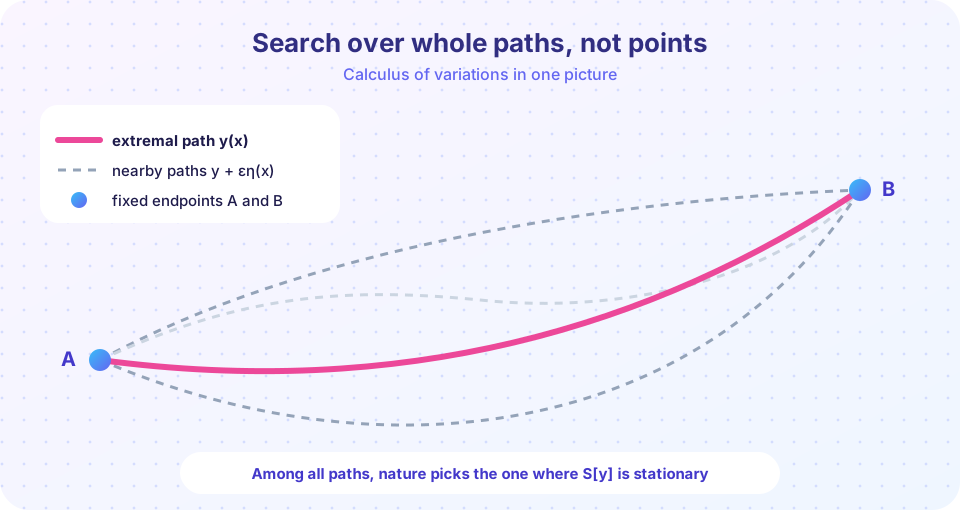
At a minimum of an ordinary function, the first derivative is zero: tiny changes in x do not change f to first order. In the same spirit, an extremal y(x) is a function where tiny changes in the path, written y + ε η(x), leave S unchanged to first order in ε:
dS/dε at ε = 0 equals 0 for every admissible η(x)
The requirement that this hold for every wiggle η is very strong, and it produces a differential equation for y, the Euler-Lagrange equation. In mechanics the integrand is L = T − V, the functional is the action S = ∫ L dt, and the extremal path is the true motion.
The plan for the chapter
Chapter 3 roadmap
Classic problems
Constraints
- Functionals and the Euler-Lagrange Equation: the derivation and first examples.
- Brachistochrone and Shortest Paths: two classic problems solved.
- Constraints, Multipliers and the Catenary: problems with a side condition.
- Chapter 3 Review.
Try it
Numbers first. Evaluate the arc-length functional on a family of curves from (0, 0) to (1, 1): the straight line plus a bump ε sin(πx) that vanishes at both ends. The straight line should give the smallest value.
Press Run (or Ctrl + Enter) to see the result here.
Program input · what you'd type while the program runs
Type the answers before you press Run, one per line. Each time the program reads a line (with input()), it gets the next line from this box.
Notice that the curve of S(ε) is flat at ε = 0 and rises on both sides: that flatness is the "stationary" condition. A second experiment evaluates two different functionals on three candidate functions.
Press Run (or Ctrl + Enter) to see the result here.
Program input · what you'd type while the program runs
Type the answers before you press Run, one per line. Each time the program reads a line (with input()), it gets the next line from this box.
Check your understanding
Quick check · 4 questions
of 4 answered You scored / 4 · perfect!
-
1. What does a functional take as input?
A functional maps a function, such as a path y(x), to a number. -
2. What is the arc length of y = x on [0, 1]?
∫₀¹ √(1 + 1²) dx = √2. -
3. In the variation y + εη(x), what must η satisfy for fixed endpoints?
All varied paths must start and end at the same two points. -
4. In mechanics, which functional is made stationary by the true motion?
Hamilton's principle says the action is stationary along the actual path.
Summary
- A functional assigns a number to a whole function; an extremal makes it stationary.
- Stationary means the first-order change under
y → y + εηvanishes for everyηwith fixed endpoints. - This idea gives differential equations (Euler-Lagrange) and, with
L = T − V, Lagrangian mechanics.
Track your progress
Create a free account to tick off lessons and pick up where you left off on any device.
of Classical Mechanics: Lagrangian and Hamiltonian lessons completed