


















Lesson 31 of 44 · Central Forces and Orbits
The Effective Potential and the Orbit Equation
Reduce the two-body problem to one body, use conserved angular momentum to build the effective potential, derive Kepler's second law and the Binet orbit equation.
Two bodies attracting each other look like a six-dimensional problem: three coordinates for each. Three steps shrink it to one equation. First separate the center-of-mass motion, which is trivial. Second use angular momentum conservation to flatten the motion into a plane and remove the angle. Third fold the leftover angular term into an effective potential. What remains is a one-dimensional problem in the distance r, which you can read like an energy diagram.
This lesson carries out those three steps for any central force, derives Kepler's second law along the way, and ends with the orbit equation that gives the path r(θ) directly.
What you will learn
- How the two-body problem reduces to one body with reduced mass
μ. - Why angular momentum
ℓis conserved and what it implies for areas. - How to build and read
V_eff(r). - How to derive the orbit equation and test circular-orbit stability.
Key terms
Reduced mass: μ = m₁m₂/(m₁ + m₂).
Angular momentum: ℓ = μ r² θ̇, constant for a central force.
Effective potential: V_eff(r) = ℓ²/(2μr²) + V(r).
Turning point: a radius where E = V_eff(r), so the radial velocity is zero.
From two bodies to one
Let two masses m₁ and m₂ sit at positions r₁ and r₂, with a potential that depends only on their separation V(|r₂ − r₁|). Define the center of mass R = (m₁r₁ + m₂r₂)/M with M = m₁ + m₂, and the relative position r = r₂ − r₁. The kinetic energy separates:
T = ½ M Ṙ² + ½ μ ṙ², μ = m₁m₂ / (m₁ + m₂)
The Lagrangian is L = ½MṘ² + ½μṙ² − V(r). The coordinates R do not appear in L, so they are cyclic: the center of mass moves uniformly. What is left is a single particle of mass μ moving in the potential V(r) around a fixed center. For a planet orbiting the Sun, μ is almost exactly the planet's mass, because the Sun is so much heavier.
Angular momentum and the plane
For a central force the relative position, velocity and force all lie in the plane defined by the initial r and ṙ. The orbit is flat. Use polar coordinates (r, θ) in that plane:
L = ½μ(ṙ² + r²θ̇²) − V(r)
The angle θ is cyclic, so
ℓ = ∂L/∂θ̇ = μ r² θ̇ is constant
Kepler's second law
The area swept out by the line from the center to the body is dA = ½ r² dθ. Therefore
dA/dt = ½ r² θ̇ = ℓ / (2μ) = constant
Equal areas are swept in equal times. This is Kepler's second law, and it holds for every central force, not only for gravity.
The effective potential
The radial Euler-Lagrange equation is
μ r̈ = μ r θ̇² − V'(r)
Eliminate θ̇ with θ̇ = ℓ/(μr²):
μ r̈ = ℓ²/(μ r³) − V'(r) = −d/dr [ ℓ²/(2μr²) + V(r) ]
So the radial motion is exactly that of a one-dimensional particle in the effective potential
V_eff(r) = ℓ²/(2μr²) + V(r)
The first term is the centrifugal barrier: it grows without limit as r → 0 and keeps the body away from the center (unless ℓ = 0). The energy is
E = ½ μ ṙ² + V_eff(r)
and the body can only be where E ≥ V_eff(r).
Reading the diagram
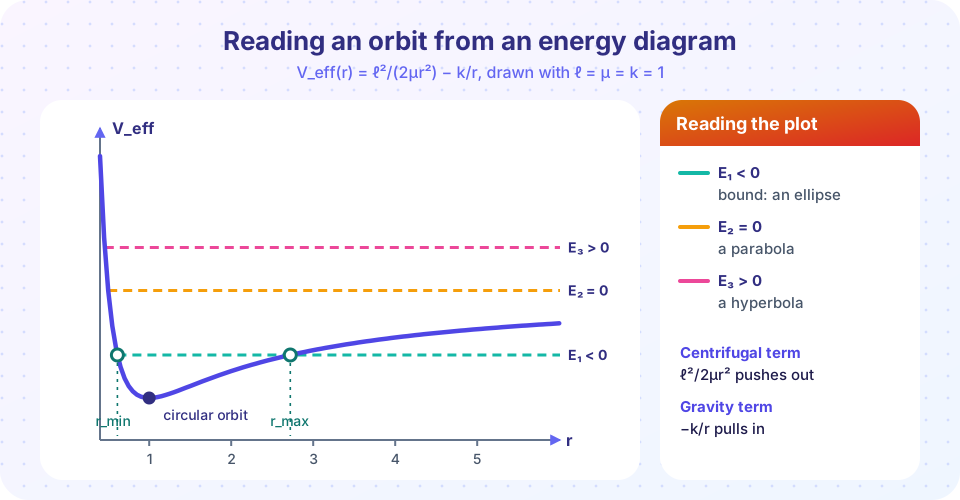
For gravity (V = −k/r), V_eff has a single minimum. Draw a horizontal line at the energy E:
Eat the bottom of the well:rcannot change, so the orbit is a circle.E < 0above the bottom:roscillates between two turning pointsr_minandr_max, a bound orbit.E ≥ 0: the line meets the curve only once; the body comes in, turns atr_minand leaves forever, unbound.
The picture classifies orbits without solving anything.
Stability of circular orbits
A circular orbit sits at a minimum of V_eff. The condition V_eff'(r₀) = 0 gives ℓ²/(μr₀³) = V'(r₀), which is just centripetal force equal to attraction. It is stable if V_eff''(r₀) > 0. For a power-law force F = −k rⁿ (attractive for k > 0) the second derivative at the circular radius is k r₀ⁿ⁻¹(3 + n). So circular orbits are stable if n > −3. Gravity has n = −2 and a Hooke spring has n = 1, both stable.
The orbit equation
Usually you want the path r(θ) rather than r(t). Substitute u = 1/r. From θ̇ = ℓu²/μ:
ṙ = −(ℓ/μ) du/dθ, r̈ = −(ℓ²u²/μ²) d²u/dθ²
Put these into the radial equation, with the force F(r) = −V'(r):
d²u/dθ² + u = − μ F(1/u) / (ℓ² u²)
This is the Binet equation. For gravity, F = −k/r² = −ku², and the right side becomes the constant μk/ℓ²:
d²u/dθ² + u = μk/ℓ² → u = (μk/ℓ²)(1 + e cos(θ − θ₀))
That is a conic section with focus at the center. The next lesson explores it fully.
For other power laws the orbits are generally not closed. Bertrand's theorem says that only the inverse-square law (F ∝ 1/r²) and the linear Hooke law (F ∝ r) give closed orbits for all bound motions. A slightly different exponent produces an orbit that keeps turning: it precesses, drawing a rosette.
Common misconceptions
- "The centrifugal force is a real force." In the radial equation it is just the angular term moved to the other side. It appears in the rotating description; in an inertial frame the body simply wants to go straight.
- "
V_effis the potential energy." It is the potential energy plus the angular part of the kinetic energy. The total energy is½μṙ² + V_eff. - "A bound orbit must be an ellipse." Only for forces like
1/r²(and Hooke's law). Other bound orbits are rosettes.
Try it
The first TryIt builds V_eff for gravity (units with μ = k = 1) for ℓ = 1, picks three energies, solves for the turning points from 2E r² + 2r − ℓ² = 0, and checks the ellipse relations: a = (r_min + r_max)/2 = −k/(2E) and e = (r_max − r_min)/(r_max + r_min). The prints are computed values, not fitted ones.
Press Run (or Ctrl + Enter) to see the result here.
Program input · what you'd type while the program runs
Type the answers before you press Run, one per line. Each time the program reads a line (with input()), it gets the next line from this box.
The second TryIt tests Bertrand's theorem numerically. It integrates a body in the force F = −k/r^α (m = 1, k = 1) from r = 1 with tangential speed 0.9. With α = 2 the orbit is a closed ellipse. With α = 2.15 it is not closed, and the pericenter turns around the center. The code also reports how much ℓ changes (it should not). This is a simulation with a numerical integrator, so the angular momentum is constant to the integration accuracy.
Press Run (or Ctrl + Enter) to see the result here.
Program input · what you'd type while the program runs
Type the answers before you press Run, one per line. Each time the program reads a line (with input()), it gets the next line from this box.
The last TryIt checks the Binet equation symbolically. It confirms that u(θ) = (μk/ℓ²)(1 + e cosθ) solves u'' + u = μk/ℓ², and that the same equation for the exponent n in F = −k rⁿ yields the stability condition n > −3.
Press Run (or Ctrl + Enter) to see the result here.
Program input · what you'd type while the program runs
Type the answers before you press Run, one per line. Each time the program reads a line (with input()), it gets the next line from this box.
Check your understanding
Quick check · 6 questions
of 6 answered You scored / 6 · perfect!
-
1. What is the reduced mass of two equal masses m?
μ = m·m/(m + m) = m/2. -
2. Kepler's second law (equal areas in equal times) follows from which conservation law?
dA/dt = ℓ/(2μ), so a constant ℓ means a constant areal speed. It holds for every central force. -
3. What does the centrifugal term ℓ²/(2μr²) do?
It diverges as r → 0, so a body with ℓ ≠ 0 cannot reach the center. -
4. At a turning point of the radial motion...
E = ½μṙ² + V_eff, so ṙ = 0 exactly where E = V_eff(r). -
5. For a force F = −k rⁿ, circular orbits are stable when...
V_eff'' at the circular radius is k r₀ⁿ⁻¹(3 + n). -
6. The Binet equation for gravity reduces to which equation for u = 1/r?
F = −ku², so the right-hand side becomes the constant μk/ℓ².
Summary
- Separating the center of mass leaves one body of reduced mass
μ; the angle is cyclic, soℓ = μr²θ̇is constant. - Equal areas in equal times (
dA/dt = ℓ/2μ) holds for every central force. V_eff = ℓ²/(2μr²) + V(r)turns the radial motion into a 1D energy-diagram problem.- The Binet equation
u'' + u = −μF(1/u)/(ℓ²u²)gives the path; for gravity it is a conic section.
Next: The Kepler problem
Track your progress
Create a free account to tick off lessons and pick up where you left off on any device.
of Classical Mechanics: Lagrangian and Hamiltonian lessons completed