


















Lesson 18 of 44 · Lagrangian Mechanics
Worked Examples: Atwood Machine and Bead on a Rotating Hoop
Apply the five-step Lagrangian recipe to an Atwood machine and a bead on a rotating hoop, recover the tension afterwards, and explain the hoop's bifurcation with an effective potential.
A method is only as good as the problems it solves. This lesson walks through two classical examples in full detail, each with a single generalized coordinate: the Atwood machine, a "textbook" system where Lagrange's method is quicker than Newton's, and the bead on a rotating hoop, where the method reveals physics (a change of equilibrium) that is hidden in the force picture. We also see how to get the constraint force back when you want it.
What you will learn
- How to carry out the five steps on two classical systems.
- How a time-dependent constraint changes the kinetic energy.
- How to recover the string tension after solving.
- How an effective potential explains the hoop's change of equilibrium.
Key terms
An ideal pulley is massless and frictionless. A rheonomic constraint depends on time (a hoop forced to rotate). An effective potential V_eff(q) combines the real potential with centrifugal-like terms so the motion looks like a particle in a 1D well.
Example 1: The Atwood machine
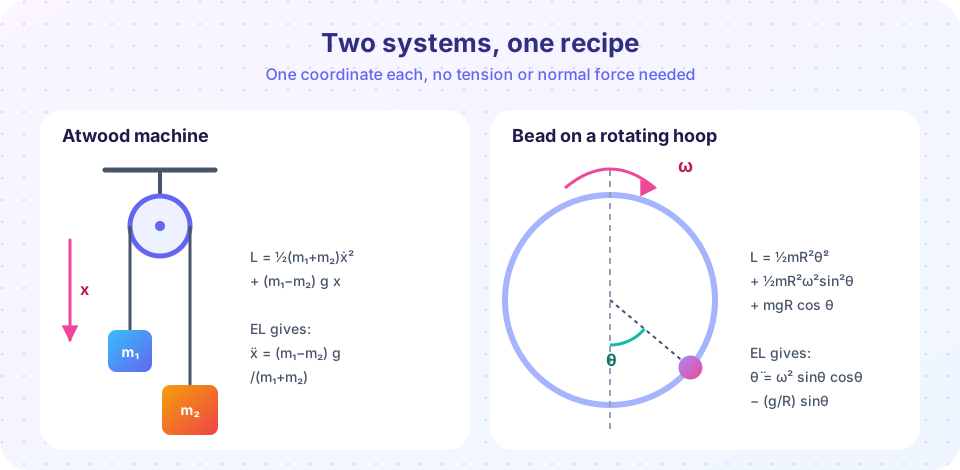
Two masses m₁ and m₂ hang from a light cord over an ideal pulley. The cord has fixed length, so one coordinate is enough: let x be the downward position of m₁. Then m₂ is at ℓ − x below the pulley's top (with ℓ the constant cord length used).
- Coordinate:
x. - Kinetic energy:
T = ½ m₁ ẋ² + ½ m₂ ẋ² = ½ (m₁ + m₂) ẋ². - Potential energy (heights measured downward from the pulley):
V = −m₁ g x − m₂ g (ℓ − x). So
L = ½ (m₁ + m₂) ẋ² + (m₁ − m₂) g x + constant
- Lagrange equation:
∂L/∂ẋ = (m₁ + m₂) ẋand∂L/∂x = (m₁ − m₂) g, so(m₁ + m₂) ẍ = (m₁ − m₂) g, giving
ẍ = (m₁ − m₂) g / (m₁ + m₂)
Check. For m₁ = 3 kg and m₂ = 1 kg: ẍ = 2g/4 = 4.905 m/s². For equal masses ẍ = 0, as you would expect.
Tension afterwards. Newton's law for m₂ gives T − m₂ g = m₂ a_up, where a_up = ẍ (it rises as m₁ falls). So T = m₂ (g + ẍ) = 2 m₁ m₂ g/(m₁ + m₂). For our masses T = 2·3·1·9.81/4 = 14.715 N. The Lagrangian never needed it.
Example 2: A bead on a rotating hoop
A bead of mass m slides without friction on a vertical circular hoop of radius R, which rotates at constant angular speed ω about its vertical diameter. Take θ as the angle measured from the bottom.
- Coordinate:
θ(the hoop's rotation angle isωt, not a coordinate; it is prescribed). - Kinetic energy: the bead has speed
R θ̇along the hoop andR sin θ · ωaround the axis, at right angles, soT = ½ m R² θ̇² + ½ m R² ω² sin² θ. - Potential energy: height above the bottom is
R(1 − cos θ), soV = −m g R cos θ(up to a constant) and
L = ½ m R² θ̇² + ½ m R² ω² sin² θ + m g R cos θ
- Lagrange equation:
∂L/∂θ̇ = m R² θ̇and∂L/∂θ = m R² ω² sin θ cos θ − m g R sin θ, so
θ̈ = ω² sin θ cos θ − (g/R) sin θ = sin θ ( ω² cos θ − g/R )
- Equilibria:
θ̈ = 0whensin θ = 0(bottom and top) orcos θ = g/(R ω²), which exists only ifω² > g/R. This confirms the critical speedω_c = √(g/R)from lesson 1.2.
The hoop's rotation is a time-dependent constraint, so the kinetic energy of the bead contains the extra term ½ m R² ω² sin² θ. Total energy T + V is not conserved, but a related quantity, the Jacobi energy h = T₂ − T₀ + V, is (chapter 5).
The effective potential
Write the equation as m R² θ̈ = −dV_eff/dθ with
V_eff(θ) = −m g R cos θ − ½ m R² ω² sin² θ
For ω < ω_c it has one minimum at θ = 0; for ω > ω_c the bottom becomes a maximum and two symmetric minima appear at cos θ = g/(R ω²): a pitchfork bifurcation.
Numbers for the Atwood machine
Let m₁ = 3 kg and m₂ = 1 kg hang over an ideal pulley. The Lagrangian equation gives (m₁ + m₂) ẍ = (m₁ − m₂) g, so
a = (3 − 1)/(3 + 1) · 9.81 = 4.905 m/s² T = 2 m₁ m₂ g/(m₁ + m₂) = 14.715 N
The acceleration is exactly g/2, and the string tension (found by going back to Newton for one mass: T = m₁(g − a)) lies between the two weights, 29.43 N and 9.81 N. If the masses are equal, a = 0; if m₂ → 0, a → g. George Atwood built the machine in 1784 at Cambridge to test Newton's laws with slow, measurable accelerations. The Lagrangian itself never contains T: it appears only when you return to Newton for the string force, which is the price of hiding the constraint.
Numbers for the rotating hoop
For a hoop of radius R = 0.5 m spinning at ω = 8 rad/s, the critical rate is √(g/R) = 4.43 rad/s, so we are above it and the bead settles at cos θ₀ = g/(ω²R) = 9.81/32 = 0.307, θ₀ = 72.1° from the bottom. Small oscillations about that point have frequency ω sin θ₀ = 8 · 0.952 = 7.61 rad/s. This follows by linearizing θ̈ = ω² sin θ cos θ − (g/R) sin θ about θ₀: the derivative is ω²(cos²θ₀ − sin²θ₀) − (g/R) cos θ₀, and substituting g/R = ω² cos θ₀ leaves −ω² sin²θ₀. Below the critical speed the bottom is the only stable point and the frequency there is √(g/R − ω²), which tends to zero as ω approaches √(g/R): the bead becomes sluggish exactly where it is about to become unstable (a pitchfork bifurcation).
How to attack any new problem
- Draw the system and choose the fewest independent coordinates.
- Write
Tusing velocities in those coordinates; writeV. - Form
L = T − Vand applyd/dt(∂L/∂q̇) − ∂L/∂q = 0for eachq. - Check limits (zero mass, no rotation, small angle) against what you know.
- Only now return to Newton for any force you actually need, such as a tension.
Common misconceptions
"The Lagrangian must include the hoop's rotation as a coordinate." The hoop's angle is imposed from outside; only the bead's motion relative to the hoop is unknown, so θ is the only coordinate.
"If I ignore the normal force, I cannot know it." You can recover it afterwards: with θ(t) known, plug into Newton's law along the directions that were omitted.
"Energy T + V is always conserved for the Lagrangian T − V." Not when the constraint depends on time, as the rotating hoop shows.
Try it
Let SymPy repeat the derivations. We reuse the little helper from the overview.
Press Run (or Ctrl + Enter) to see the result here.
Program input · what you'd type while the program runs
Type the answers before you press Run, one per line. Each time the program reads a line (with input()), it gets the next line from this box.
Now the effective potential of the hoop for three rotation speeds. Below the critical speed the bottom is the only minimum; above it two minima appear.
Press Run (or Ctrl + Enter) to see the result here.
Program input · what you'd type while the program runs
Type the answers before you press Run, one per line. Each time the program reads a line (with input()), it gets the next line from this box.
Check your understanding
Quick check · 5 questions
of 5 answered You scored / 5 · perfect!
-
1. For an Atwood machine with m₁ = 3 kg and m₂ = 1 kg, what is the acceleration (g = 9.81 m/s²)?
a = (m₁ − m₂)g/(m₁ + m₂) = 2·9.81/4 = 4.905 m/s². -
2. Why is the Atwood machine a one-coordinate problem?
Fixing the cord length ties the two positions together. -
3. In the rotating-hoop Lagrangian, where does the ½mR²ω² sin²θ term come from?
The bead moves around the axis at distance R sin θ with angular speed ω. -
4. At what θ do the new equilibria of the hoop appear when ω > ω_c?
θ̈ = 0 requires ω² cos θ = g/R. -
5. Is T + V constant for the bead on the rotating hoop?
The motor that spins the hoop adds or removes energy through the constraint force.
Summary
- Atwood machine:
L = ½(m₁ + m₂)ẋ² + (m₁ − m₂) g x, givingẍ = (m₁ − m₂)g/(m₁ + m₂). - Rotating hoop:
L = ½mR²θ̇² + ½mR²ω² sin²θ + mgR cos θ, givingθ̈ = sin θ (ω² cos θ − g/R). - Constraint forces can be recovered afterwards from Newton's law.
- The effective potential explains the pitchfork bifurcation at
ω_c = √(g/R).
Next: Generalized Momentum and Velocity-Dependent Potentials
Track your progress
Create a free account to tick off lessons and pick up where you left off on any device.
of Classical Mechanics: Lagrangian and Hamiltonian lessons completed