


















Lesson 19 of 44 · Lagrangian Mechanics
Generalized Momentum and Velocity-Dependent Potentials
Define generalized (canonical) momentum, see cyclic coordinates, and derive the Lorentz force from the Lagrangian L = ½mv² − qφ + q v·A, with a cyclotron and E×B drift simulation.
So far the potential V depended only on position. Nature also has forces that depend on velocity, the magnetic force being the most important. The Lagrangian method handles them with a small generalization: a potential that is allowed to depend on q̇. Along the way we meet a quantity that will dominate the rest of the course: the generalized momentum.
What you will learn
- The definition of generalized momentum
pⱼ = ∂L/∂q̇ⱼand examples. - What a cyclic (ignorable) coordinate is, and why it gives a conserved momentum.
- The Lagrangian of a charged particle, and how it gives the Lorentz force.
- How cyclotron motion and the
E × Bdrift come out of simulation.
Key terms
The generalized (conjugate) momentum of coordinate qⱼ is pⱼ = ∂L/∂q̇ⱼ. A cyclic coordinate is one that does not appear in L. Scalar potential φ and vector potential A give E = −∇φ − ∂A/∂t and B = ∇ × A. The Lorentz force is F = q (E + v × B).
Generalized momentum
For every coordinate qⱼ define pⱼ = ∂L/∂q̇ⱼ. Lagrange's equation can then be read as
dpⱼ/dt = ∂L/∂qⱼ
The momentum changes only if L depends on that coordinate. If it does not (a cyclic coordinate), pⱼ is conserved: that is the seed of Noether's theorem (chapter 5).
Examples.
- A particle on a line with
L = ½ m ẋ² − V(x):p = m ẋ, the ordinary momentum. - A free particle in polar coordinates,
L = ½ m (ṙ² + r² θ̇²):p_r = m ṙ,p_θ = m r² θ̇, the angular momentum.θis cyclic, sop_θis conserved. - The pendulum,
L = ½ m l² θ̇² + m g l cos θ:p_θ = m l² θ̇, angular momentum about the pivot (not conserved, sinceθappears inL).
Generalized momenta need not have the units of momentum: p_θ has units of angular momentum.
Velocity-dependent potentials
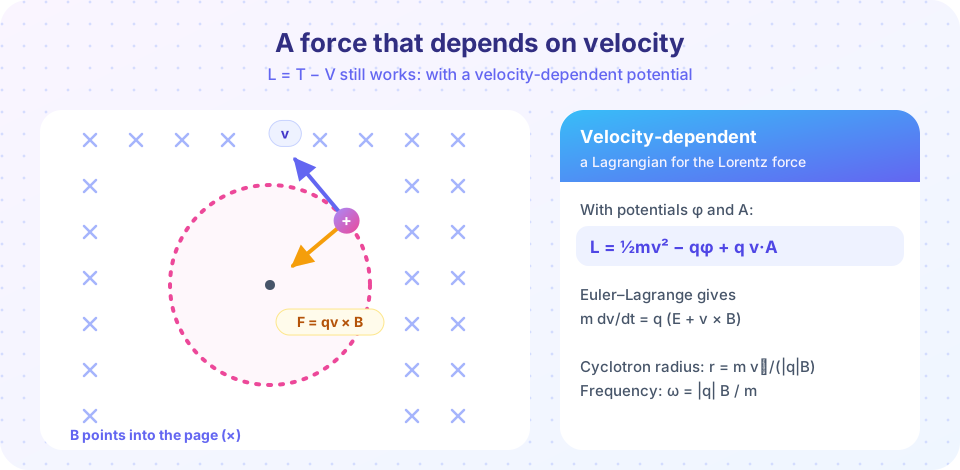
Newton's second law with the Lorentz force is m v̇ = q (E + v × B). The Lagrangian that produces it is
L = ½ m v² − q φ + q v · A
Here φ and A are functions of position and time. The "potential energy" U = q φ − q v · A now contains the velocity. The Lagrange equations still work because they only need L(q, q̇, t).
Derivation (x component). ∂L/∂ẋ = m ẋ + q Aₓ, so
d/dt(∂L/∂ẋ) = m ẍ + q (∂Aₓ/∂t + v · ∇Aₓ)
∂L/∂x       = −q ∂φ/∂x + q v · ∂A/∂x
Setting them equal and rearranging:
m ẍ = q ( −∂φ/∂x − ∂Aₓ/∂t ) + q ( v · ∂A/∂x − v · ∇Aₓ )
The first bracket is q Eₓ. The second equals the x component of q v × (∇ × A) = q v × B, by the vector identity for a triple product. So m v̇ = q (E + v × B).
Notice that the generalized momentum is no longer m v. It is the canonical momentum
p = m v + q A
and it is p, not m v, that appears in quantum mechanics (as −iħ∇) and in Hamiltonian mechanics (chapter 6).
Cyclotron motion
In a uniform magnetic field B = B ẑ, use the symmetric gauge A = (−B y/2, B x/2, 0). A charge with velocity perpendicular to B circles with
radius r = m v⊥ / (|q| B) angular frequency ω = |q| B / m
The frequency does not depend on the speed. This is the principle of the cyclotron accelerator.
If an electric field E is added perpendicular to B, the circular motion drifts at speed E/B in the direction E × B/B², independent of charge and mass.
Numbers for a proton in a magnetic field
Let a proton (q = 1.602×10⁻¹⁹ C, m = 1.673×10⁻²⁷ kg) move at 10⁶ m/s perpendicular to a uniform field B = 0.5 T. The cyclotron frequency is ω = qB/m = 4.79×10⁷ rad/s, that is 7.62 MHz, independent of speed. The radius is r = mv/(qB) = 0.0209 m, about 2 cm. Double the speed and the radius doubles while the frequency stays put, which is the principle behind Ernest Lawrence's cyclotron (1930s): the accelerating field can be driven at a fixed frequency while particles spiral outward.
Canonical versus kinetic momentum
In a magnetic field the Lagrangian is L = ½ m v² + q v·A − qφ. The conjugate momentum is p = ∂L/∂v = m v + q A. This is not m v. For a uniform B along z one choice is A = ½ B × r, so A = ½ B (−y, x, 0). By symmetry the canonical angular momentum p_φ = m r² φ̇ + ½ q B r² is conserved (the system is unchanged by rotation about the axis), even though the kinetic angular momentum m r² φ̇ alone is not conserved when the particle moves in and out. Which A you pick is a matter of gauge: replacing A by A + ∇χ changes p but not the motion, because L changes by a total time derivative. Only m v is gauge-invariant and measurable.
The Lorentz force from L
Differentiate L as in the lesson: d/dt(m v + q A) = q ∇(v·A) − q ∇φ. Using dA/dt = ∂A/∂t + (v·∇)A and the identity ∇(v·A) − (v·∇)A = v × (∇ × A) gives m dv/dt = q(−∇φ − ∂A/∂t) + q v × (∇ × A) = q(E + v × B). A magnetic force does no work: v · (v × B) = 0, so speed never changes in a pure magnetic field. In quantum mechanics the same structure survives as "minimal coupling", where p − qA takes the place of p.
Common misconceptions
"Generalized momentum is always m v." Only for simple Lagrangians. With a vector potential p = m v + q A, and for angular coordinates p is angular momentum.
"Magnetic forces do work." They do none; the force is perpendicular to the velocity. The speed of a particle in a pure magnetic field is constant.
"A velocity-dependent L breaks the Lagrangian method." It does not; the Euler-Lagrange equations hold for any L(q, q̇, t).
Try it
Let SymPy derive the equations of motion for a charge in a uniform magnetic field from L = ½ m v² + q v · A (with φ = 0).
Press Run (or Ctrl + Enter) to see the result here.
Program input · what you'd type while the program runs
Type the answers before you press Run, one per line. Each time the program reads a line (with input()), it gets the next line from this box.
Now a proton in B = 0.5 T with an electric field E = 1×10⁵ V/m perpendicular to B. We check the cyclotron radius and the drift speed against the formulas.
Press Run (or Ctrl + Enter) to see the result here.
Program input · what you'd type while the program runs
Type the answers before you press Run, one per line. Each time the program reads a line (with input()), it gets the next line from this box.
Check your understanding
Quick check · 6 questions
of 6 answered You scored / 6 · perfect!
-
1. The generalized momentum of coordinate q is:
pⱼ = ∂L/∂q̇ⱼ. -
2. For a free particle in polar coordinates, what is the momentum conjugate to θ?
p_θ = ∂L/∂θ̇ = m r² θ̇, the angular momentum. -
3. Which Lagrangian gives the Lorentz force on a charge q?
That is the standard Lagrangian with scalar potential φ and vector potential A. -
4. A proton moves perpendicular to B = 0.5 T. How does its cyclotron frequency change if its speed doubles?
ω = qB/m does not depend on speed (the radius doubles instead). -
5. A charge moves in crossed fields E ⟂ B. It drifts at speed:
The E × B drift speed is E/B, independent of q and m. -
6. Why does a magnetic force do no work?
Power = F · v = q (v × B) · v = 0.
Summary
- Generalized momentum is
pⱼ = ∂L/∂q̇ⱼ; Lagrange's equation saysṗⱼ = ∂L/∂qⱼ, so cyclic coordinates have conserved momenta. L = ½ m v² − q φ + q v · Ayieldsm v̇ = q (E + v × B); the canonical momentum ism v + q A.- Cyclotron frequency
ω = |q| B / m, radiusm v⊥ /(|q| B), drift speedE/B. - Velocity-dependent potentials fit into the Lagrangian method without change.
Next: Chapter 4 Review
Track your progress
Create a free account to tick off lessons and pick up where you left off on any device.
of Classical Mechanics: Lagrangian and Hamiltonian lessons completed