


















Lesson 7 of 44 · Newtonian Mechanics Revisited
Systems of Particles and the Center of Mass
Derive how internal forces cancel in a system of particles, how the center of mass moves, and how total momentum, angular momentum and energy split into two parts.
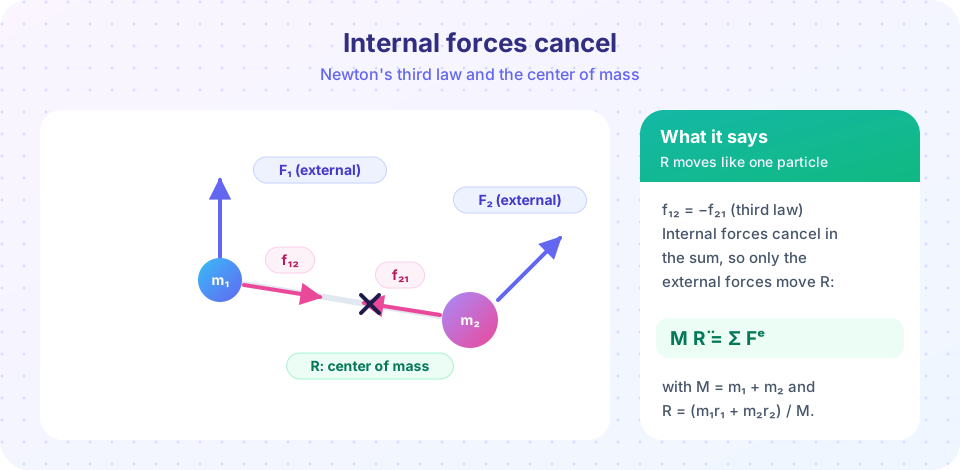
A rigid body, a gas cloud, a pair of planets and a spinning wrench are all collections of particles. We almost never track each one. Newton's third law lets us treat the group as if it were a single particle located at its center of mass, and it separates the motion of the whole from the motion inside. The same split will return in chapters 7 and 8, where it is the key to two-body orbits and rigid-body rotation.
What you will learn
- How to separate forces into internal and external.
- Why the center of mass obeys
M R̈ = Σ Fᵉ. - How total angular momentum and kinetic energy split into "center of mass" and "relative" parts.
- How to check these facts in a simulation.
Key terms
Key terms. Internal force: a force between two particles of the system. External force: a force from outside it. Center of mass: R = Σ mᵢ rᵢ / M with M = Σ mᵢ. Total momentum: P = Σ mᵢ vᵢ = M Ṙ.
Equations for N particles
For particle i, Newton's second law reads
mᵢ r̈ᵢ = Fᵢᵉ + Σⱼ≠ᵢ fᵢⱼ
where fᵢⱼ is the force on i caused by j. Add all N equations. The third law says fᵢⱼ = −fⱼᵢ, so the double sum of internal forces cancels in pairs:
Σᵢ mᵢ r̈ᵢ = Σᵢ Fᵢᵉ ⇒ M R̈ = Fᵉ_total
The center of mass moves exactly as a single particle of mass M under the total external force. A firework that explodes in midair keeps its center of mass on the same parabola, as long as air resistance is ignored, even though the fragments scatter. Internal forces can only redistribute momentum between particles, never change the total.
Worked example. Two particles, m₁ = 1 kg at x = 0 and m₂ = 2 kg at x = 0.9 m. Then R = (1·0 + 2·0.9)/3 = 0.6 m. The center of mass sits closer to the heavier body, at 0.3 m from m₂.
Angular momentum and energy split in two
Write rᵢ = R + rᵢ′, where rᵢ′ is the position relative to the center of mass. Using Σ mᵢ rᵢ′ = 0 the cross terms vanish, giving
L = R × P + Σ mᵢ rᵢ′ × vᵢ′ T = ½ M V² + Σ ½ mᵢ vᵢ′²
The first terms describe the system as a whole (the "orbital" part), and the second terms the motion about the center of mass (the "spin" or internal part). Chapter 7 applies this to a two-body problem and chapter 8 to rigid bodies.
If the torque of the external forces about the origin is τᵉ, then dL/dt = τᵉ, provided the internal forces obey the strong third law (they act along the line joining each pair), so they exert no net internal torque.
Worked examples with numbers
An explosion. A 3 kg shell moving horizontally at 20 m/s bursts into a 1 kg piece and a 2 kg piece. If the 1 kg piece flies off at 50 m/s in the same direction, momentum conservation (the burst forces are internal) gives 3 · 20 = 1 · 50 + 2 v, so v = 5 m/s. Check the center of mass: (1·50 + 2·5)/3 = 20 m/s, unchanged. The kinetic energy, however, jumps from ½·3·400 = 600 J to ½·1·2500 + ½·2·25 = 1275 J. Momentum is conserved because internal forces cancel in pairs, but energy is not: the chemical energy of the explosive supplied the extra 675 J. Internal forces can change energy, never momentum.
Splitting the energy. In the explosion the center-of-mass part is ½MV² = ½·3·20² = 600 J, unchanged, and the relative part rose from 0 to 675 J. Only the relative part is available to be converted: this is why colliding particles lose at most their relative kinetic energy, and why accelerator physicists work in the center-of-mass frame.
Why the third law matters
The cancellation fᵢⱼ = −fⱼᵢ is Newton's third law (1687). It fails for forces that do not obey it, such as the magnetic force between two moving charges (momentum then also sits in the fields), but for contact forces, springs and gravity it holds, and it is why Euler (1750s) could treat any extended body through its center of mass plus a rotation about it. Euler also formulated the angular-momentum equation dL/dt = τ as an independent principle, because it does not follow from the weak third law alone.
Checking your own results
- Compute
Rfrom the positions and masses. - Compute
P = M Ṙand compare withΣ mᵢ vᵢ. - If external forces vanish,
Pmust not change; if it does, there is an error (or an overlooked external force).
Common misconceptions
"Internal forces can accelerate the whole system." They cannot. A person inside a car cannot move it by pushing the dashboard: both forces are internal, and the center of mass is unchanged.
"The center of mass is always inside the object." A boomerang or a ring has its center of mass in empty space.
Try it
Two bodies joined by a spring fly through gravity, stretching and oscillating as they go. A numerical solution shows that each body follows a complicated path, but the center of mass traces the simple parabola R(t) = R₀ + V₀ t − ½ g t² ŷ.
Press Run (or Ctrl + Enter) to see the result here.
Program input · what you'd type while the program runs
Type the answers before you press Run, one per line. Each time the program reads a line (with input()), it gets the next line from this box.
The second example checks conservation numerically: random internal pair forces never change total momentum.
Press Run (or Ctrl + Enter) to see the result here.
Program input · what you'd type while the program runs
Type the answers before you press Run, one per line. Each time the program reads a line (with input()), it gets the next line from this box.
Check your understanding
Quick check · 5 questions
of 5 answered You scored / 5 · perfect!
-
1. Two particles have masses 1 kg and 3 kg at x = 0 and x = 4 m. Where is the center of mass?
R = (1·0 + 3·4)/4 = 3 m. -
2. What do internal forces do to the total momentum of a system?
By the third law internal forces cancel in pairs in the sum. -
3. Which law is used to cancel the internal forces?
fᵢⱼ = −fⱼᵢ makes the double sum vanish. -
4. A bomb explodes in mid-air. Ignoring air resistance, the center of mass of the fragments:
Only gravity, an external force, acts on the system's center of mass. -
5. The total kinetic energy is T = ½MV² + Σ ½ mᵢ vᵢ′². What do the primed velocities measure?
rᵢ′ = rᵢ − R, so vᵢ′ is velocity relative to the center of mass.
Summary
- For a system,
M R̈ = Fᵉ_total: internal forces cancel in pairs. P = M Ṙis conserved when the total external force is zero.LandTeach split into a center-of-mass part and a relative part.- Numerical simulations can check these results directly.
Track your progress
Create a free account to tick off lessons and pick up where you left off on any device.
of Classical Mechanics: Lagrangian and Hamiltonian lessons completed