


















Lesson 43 of 44 · Projects and Practice
Cheat Sheet: Lagrangian and Hamiltonian Mechanics
A one-page summary of the key formulas of Lagrangian and Hamiltonian mechanics, with units, sanity checks and quick calculators for orbits, oscillations and rotation.
Here is the whole course on one page. Keep the picture open when you solve problems, and use the tables below it when you need the exact statement, the units or the conditions under which a formula holds.
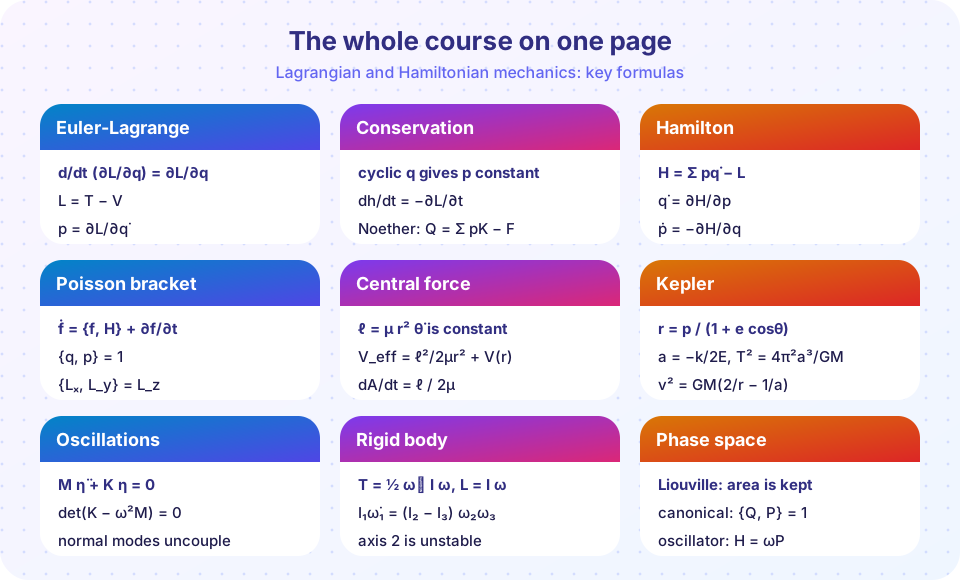
What you will learn
- Where each key formula applies and what its units are.
- A short list of checks that catch most mistakes.
- How to turn the formulas into quick numerical calculators.
Formulas with their conditions
| Topic | Formula | Condition or note |
|---|---|---|
| Lagrangian | L = T − V |
V independent of velocities |
| Euler-Lagrange | d/dt(∂L/∂q̇ᵢ) = ∂L/∂qᵢ |
holonomic constraints, one equation per qᵢ |
| Momentum | pᵢ = ∂L/∂q̇ᵢ |
with a vector potential p = mv + qA |
| Cyclic coordinate | ∂L/∂q = 0 ⇒ p constant |
choose coordinates that expose symmetry |
| Energy function | h = Σ q̇ p − L, dh/dt = −∂L/∂t |
h = T + V only if constraints are time independent |
| Noether | δL = ε dF/dt ⇒ Q = Σ pK − F |
on solutions of the equations of motion |
| Hamiltonian | H = Σ pq̇ − L |
written in q, p, t only |
| Hamilton's equations | q̇ = ∂H/∂p, ṗ = −∂H/∂q |
2n first-order equations |
| Poisson bracket | ḟ = {f, H} + ∂f/∂t, {q, p} = 1 |
{f, g} = Σ(∂f/∂q ∂g/∂p − ∂f/∂p ∂g/∂q) |
| Canonical map | {Q, P} = 1 |
built from F₁(q, Q) or F₂(q, P) |
| Liouville | ∂q̇/∂q + ∂ṗ/∂p = 0 |
no friction |
| Reduced mass | μ = m₁m₂/(m₁ + m₂) |
two-body central problem |
| Angular momentum | ℓ = μr²θ̇, dA/dt = ℓ/2μ |
any central force |
| Effective potential | V_eff = ℓ²/(2μr²) + V(r) |
E = ½μṙ² + V_eff |
| Kepler orbit | r = p/(1 + e cosθ), p = ℓ²/(μk) |
e = √(1 + 2Eℓ²/(μk²)) |
| Ellipse | a = −k/(2E), T² = 4π²a³/G(m₁+m₂) |
bound orbits |
| Vis-viva | v² = GM(2/r − 1/a) |
any Kepler orbit |
| Small oscillations | Mη̈ + Kη = 0, det(K − ω²M) = 0 |
near a stable equilibrium |
| Inertia tensor | T = ½ωᵀIω, L = Iω |
principal axes diagonalize I |
| Euler's equations | I₁ω̇₁ = (I₂ − I₃)ω₂ω₃ + N₁ |
body frame; middle axis unstable |
Quick sanity checks
- Units.
LandHhave the unit of energy (J), the action has J·s, a conjugate momentum has the unit of[L]/[q̇]. - Limits. Set the coupling to zero, the angle to zero or the distance to infinity, and compare with a known result.
- Conservation. Check
E(orh), and anyporℓthe symmetry promises. - Signs.
ṗ = −∂H/∂q; the force and potential are related byF = −∇V;{L_z, x} = y. - Special cases. A circular orbit has
e = 0, a parabolaE = 0, and the pendulum's separatrix hasE = mgl.
Try it
The calculator below collects the formulas that you meet most often. It reports the small-angle pendulum period, an orbital period and vis-viva speed (using GM = 3.986 × 10¹⁴ m³/s² for Earth), the double-pendulum normal frequencies and the moments of inertia of a few standard bodies. Change the numbers and compare with your hand calculation. The values are computed by the code; none are measured data.
Press Run (or Ctrl + Enter) to see the result here.
Program input · what you'd type while the program runs
Type the answers before you press Run, one per line. Each time the program reads a line (with input()), it gets the next line from this box.
Check your understanding
Quick check · 4 questions
of 4 answered You scored / 4 · perfect!
-
1. Which formula gives the speed anywhere on a Kepler orbit?
This is the vis-viva equation; it reduces to √(GM/r) for a circle. -
2. Which condition makes h equal to T + V?
With time-independent coordinates, T is quadratic in the velocities. -
3. What is the unit of the action S = ∫ L dt?
Energy times time. -
4. Which tool finds normal frequencies?
That is the characteristic equation of the small-oscillation problem.
Summary
- The formulas split into three groups: Lagrangian and symmetry, Hamiltonian and brackets, and applications (orbits, oscillations, rotation).
- Always check units, limits and conserved quantities.
Next: Further study
Track your progress
Create a free account to tick off lessons and pick up where you left off on any device.
of Classical Mechanics: Lagrangian and Hamiltonian lessons completed