


















Lesson 24 of 44 · Conservation Laws and Symmetries
Chapter 5 Review: Conservation Laws and Symmetries
Review of cyclic coordinates, the energy function h and Noether's theorem, with a one-page picture, a recap table, a numerical conservation audit and ten questions.
You have now met the whole link between symmetry and conservation. Use this page to pull it together before you move on to Hamiltonian mechanics, where conserved quantities get an even cleaner description.
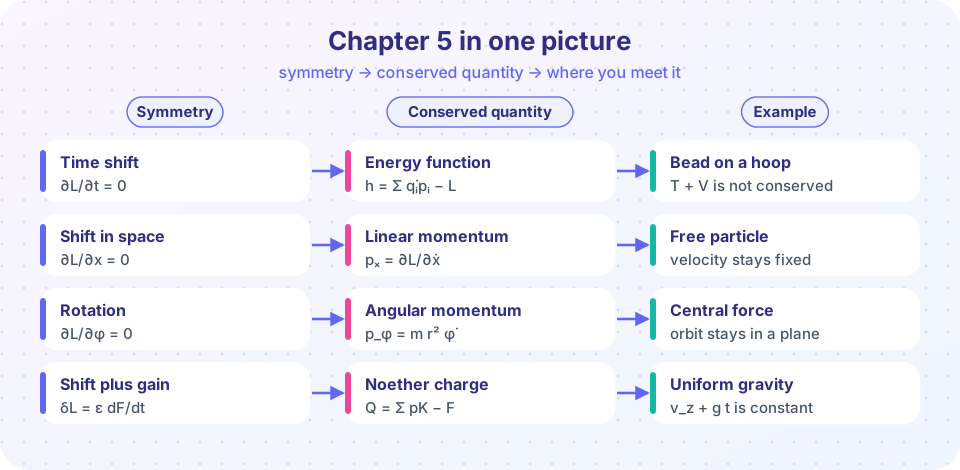
Recap table
Symmetry of L |
Test | Conserved quantity |
|---|---|---|
Coordinate q missing |
∂L/∂q = 0 |
p = ∂L/∂q̇ |
| No explicit time | ∂L/∂t = 0 |
h = Σ q̇ p − L |
Shift in x |
L unchanged by x → x + ε |
pₓ |
Rotation about z |
L unchanged by δx = −εy, δy = εx |
L_z = x p_y − y pₓ |
| Shift with gain | δL = ε dF/dt |
Q = Σ pK − F |
Three points to remember:
- Cyclic coordinates are the quick test. Pick coordinates that match the symmetry (polar coordinates for a central force).
his not alwaysT + V. It equals the energy only when the coordinates do not depend explicitly on time.- Noether needs real motion. The conserved charge is constant on solutions of the equations of motion, not on arbitrary paths.
A conservation audit
A good habit: whenever you simulate a system, list the quantities you expect to be conserved and measure their drift. The TryIt below checks three systems. It prints the spread (maximum minus minimum) of each quantity and marks it conserved if the spread is below 1e-6. The systems are a planar inverse-square orbit (m = 1, k = 1), a projectile in uniform gravity (g = 9.81 m/s²) and the spinning hoop of lesson 2 (per unit m R²). This is a numerical test of ideas you derived above, not a new theory.
Press Run (or Ctrl + Enter) to see the result here.
Program input · what you'd type while the program runs
Type the answers before you press Run, one per line. Each time the program reads a line (with input()), it gets the next line from this box.
Check your understanding
Quick check · 10 questions
of 10 answered You scored / 10 · perfect!
-
1. A Lagrangian L(q, q̇) has no dependence on q. Which statement is right?
dp/dt = ∂L/∂q = 0. -
2. Why does choosing polar coordinates help for a central force?
V depends only on r, so θ is missing from L and p_θ is conserved. -
3. Under which condition is h conserved?
dh/dt = −∂L/∂t. -
4. For which kind of system does h differ from T + V?
The coordinate transformation depends on time through the hoop's rotation, so T has a velocity-independent part. -
5. What does the Noether charge equal for a rotation about z, with K = (−y, x)?
Q = Σ pK = pₓ(−y) + p_y x. -
6. For uniform gravity L = ½mż² − mgz, which quantity is conserved?
ż = v₀ − gt, so mż + mgt = mv₀ is constant. -
7. Which statement about quasi-symmetries is true?
If δL = ε dF/dt, then Q = Σ pK − F is conserved. -
8. Which pair is correctly matched?
Space shift gives momentum; rotation gives angular momentum; time shift gives energy (h). -
9. Why does a uniform sideways force break conservation of L_z in a central-force orbit?
The uniform field picks out a direction, so rotating the system changes L. Energy remains conserved because the field is static. -
10. What must be true for Noether's conserved charge to be constant?
The proof uses ∂L/∂q = ṗ, which holds on real solutions.
Summary
- Symmetry of
Lleads to conserved quantities: space shift to momentum, rotation to angular momentum, time shift toh. - Cyclic coordinates are the quick test; Noether's recipe covers the general case.
hequalsT + Vonly when constraints and coordinates do not depend explicitly on time.- Always audit your simulations by checking the quantities that should be conserved.
Track your progress
Create a free account to tick off lessons and pick up where you left off on any device.
of Classical Mechanics: Lagrangian and Hamiltonian lessons completed