


















Lesson 5 of 44 · Getting Started
Chapter 1 Review: Getting Started
Review chapter 1 with a one-page poster, a recap table and a ten-question quiz on generalized coordinates, degrees of freedom, partial derivatives and the chain rule.
Chapter 1 gave you the vocabulary and the calculus tools for the rest of the course. You learned why Lagrange and Hamilton rewrote mechanics, how to count degrees of freedom and choose generalized coordinates, and how to use partial derivatives and the chain rule. This review collects the key facts on one page and tests them.
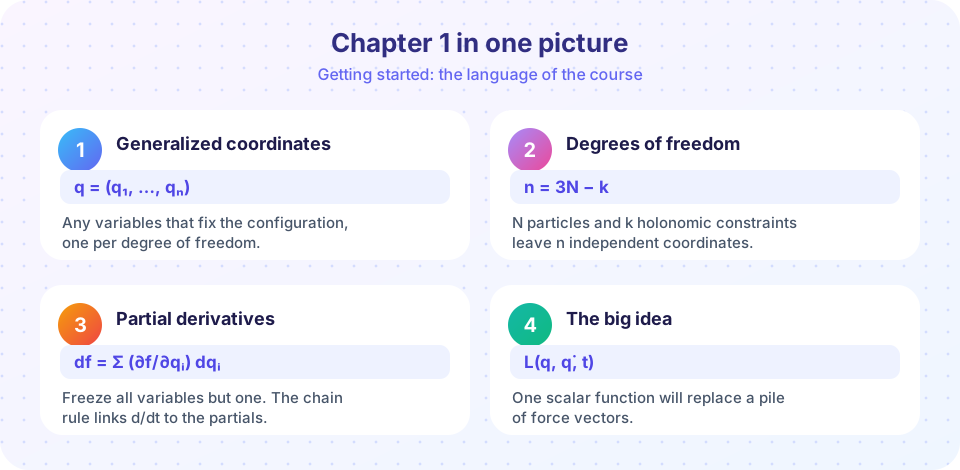
Recap table
| Idea | Statement | Lesson |
|---|---|---|
| Motivation | Constraint forces are unknown; energies are not | Why Lagrange and Hamilton? |
| Partial derivative | ∂f/∂x freezes all other variables |
Math toolkit |
| Chain rule | df/dt = ∂f/∂t + Σ (∂f/∂qᵢ) q̇ᵢ |
Math toolkit |
| Degrees of freedom | n = 3N − k for holonomic constraints |
Generalized coordinates |
| Generalized coordinates | n independent variables, rᵢ(q, t) |
Generalized coordinates |
| Kinetic energy | quadratic in q̇, coefficients may depend on q |
Generalized coordinates |
Try it
Press Run (or Ctrl + Enter) to see the result here.
Program input · what you'd type while the program runs
Type the answers before you press Run, one per line. Each time the program reads a line (with input()), it gets the next line from this box.
The last row prints n = 6, matching the rule that any rigid body has six degrees of freedom. A pendulum in a plane counts z = 0 as one constraint plus the rod as another.
Press Run (or Ctrl + Enter) to see the result here.
Program input · what you'd type while the program runs
Type the answers before you press Run, one per line. Each time the program reads a line (with input()), it gets the next line from this box.
Check your understanding
Quick check · 10 questions
of 10 answered You scored / 10 · perfect!
-
1. What is the main reason Lagrange's method is attractive for constrained systems?
Coordinates that respect the constraints, plus energies, give the motion without the constraint forces. -
2. How many degrees of freedom does a particle moving on the surface of a fixed sphere have?
The constraint x² + y² + z² = R² removes one of three, leaving two (for example latitude and longitude). -
3. For f(x, y) = x y², the partial ∂f/∂x is:
Treat y as a constant: the derivative of x y² with respect to x is y². -
4. In L(q, q̇, t), which statement is correct?
At one instant position and velocity can be chosen freely, so L is a function of independent arguments. -
5. Which is a valid set of generalized coordinates for a bead on a circular wire?
One angle is independent and fixes the bead's position. -
6. A coin rolling without slipping on a table is an example of:
The no-slip condition constrains velocities and cannot be integrated into a relation among coordinates. -
7. What is n for N = 4 free particles with k = 3 holonomic constraints in 3D?
n = 3·4 − 3 = 9. -
8. Which expression gives the total rate of change of f(q, t) along a motion?
That is the multivariable chain rule, including explicit time dependence. -
9. What does the cos(θ₁ − θ₂) term in the double pendulum's kinetic energy represent?
It comes from the dot product of the two velocity contributions of the lower mass. -
10. A rod of fixed length l connects a particle to a fixed pivot in 3D. What is n?
The particle sits on a sphere of radius l about the pivot: two angles.
Summary
- Constraint forces are the reason force methods get complicated; energy methods avoid them.
n = 3N − kcounts independent coordinates; choosengeneralized coordinates that fit the symmetry.- Partial derivatives and the chain rule are the calculus you need; keep
∂/∂tandd/dtapart. - Next chapter: a quick but careful look at Newton's laws, constraints and energy.
Track your progress
Create a free account to tick off lessons and pick up where you left off on any device.
of Classical Mechanics: Lagrangian and Hamiltonian lessons completed