


















Lesson 36 of 44 · Rigid Bodies and Small Oscillations
The Inertia Tensor and Euler's Equations
Learn the inertia tensor, principal axes and Euler's equations for rigid bodies, and see why a spinning book or tennis racket flips about its middle axis.
A rigid body has six degrees of freedom: three for its center of mass and three for its orientation. The center of mass moves like a point particle, so the interesting part is the rotation. Rotation is where intuition from point particles fails. The angular momentum of a spinning body is generally not parallel to its angular velocity, and the quantity that links them is not a number but a matrix: the inertia tensor.
This lesson builds the tensor, finds the principal axes by diagonalization (the same matrix idea as for normal modes), derives Euler's equations for torque-free rotation, and explains the intermediate-axis theorem, the reason why a tossed book flips.
What you will learn
- How
T = ½ ωᵀIωandL = Iωcome fromv = ω × r. - How to find principal moments and axes, and use the parallel-axis theorem.
- How to write and use Euler's equations.
- Why rotation about the middle axis is unstable.
Key terms
Inertia tensor I: the symmetric 3 × 3 matrix Iᵢⱼ = Σ m (r² δᵢⱼ − rᵢrⱼ).
Principal axes: the eigenvectors of I; the axes along which L ∥ ω.
Principal moments I₁, I₂, I₃: the eigenvalues of I.
Torque-free rotation: rotation with no external torque, so L is fixed in space.
The inertia tensor
Place the origin at the center of mass (or at a fixed point). A particle of mass m at position r has velocity v = ω × r due to rotation with angular velocity ω. The rotational kinetic energy of the body is
T = ½ Σ m (ω × r)² = ½ ωᵀ I ω
and the angular momentum is
L = Σ m r × (ω × r) = I ω
with
Iᵢⱼ = Σ m (r² δᵢⱼ − rᵢ rⱼ) (for a continuous body: ∫ ρ (r² δᵢⱼ − rᵢrⱼ) dV)
The diagonal terms are the familiar moments of inertia, such as Iₓₓ = Σ m (y² + z²). The off-diagonal terms (products of inertia) Iₓᵧ = −Σ m x y measure how lopsided the mass is. Because I is a real symmetric matrix it can be diagonalized by a rotation of axes. The eigenvectors are the principal axes and the eigenvalues are the principal moments I₁, I₂, I₃. In principal axes
T = ½ (I₁ω₁² + I₂ω₂² + I₃ω₃²), L = (I₁ω₁, I₂ω₂, I₃ω₃)
L is parallel to ω only if ω lies along a principal axis, or if two principal moments are equal and ω lies in the plane of those two axes.
Parallel-axis theorem
If the tensor about the center of mass is I_cm, then about a point displaced by d
I = I_cm + M (d² 𝟙 − d dᵀ)
For rotation about an axis parallel to one through the center of mass, at distance d: I = I_cm + M d².
Common moments (about a centroidal axis)
| Body | Axis | I |
|---|---|---|
Thin ring, radius R |
through the center, perpendicular to the plane | MR² |
| Solid disk or cylinder | symmetry axis | ½MR² |
| Solid sphere | any diameter | (2/5)MR² |
Thin rod, length L |
perpendicular, through the center | (1/12)ML² |
Thin rod, length L |
perpendicular, through an end | (1/3)ML² |
Cuboid, edges a, b, c |
parallel to edge c |
(1/12)M(a² + b²) |
Euler's equations
In the body frame (axes fixed in the body, aligned with the principal axes) the rate of change of L seen from space is dL/dt = (dL/dt)_body + ω × L = N, where N is the torque. In components:
I₁ ω̇₁ − (I₂ − I₃) ω₂ ω₃ = N₁
I₂ ω̇₂ − (I₃ − I₁) ω₃ ω₁ = N₂
I₃ ω̇₃ − (I₁ − I₂) ω₁ ω₂ = N₃
With no torque, they read
I₁ ω̇₁ = (I₂ − I₃) ω₂ ω₃
I₂ ω̇₂ = (I₃ − I₁) ω₃ ω₁
I₃ ω̇₃ = (I₁ − I₂) ω₁ ω₂
Two quantities are conserved: the rotational energy T = ½ΣIᵢωᵢ² and the squared magnitude of the angular momentum L² = ΣIᵢ²ωᵢ².
The symmetric top, free
If I₁ = I₂, then ω̇₃ = 0, so ω₃ is constant. The other two components rotate in the body frame at angular speed Ω = (I₃ − I₁)ω₃/I₁. The Earth is a slightly flattened symmetric body, and this is the origin of the Chandler wobble of its axis.
The intermediate-axis theorem
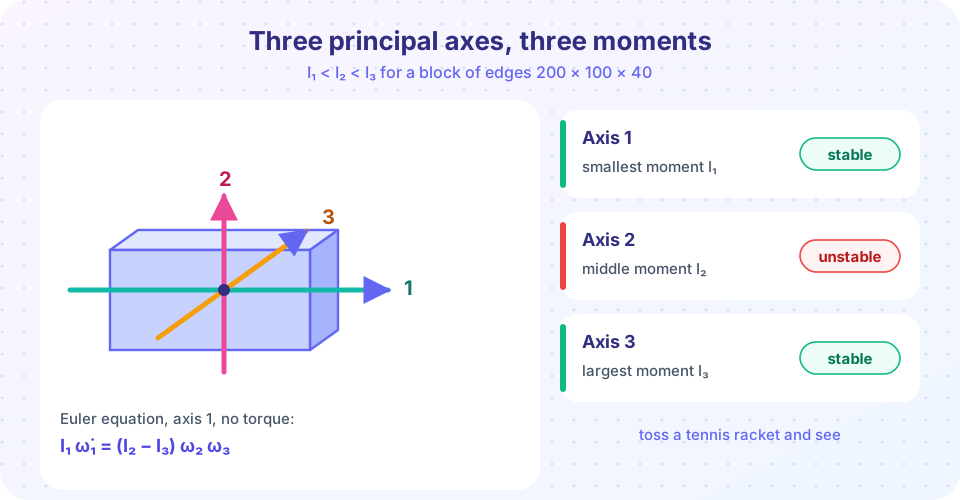
Order the moments I₁ < I₂ < I₃. Start rotating almost exactly about axis 1 with ω₁ ≈ Ω and tiny ω₂, ω₃. To first order in the small components, differentiating the second equation and using the third gives
ω̈₂ = [(I₃ − I₁)(I₁ − I₂) / (I₂ I₃)] Ω² ω₂
The coefficient is negative (I₃ > I₁ and I₁ < I₂), so ω₂ oscillates: the rotation is stable. The same works for axis 3 (the largest moment). For axis 2, with ω₂ ≈ Ω, the corresponding coefficient is
ω̈₁ = [(I₂ − I₃)(I₁ − I₂) / (I₁ I₃)] Ω² ω₁
and now both factors are negative, so the coefficient is positive: small deviations grow exponentially. The body tumbles. This is the tennis-racket or Dzhanibekov effect. It is not a trick of friction; it happens in free space and is visible in video from the International Space Station.
A glimpse of the heavy top
For a symmetric body with a fixed point (a spinning top) the Euler angles φ, θ, ψ give a Lagrangian
L = ½I₁(θ̇² + φ̇² sin²θ) + ½I₃(ψ̇ + φ̇ cosθ)² − M g l cosθ
where l is the distance from the pivot to the center of mass and θ is the angle from the upward vertical. The angles φ and ψ are cyclic, so p_φ and p_ψ are conserved, and with energy conservation the problem reduces to the motion of θ in an effective potential, exactly like the central-force problem. That the whole top reduces to a one-dimensional problem is the payoff of the symmetry ideas of chapter 5.
Common misconceptions
- "The moment of inertia is one number for a body." It depends on the axis, and for a general direction you need the whole tensor.
- "Angular momentum is always parallel to angular velocity." Only along principal axes (or in special symmetric cases). A wobbling dumbbell has
Landωat different angles. - "Spinning about the middle axis would be unstable only because of friction." It is unstable even in the absence of any dissipation; it follows from Euler's equations alone.
Try it
The first TryIt computes the inertia tensor of a uniform block (M = 3 kg, edges 0.20 × 0.10 × 0.04 m) by summing over a grid of small masses, compares with the textbook formulas, then rotates and shifts the block to show that the eigenvalues of the tensor are the principal moments independent of orientation (and that the parallel-axis theorem predicts the shifted tensor). The grid sum is an approximation of the continuous integral, so agreement is to a fraction of a percent.
Press Run (or Ctrl + Enter) to see the result here.
Program input · what you'd type while the program runs
Type the answers before you press Run, one per line. Each time the program reads a line (with input()), it gets the next line from this box.
The second TryIt integrates Euler's torque-free equations for a body with I = (1, 2, 3) kg m² and plots the angular velocity components when it is set spinning (1 rad/s) about each of the three principal axes, with a small 0.05 rad/s push in the other two. The code also checks that T and L² stay constant. This is a numerical experiment on the model equations, in dimensionless-friendly units.
Press Run (or Ctrl + Enter) to see the result here.
Program input · what you'd type while the program runs
Type the answers before you press Run, one per line. Each time the program reads a line (with input()), it gets the next line from this box.
Check your understanding
Quick check · 6 questions
of 6 answered You scored / 6 · perfect!
-
1. A uniform solid sphere of mass M and radius R has moment of inertia about a diameter equal to...
I = (2/5)MR² for a solid sphere (and (2/3)MR² for a thin hollow shell). -
2. A thin rod of length L and mass M is pivoted at one end. Its moment of inertia about the pivot is...
Parallel-axis theorem: (1/12)ML² + M(L/2)² = (1/3)ML². -
3. When is the angular momentum L parallel to ω?
L = Iω, and ω is an eigenvector of I only along a principal axis (or in a plane of equal moments). -
4. Which rotation is unstable when I₁ < I₂ < I₃?
Rotation about the intermediate axis is unstable. -
5. For a torque-free symmetric top with I₁ = I₂, ω₃ is...
I₃ω̇₃ = (I₁ − I₂)ω₁ω₂ = 0. -
6. Which pair of quantities is conserved in torque-free rotation?
Both T and the magnitude of L (fixed in space) are constant.
Summary
T = ½ωᵀIωandL = Iω; the principal axes and moments are the eigenvectors and eigenvalues of the symmetric matrixI.- Parallel-axis theorem:
I = I_cm + M(d²𝟙 − ddᵀ). - Euler's equations:
I₁ω̇₁ = (I₂ − I₃)ω₂ω₃and cyclic permutations (plus torques). - Rotation about the smallest and largest principal axes is stable; about the middle one it is unstable.
Next: Chapter 8 review
Track your progress
Create a free account to tick off lessons and pick up where you left off on any device.
of Classical Mechanics: Lagrangian and Hamiltonian lessons completed