


















Lesson 41 of 44 · Projects and Practice
Practice Problem Set with Worked Answers
Ten problems on Lagrangians, symmetries, Hamilton's equations, orbits, normal modes and rigid bodies, with a six-step method and worked answers checked by code.
The best way to learn mechanics is to solve problems with a method you trust. This lesson gives you a six-step method and ten problems that cover the second half of the course. Try each problem on paper first. The answers follow, and the code blocks check the numbers.
What you will learn
- A six-step routine that works on almost every problem.
- How to spot cyclic coordinates and conserved quantities quickly.
- How to check numerical answers for units and limits.
The method
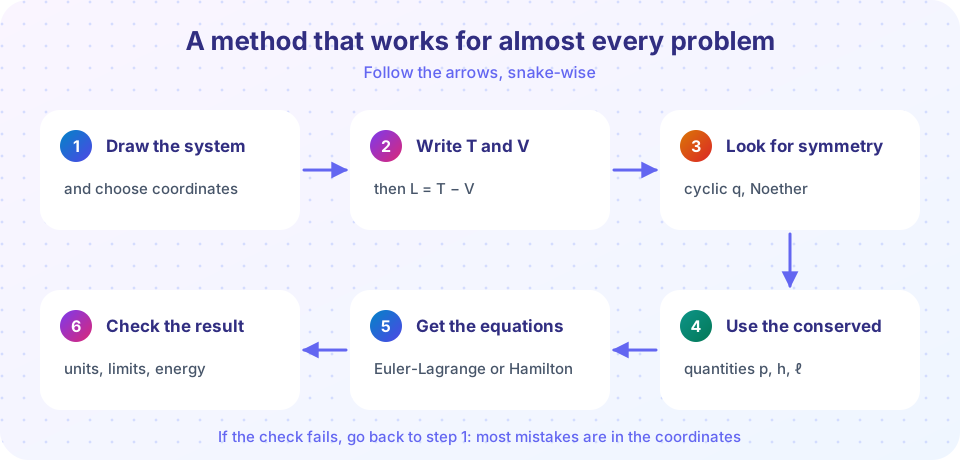
- Draw the system and pick generalized coordinates that match the constraints and the symmetry.
- Write
T,VandL = T − V. - Look for symmetry: coordinates missing from
L(cyclic), time independence (energy functionh), rotations. - Use the conserved quantities to reduce the number of unknowns.
- Get the equations of motion from the Euler-Lagrange equations or Hamilton's equations.
- Check units, limiting cases (zero rotation, small angles, large distance) and conservation laws.
The problems
1. Spinning hoop. A bead of mass m slides on a smooth hoop of radius R = 0.50 m spinning about a vertical diameter with constant angular speed ω. Use θ from the lowest point. (a) Find the equation of motion. (b) Find the critical ω above which the bottom becomes unstable. (c) For ω = 6.0 rad/s, find the new equilibrium angle. (g = 9.81 m/s²)
2. Spherical pendulum. A bob of mass m on a rod of length l, free to move in three dimensions. Use the polar angle θ from the downward vertical and the azimuth φ. (a) Write L and name the conserved quantities. (b) Find φ̇ for motion at constant θ (a conical pendulum). (c) Evaluate it for l = 1.0 m, θ = 40°.
3. A velocity-linear term. A system has L = ½aẋ² + bẋ − V(x) with constants a > 0 and b. Find the momentum p and the Hamiltonian H.
4. Brackets. For a particle in three dimensions with L_z = x p_y − y pₓ, compute {L_z, x}, {L_z, pₓ} and {L_z, x² + y²}.
5. Over the top. A pendulum has a light rigid rod of length l = 1.0 m. What is the smallest angular speed at the lowest point that lets the bob swing all the way around?
6. A satellite. A satellite is at distance r = 7000 km from Earth's center, moving with speed 8.0 km/s perpendicular to the radius. GM = 3.986 × 10¹⁴ m³/s². Find the semi-major axis, the eccentricity, the apogee distance and the period.
7. Transfer orbit. Move a satellite from a circular orbit of radius 7000 km to a circular orbit of radius 42,164 km with a Hohmann transfer: an ellipse touching both circles. Find the two speed changes and the transfer time.
8. Normal modes. Two equal masses m are connected in a line: a wall, a spring k, mass 1, a spring k, mass 2 (the far end is free). Find the normal frequencies and mode shapes.
9. A book. A uniform book of mass 0.80 kg with edges 0.24 m × 0.17 m × 0.03 m. Find the three principal moments about its center, and say which axis is unstable for free rotation.
10. A screw symmetry. In cylindrical coordinates a particle has L = ½m(ρ̇² + ρ²φ̇² + ż²) − V(ρ, z − cφ), with a constant c. Find the symmetry and the conserved quantity.
Answers
1. (a) L = ½mR²θ̇² + ½mR²ω² sin²θ + mgR cosθ gives θ̈ = sinθ (ω² cosθ − g/R). (b) Near θ = 0, θ̈ ≈ (ω² − g/R)θ, which is unstable when ω² > g/R, so ω_c = √(g/R) ≈ 4.43 rad/s. (c) The new equilibrium solves cosθ₀ = g/(Rω²) = 0.545, so θ₀ ≈ 57.0°. (The motor does work on the bead, so T + V is not conserved but h is.)
2. (a) L = ½ml²(θ̇² + sin²θ φ̇²) + mgl cosθ. The angle φ is cyclic, so p_φ = ml² sin²θ φ̇ is conserved; h = T + V is also conserved. (b) The θ equation ml²θ̈ = ml² sinθ cosθ φ̇² − mgl sinθ with θ̈ = 0 gives φ̇² = g/(l cosθ). (c) φ̇ ≈ 3.58 rad/s, period ≈ 1.76 s.
3. p = aẋ + b, so ẋ = (p − b)/a and H = pẋ − L = (p − b)²/(2a) + V(x). Compare with the charged particle, where p − qA appears the same way.
4. {L_z, x} = y, {L_z, pₓ} = p_y, and {L_z, x² + y²} = 0 (the function is rotation invariant). Together with {L_z, y} = −x this shows that L_z generates rotations in the xy plane.
5. Energy: ½ml²θ̇² − mgl = mgl at the threshold, giving θ̇ = 2√(g/l) ≈ 6.26 rad/s. A rigid rod can balance at the top with zero speed, so only the energy at the top matters (a string would need a higher speed).
6. The specific energy is ε = v²/2 − GM/r, so a = −GM/(2ε) ≈ 7990 km. The speed is above circular (7.55 km/s) at the point given, which is therefore the perigee: e = 1 − r/a ≈ 0.124, apogee a(1 + e) ≈ 8980 km, period T = 2π√(a³/GM) ≈ 118.5 min.
7. The transfer ellipse has a_t = (7000 + 42,164)/2 = 24,582 km. The speeds from the vis-viva equation: circular at 7000 km 7.546 km/s, transfer at perigee 9.883 km/s, so Δv₁ ≈ 2.34 km/s; transfer at apogee 1.641 km/s, circular at 42,164 km 3.075 km/s, so Δv₂ ≈ 1.43 km/s. The total is about 3.77 km/s, and the transfer takes half a period, π√(a_t³/GM) ≈ 5.33 h.
8. M = mI, K = k[[2, −1], [−1, 1]]. det(K − mω²I) = 0 gives (mω²)² − 3k(mω²) + k² = 0, so ω² = (3 ∓ √5)k/(2m): ω₁² ≈ 0.382k/m with shape (1, 1.618) and ω₂² ≈ 2.618k/m with shape (1, −0.618). The golden ratio appears in both the frequencies and the shapes.
9. I = M(b² + c²)/12 ≈ 0.00199 kg m² about the longest edge (axis 1), M(a² + c²)/12 ≈ 0.00390 kg m² about the middle edge (axis 2), and M(a² + b²)/12 ≈ 0.00577 kg m² about the axis through the cover (axis 3). Free rotation about the middle axis (the edge of length 0.17 m) is unstable: that is the one that makes the book flip when you toss it.
10. The shift φ → φ + ε, z → z + cε leaves z − cφ unchanged, so L is invariant (K = (φ: 1, z: c), F = 0). The conserved charge is Q = p_φ + c p_z = mρ²φ̇ + c m ż. A particle with c = 0 has the pure rotation symmetry and conserves p_φ; with c ≠ 0 the rotation and a translation along z are combined.
Try it
The first TryIt recomputes the numerical answers of problems 1, 2, 5, 6, 7 and 9, so you can compare your own results. Change the inputs to explore.
Press Run (or Ctrl + Enter) to see the result here.
Program input · what you'd type while the program runs
Type the answers before you press Run, one per line. Each time the program reads a line (with input()), it gets the next line from this box.
The second TryIt checks the algebraic answers (3, 4, 8, 10) with sympy.
Press Run (or Ctrl + Enter) to see the result here.
Program input · what you'd type while the program runs
Type the answers before you press Run, one per line. Each time the program reads a line (with input()), it gets the next line from this box.
Check your understanding
Quick check · 5 questions
of 5 answered You scored / 5 · perfect!
-
1. Which step of the method do you use to decide if energy and momentum are conserved?
Cyclic coordinates and time independence of L are found in the symmetry step. -
2. In problem 1, the bottom of the hoop becomes unstable when...
Near θ = 0, θ̈ ≈ (ω² − g/R)θ. -
3. In problem 6 the given point is the perigee because...
A tangential speed above the circular value means the body will climb: it is at its closest point. -
4. For the Hohmann transfer, the total speed change is the sum of...
One burn puts you on the ellipse; a second circularizes at the target radius. -
5. In the answer to problem 8, what special number appears in the mode shapes?
The shape (1, 1.618) and the frequencies involve √5, hence the golden ratio.
Summary
- Use the six-step method: draw, write
L, find symmetry, use constants, get equations, check. - Many problems are decided by a cyclic coordinate or a quick energy argument.
- Always verify numbers by code or by a limiting case.
Next: Glossary
Track your progress
Create a free account to tick off lessons and pick up where you left off on any device.
of Classical Mechanics: Lagrangian and Hamiltonian lessons completed