


















Lesson 30 of 44 · Central Forces and Orbits
Chapter 7 Overview: Central Forces and Orbits
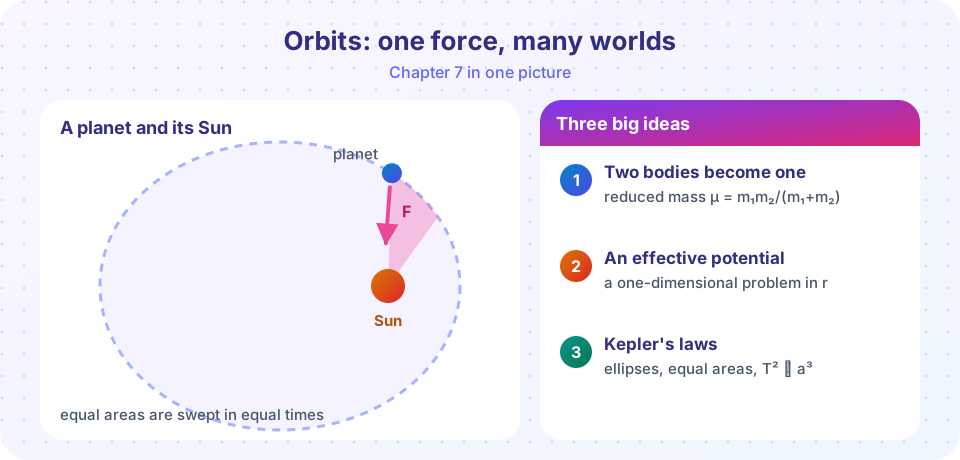
Preview of chapter 7: reduce the two-body problem, use the effective potential, and derive Kepler's laws and the shapes of orbits from conservation laws.
A planet circles a star. An electron is scattered by a nucleus. A comet swings by the Sun and leaves again. All three are central-force problems: the force on a body points along the line to a fixed center and depends only on the distance from it. Central forces are where the conservation laws of chapter 5 pay off most spectacularly, because rotational symmetry hands you angular momentum for free and reduces a three-dimensional problem to a single equation in the radius.
By the end of this chapter you will derive Kepler's three laws from first principles and read the shape of an orbit off an energy diagram.
What you will learn
- Why a two-body problem becomes a one-body problem with a reduced mass.
- How angular momentum conservation gives Kepler's second law for any central force.
- What the effective potential is and how it classifies orbits.
- How conic sections arise as the orbits of an inverse-square force.
The chapter at a glance
Two bodies, one problem
Angular momentum is fixed
An energy diagram for orbits
Conic sections
What each lesson covers
- The effective potential and the orbit equation: reduction of the two-body problem,
ℓ,V_eff, the equation forr(θ), stability of circular orbits. - The Kepler problem: ellipses, parabolas and hyperbolas, Kepler's three laws, the Runge-Lenz vector.
- Chapter review: one-page summary and ten questions.
A first look: conic sections
The orbit of a body under an attractive inverse-square force has the polar equation r = p / (1 + e cosθ), with the center of force at the origin. The parameter p sets the size and e (the eccentricity) sets the shape. The plot draws four values of e with the same p. This plot only evaluates the equation; the lessons that follow derive it.
Press Run (or Ctrl + Enter) to see the result here.
Program input · what you'd type while the program runs
Type the answers before you press Run, one per line. Each time the program reads a line (with input()), it gets the next line from this box.
Check your understanding
Quick check · 4 questions
of 4 answered You scored / 4 · perfect!
-
1. What is a central force?
That includes gravity from a point mass and the Coulomb force from a point charge. -
2. Which quantity does rotational symmetry make constant for a central force?
The angle is cyclic, so p_θ = μr²θ̇ is conserved. -
3. Which orbit shape belongs to an attractive inverse-square force with E < 0?
Bound orbits are ellipses (circles are the special case e = 0). -
4. Eccentricity e > 1 gives which shape?
e = 1 is a parabola and e > 1 a hyperbola.
Summary
- A central force makes angular momentum constant, flattens the motion into a plane and gives equal areas in equal times.
- The effective potential turns the problem into one-dimensional motion in
r. - Orbits of an inverse-square force are conic sections, chosen by the energy.
Track your progress
Create a free account to tick off lessons and pick up where you left off on any device.
of Classical Mechanics: Lagrangian and Hamiltonian lessons completed