


















Lesson 32 of 44 · Central Forces and Orbits
The Kepler Problem: Orbits Under Gravity
Solve the Kepler problem: derive the conic-section orbit, the eccentricity from energy, Kepler's three laws, the vis-viva equation and the Runge-Lenz vector.
The Kepler problem is a body moving under an attractive inverse-square force F = −k/r². It describes planets around the Sun, moons around planets, spacecraft and binary stars, and with k replaced by a Coulomb constant it describes a classical charged particle near a fixed charge. It is also one of the few problems in physics that can be solved exactly in full detail.
The last lesson ended with the orbit equation u'' + u = μk/ℓ². Here you finish the job: write the orbit, relate its shape to the energy, and derive Kepler's three laws, which Johannes Kepler found from Tycho Brahe's observations early in the 17th century and Newton explained.
What you will learn
- How to write the orbit as
r = p/(1 + e cosθ)and findpandefromℓandE. - Why
E < 0,E = 0,E > 0give ellipses, parabolas and hyperbolas. - How to derive Kepler's three laws and the vis-viva equation.
- What the Runge-Lenz vector is and why orbits close.
Key terms
Eccentricity e: the shape parameter of a conic. 0 is a circle, 0 < e < 1 an ellipse, e = 1 a parabola, e > 1 a hyperbola.
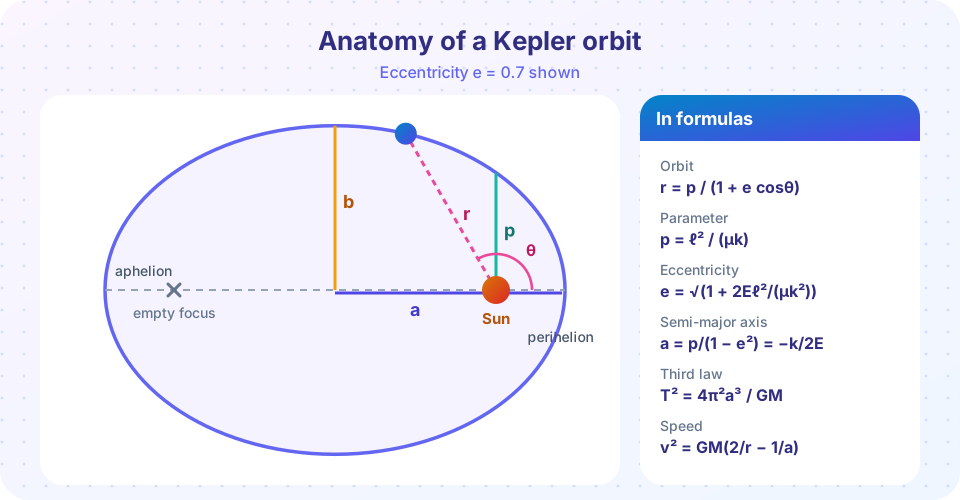
Semi-latus rectum p: p = ℓ²/(μk).
Perihelion / aphelion: the closest and farthest points of an orbit around the Sun (generally periapsis and apoapsis).
Vis-viva equation: v² = GM(2/r − 1/a).
The orbit
The solution of the Binet equation is u = 1/r = (μk/ℓ²)(1 + e cos(θ − θ₀)). Choose the axis so that θ₀ = 0. Then
r = p / (1 + e cosθ), p = ℓ² / (μ k)
At θ = 0 the radius has its smallest value r_min = p/(1 + e): the closest approach. The constant e is fixed by the energy. At closest approach ṙ = 0, so E = ℓ²/(2μ r²) − k/r. Put r = p/(1 + e) and p = ℓ²/(μk) and simplify:
E = (μk²/2ℓ²)(e² − 1) → e = √(1 + 2Eℓ²/(μk²))
So the sign of E fixes the type of orbit:
| Energy | Eccentricity | Orbit |
|---|---|---|
E = −μk²/(2ℓ²) (minimum) |
e = 0 |
circle |
−μk²/(2ℓ²) < E < 0 |
0 < e < 1 |
ellipse |
E = 0 |
e = 1 |
parabola |
E > 0 |
e > 1 |
hyperbola |
An ellipse has semi-major axis a = p/(1 − e²). Substituting e² shows
a = −k / (2E)
Remarkably, the energy depends only on the semi-major axis, not on e or ℓ. The semi-minor axis is b = a√(1 − e²), and the closest and farthest distances are r_min = a(1 − e) and r_max = a(1 + e).
Kepler's three laws
- Orbits are ellipses with the Sun at one focus. That is the formula above (for bound motion).
- Equal areas in equal times. Already proved for any central force:
dA/dt = ℓ/(2μ). T² ∝ a³. In one orbit the areaπabis swept at the constant rateℓ/(2μ), so
T = πab / (ℓ/2μ) = 2πμ a b / ℓ
Square it and use b² = a²(1 − e²) and ℓ² = μk p = μk a(1 − e²):
T² = 4π² μ a³ / k
For gravity between masses m₁ and m₂, k = G m₁ m₂ and μ/k = 1/(G(m₁ + m₂)), so
T² = 4π² a³ / (G (m₁ + m₂))
Kepler's third law is the same for every planet only when the planet's mass is negligible compared with the Sun's (m₁ + m₂ ≈ M_Sun). The slight mass dependence is how we weigh binary stars.
The vis-viva equation
The energy is E = ½μv² − k/r = −k/(2a). Solve for v:
v² = G(m₁ + m₂) (2/r − 1/a)
You can find the speed at any point of an orbit from r and a alone. For example, a spacecraft on a parabola (a → ∞) has v = √(2GM/r), the escape speed.
The Runge-Lenz vector
The Kepler problem has a conserved quantity that is not obvious from any simple symmetry:
A = p × L − μ k r̂, p = μ v
To check it, differentiate. Since ṗ = −k r̂/r² and L = μr²θ̇ ẑ, the first term gives ṗ × L = k μ θ̇ θ̂ (using r̂ × ẑ = −θ̂). The second term gives −μk dr̂/dt = −μk θ̇ θ̂. They cancel, so dA/dt = 0.
A lies in the orbit plane, points from the center toward the perihelion, and has magnitude μ k e. A fixed vector pointing at perihelion means the perihelion never moves: the orbit does not precess. That is why bound Kepler orbits close. Add a small perturbation, say another planet's pull or a relativistic correction, and A slowly rotates; this is why planets' perihelia advance slowly. General relativity alone adds about 43 arcseconds per century to Mercury's.
Noether's theorem explains A too: it comes from a hidden four-dimensional rotation symmetry of the Kepler problem (SO(4) for bound states). The hydrogen atom has the same symmetry, which explains why its energy levels depend only on n.
Common misconceptions
- "The planet orbits the center of the Sun." Both bodies orbit their common center of mass. The Sun's wobble is small but real (it is how many exoplanets are found).
- "A larger orbit takes longer because the planet moves slower, and that is the whole story." The period depends only on
a(and total mass), not one: a long thin ellipse and a circle with the sameahave the same period. - "Escape needs a velocity directed away from the body." Escape speed
√(2GM/r)is the same in every direction (ignoring obstacles), because energy is a scalar.
Try it
The first TryIt is an orbit calculator. For each of three bodies it takes a (in astronomical units) and e, then computes the period from T = 2π√(a³/GM), the closest and farthest distances, and the speeds there from the vis-viva equation. It also prints T²/a³ in yr²/AU³, which should be about 1 for objects orbiting the Sun. The inputs for Mercury and Halley's comet are rounded textbook values, so treat the results as approximate.
Press Run (or Ctrl + Enter) to see the result here.
Program input · what you'd type while the program runs
Type the answers before you press Run, one per line. Each time the program reads a line (with input()), it gets the next line from this box.
The second TryIt simulates an orbit in units where μ = k = 1 (initial position (1, 0), velocity (0, 1.2)). It confirms r = p/(1 + e cosθ) with p = ℓ², e = √(1 + 2Eℓ²), checks that the Runge-Lenz vector is constant with length e and points along the x axis (perihelion), and compares the simulated period with 2πa^(3/2). All numbers here are computed by the integrator, so small deviations are the integration error.
Press Run (or Ctrl + Enter) to see the result here.
Program input · what you'd type while the program runs
Type the answers before you press Run, one per line. Each time the program reads a line (with input()), it gets the next line from this box.
The third TryIt is interactive. The slider changes the eccentricity e in r = p/(1 + e cosθ) (with p = 1) and the picture switches from circle to ellipse to parabola to hyperbola. The text shows the sign of the energy through E = (μk²/2ℓ²)(e² − 1). It is a drawing of the formula, not a simulation of motion.
Check your understanding
Quick check · 6 questions
of 6 answered You scored / 6 · perfect!
-
1. For the Kepler problem, which expression gives the semi-major axis of a bound orbit?
From E = −k/2a. The expression ℓ²/(μk) is the semi-latus rectum p. -
2. An orbit has total energy E = 0. What is its shape?
E = 0 gives e = 1, a parabola: the body just escapes. -
3. Two planets have the same semi-major axis but different eccentricities. Their periods are...
T² = 4π²a³/GM depends only on a. -
4. What does the Runge-Lenz vector point toward?
A points from the center to the perihelion and has length μke. -
5. The vis-viva equation is v² = GM(2/r − 1/a). What is the speed at a distance r on a circular orbit (a = r)?
2/r − 1/r = 1/r, so v = √(GM/r). -
6. Which of Kepler's laws holds for every central force?
Equal areas follows from angular momentum conservation, which only needs a central force.
Summary
- The orbit is
r = p/(1 + e cosθ)withp = ℓ²/(μk)ande = √(1 + 2Eℓ²/(μk²)). E < 0ellipse,E = 0parabola,E > 0hyperbola; for ellipsesE = −k/(2a)depends only ona.- Kepler's laws: ellipse with the Sun at a focus; equal areas (
ℓconstant);T² = 4π²a³/G(m₁+m₂). - The vis-viva equation
v² = GM(2/r − 1/a)gives speed from position. - The Runge-Lenz vector is conserved and explains why the orbit closes.
Next: Chapter 7 review
Track your progress
Create a free account to tick off lessons and pick up where you left off on any device.
of Classical Mechanics: Lagrangian and Hamiltonian lessons completed