


















Lesson 22 of 44 · Conservation Laws and Symmetries
Cyclic Coordinates and the Energy Function
Learn why a coordinate missing from the Lagrangian conserves its momentum, how the energy function h is defined, and why h is not always T + V.
The Euler-Lagrange equations are a set of recipes: one equation per coordinate. Sometimes one of those equations is almost trivial, and that triviality is a conservation law in disguise. This lesson covers the two simplest cases: a coordinate that the Lagrangian never mentions, and a Lagrangian that does not mention time.
The second case also introduces the energy function h. It looks like the total energy and often is, but there are famous systems where it is not, and knowing the difference saves you from an easy mistake.
What you will learn
- How to turn a missing coordinate into a conserved momentum.
- How to build the energy function
hfromL. - When
h = T + V, and when it does not. - How to verify conservation numerically for a driven system.
Key terms
Generalized momentum: pᵢ = ∂L/∂q̇ᵢ, the momentum conjugate to coordinate qᵢ.
Cyclic (ignorable) coordinate: a coordinate qᵢ that does not appear in L, so ∂L/∂qᵢ = 0.
Energy function: h = Σ q̇ᵢ pᵢ − L.
Constant of the motion: a function of the coordinates and velocities that keeps the same value along every real trajectory.
Cyclic coordinates
Start from the Euler-Lagrange equation for coordinate qᵢ:
d/dt (∂L/∂q̇ᵢ) = ∂L/∂qᵢ
The left side is dpᵢ/dt. So the equation says: the rate of change of the momentum equals the generalized force ∂L/∂qᵢ. If qᵢ does not appear in L, then the right side is zero and pᵢ is constant. That is all there is to it, and it is surprisingly powerful.
Example 1: a free particle. L = ½m(ẋ² + ẏ² + ż²). No coordinate appears, so pₓ = mẋ, p_y and p_z are all constant. That is Newton's first law.
Example 2: a projectile. L = ½m(ẋ² + ẏ²) − mgy. The coordinate x is missing, so pₓ = mẋ is constant: the horizontal velocity never changes. The coordinate y appears, so p_y is not constant (gravity changes it).
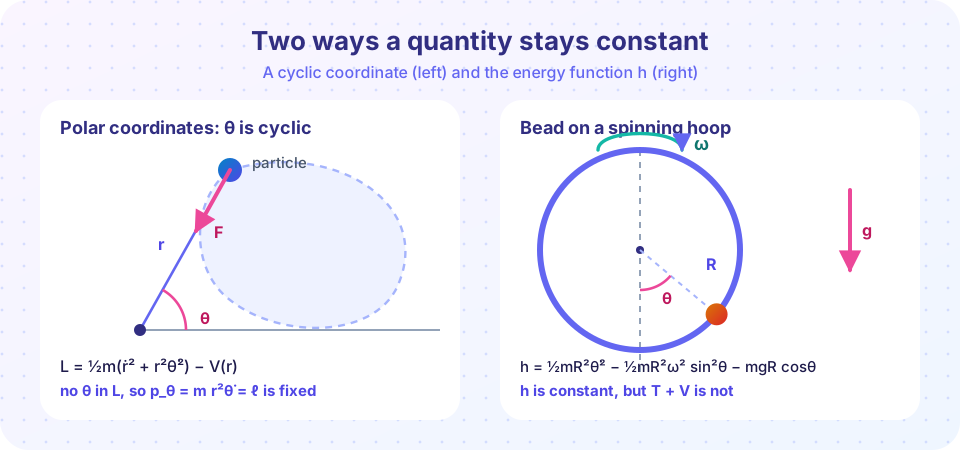
Example 3: a central force in polar coordinates. For a particle in a plane with a potential V(r):
L = ½m(ṙ² + r²θ̇²) − V(r)
The angle θ is missing. So p_θ = ∂L/∂θ̇ = m r² θ̇ is constant. You will recognize this as the angular momentum ℓ. In Newtonian mechanics you needed to prove that a central force exerts no torque. Here it follows because the potential depends only on r, never on the direction.
The choice of coordinates matters. In Cartesian coordinates the same central-force problem has no cyclic coordinate at all (x and y both appear in V(√(x²+y²))). Polar coordinates make the symmetry visible. Choosing coordinates that match the symmetry is half the art of Lagrangian mechanics.
The energy function
Now suppose L(q, q̇, t) depends on time only through q and q̇ (not through an explicit t). Define
h = Σᵢ q̇ᵢ (∂L/∂q̇ᵢ) − L = Σᵢ q̇ᵢ pᵢ − L
Differentiate with respect to time and use the Euler-Lagrange equations. The terms with q̈ cancel, the terms with q̇ cancel, and you are left with
dh/dt = − ∂L/∂t
So h is conserved exactly when L has no explicit time dependence. That is the time-shift symmetry: it does not matter when you start the clock.
When h equals T + V
Write the kinetic energy as T = T₂ + T₁ + T₀, where T₂ is quadratic in the velocities, T₁ linear and T₀ independent of velocities. Euler's theorem for homogeneous functions gives Σ q̇ ∂T/∂q̇ = 2T₂ + T₁. For a potential V that does not depend on velocities, then:
h = T₂ − T₀ + V
If the coordinates do not depend explicitly on time, then T = T₂ alone (no T₁, no T₀) and h = T + V. In that case h is the total mechanical energy.
If the transformation from Cartesian to generalized coordinates does depend on time, as with a rotating frame or a moving constraint, there can be a T₀ or T₁ part. Then h and T + V differ.
A bead on a spinning hoop
A bead of mass m slides on a frictionless circular hoop of radius R. A motor spins the hoop about a vertical diameter at constant angular speed ω. Let θ be the angle of the bead from the lowest point of the hoop. In Cartesian coordinates the bead's position is
x = R sinθ cos(ωt), y = R sinθ sin(ωt), z = −R cosθ
Its speed squared is R²θ̇² + R²ω² sin²θ, so
L = ½mR²θ̇² + ½mR²ω² sin²θ + mgR cosθ
There is no explicit t, so h is conserved:
h = θ̇ ∂L/∂θ̇ − L = ½mR²θ̇² − ½mR²ω² sin²θ − mgR cosθ
But the kinetic energy is T = ½mR²θ̇² + ½mR²ω² sin²θ, so the true mechanical energy is
E = T + V = ½mR²θ̇² + ½mR²ω² sin²θ − mgR cosθ
These differ by mR²ω² sin²θ. The energy E is not conserved, because the motor does work on the bead (the hoop pushes sideways on it). Yet h is exactly conserved. The term −½mR²ω² sin²θ plays the role of a centrifugal potential, and the one-dimensional problem has the effective potential
V_eff(θ) = −mgR cosθ − ½mR²ω² sin²θ
Its minima tell you where the bead settles. For ω² ≤ g/R the only stable point is the bottom, θ = 0. For ω² > g/R the bottom becomes unstable, and two new stable points appear at cosθ₀ = g/(Rω²).
Common misconceptions
- "
his always the total energy." No. It equalsT + Vonly when the generalized coordinates do not depend on time explicitly (andVis velocity independent). The spinning hoop is the standard counterexample. - "If energy is not conserved, nothing is." The hoop loses
Econservation but keepsh. Always check which symmetries remain. - "A cyclic coordinate means the system is periodic." No. Cyclic only means the coordinate itself is absent from
L.
Try it
First let sympy derive the conserved momentum for the polar-coordinate problem and confirm that the Euler-Lagrange equation for θ says d(m r² θ̇)/dt = 0. This is a calculation, not a simulation.
Press Run (or Ctrl + Enter) to see the result here.
Program input · what you'd type while the program runs
Type the answers before you press Run, one per line. Each time the program reads a line (with input()), it gets the next line from this box.
Now the spinning hoop. The simulation integrates the equation of motion θ̈ = sinθ (ω² cosθ − g/R) and plots h and E (per unit m R²) over time. Watch which one stays flat. This is a numerical check of the algebra above.
Press Run (or Ctrl + Enter) to see the result here.
Program input · what you'd type while the program runs
Type the answers before you press Run, one per line. Each time the program reads a line (with input()), it gets the next line from this box.
Check your understanding
Quick check · 5 questions
of 5 answered You scored / 5 · perfect!
-
1. For L = ½m(ṙ² + r²θ̇²) − V(r), which quantity is conserved because θ is cyclic?
p_θ = ∂L/∂θ̇ = m r² θ̇ is the angular momentum. The other two are not constant in general. -
2. The Euler-Lagrange equation d/dt(∂L/∂q̇) = ∂L/∂q says that a conserved momentum needs which condition?
If the generalized force ∂L/∂q vanishes, dp/dt = 0. -
3. What is dh/dt for h = Σ q̇ p − L?
Using the Euler-Lagrange equations, all terms cancel except the explicit time derivative of L. -
4. In the spinning-hoop problem, why is T + V not conserved?
The hoop is driven at fixed ω, so it can feed energy into the bead. The Lagrangian has no explicit time dependence, however, so h is conserved. -
5. For ω² > g/R, where do the stable equilibria of the bead sit?
Setting dV_eff/dθ = 0 gives sinθ (ω² cosθ − g/R) = 0, so besides θ = 0 there is a solution cosθ₀ = g/(Rω²), which exists only when ω² > g/R.
Summary
- A coordinate missing from
Lis cyclic, and its momentumpᵢ = ∂L/∂q̇ᵢis constant. - Good coordinates make symmetries visible: polar coordinates show the rotation symmetry of a central force.
h = Σ q̇ p − Lobeysdh/dt = −∂L/∂t, so it is conserved whenLhas no explicit time dependence.h = T + Vonly when the coordinates do not depend explicitly on time. On a driven constraint such as a spinning hoop the two differ.
Next: Noether's theorem
Track your progress
Create a free account to tick off lessons and pick up where you left off on any device.
of Classical Mechanics: Lagrangian and Hamiltonian lessons completed