


















Lesson 21 of 44 · Conservation Laws and Symmetries
Chapter 5 Overview: Conservation Laws and Symmetries
A tour of chapter 5: how cyclic coordinates, the energy function and Noether's theorem turn the symmetries of a Lagrangian into conserved quantities.
Every physics student learns three conservation laws: energy, momentum and angular momentum. In Newtonian mechanics they arrive as three separate theorems, each proved with its own little calculation. In Lagrangian mechanics they are three faces of one idea: a symmetry of the Lagrangian produces a conserved quantity. This chapter shows you how that idea works, and why it is one of the most useful tools in all of physics.
The payoff is practical. When you meet a new system, you do not have to hope that something is conserved. You look at the Lagrangian, ask which changes leave it alone, and read off the constants of the motion. Each constant you find removes one difficult second-order equation and leaves an easier first-order one.
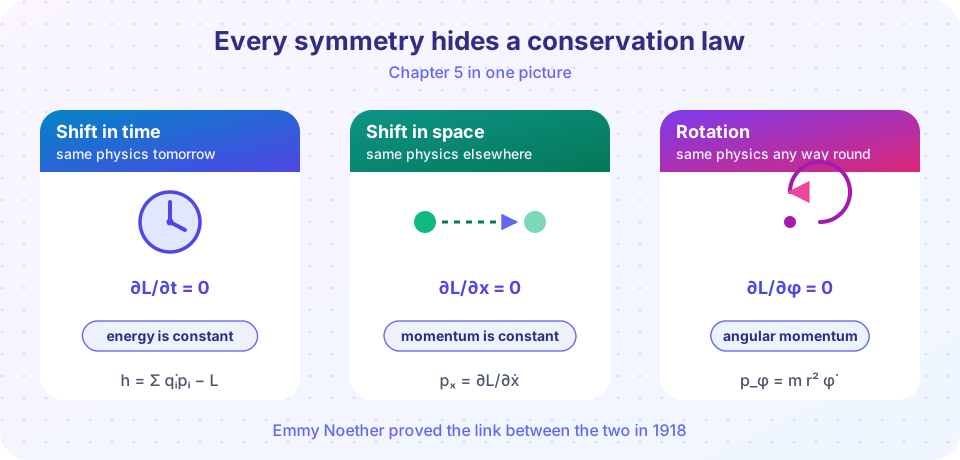
What you will learn
- Why a missing coordinate in the Lagrangian means a conserved momentum.
- How the energy function
his built, and when it equalsT + V. - What Noether's theorem says and how to use it as a recipe.
- How to check a conservation law numerically.
The chapter at a glance
Symmetry means: change something, nothing changes
If L does not notice the change, physics has a symmetry.
Each symmetry has a charge
Three tools in this chapter
What you gain
What each lesson covers
- Cyclic coordinates and the energy function: the fastest conservation law (a coordinate missing from
L), and the energy functionh = Σ q̇ p − Lwith a warning that it is not alwaysT + V. - Noether's theorem: the general recipe, including symmetries that change
Lby a total time derivative. - Chapter review: a one-page summary and a ten-question quiz.
A first look: is this coordinate cyclic?
The quickest test is a derivative: ∂L/∂q. If it is zero for some coordinate q, the coordinate is cyclic and its momentum is conserved. The next TryIt asks the computer algebra library sympy to do that test for three Lagrangians. This is a demonstration of the test, not a full solution of the systems.
Press Run (or Ctrl + Enter) to see the result here.
Program input · what you'd type while the program runs
Type the answers before you press Run, one per line. Each time the program reads a line (with input()), it gets the next line from this box.
Check your understanding
Quick check · 4 questions
of 4 answered You scored / 4 · perfect!
-
1. A coordinate q does not appear in the Lagrangian (only q̇ does). What can you conclude?
The Euler-Lagrange equation reads dp/dt = ∂L/∂q. If ∂L/∂q is zero then p is constant. -
2. Which symmetry is linked to conservation of linear momentum?
If L does not change when the system is moved along an axis, the momentum along that axis is conserved. -
3. Which symmetry is linked to conservation of the energy function h?
dh/dt = −∂L/∂t, so h is conserved exactly when L has no explicit time dependence. -
4. Who proved the general theorem linking symmetries and conserved quantities?
Emmy Noether published the theorem in 1918.
Summary
- A symmetry of the Lagrangian gives a conserved quantity.
- Space shifts give momentum, rotations give angular momentum, time shifts give energy.
- The chapter covers cyclic coordinates, the energy function and Noether's theorem.
Track your progress
Create a free account to tick off lessons and pick up where you left off on any device.
of Classical Mechanics: Lagrangian and Hamiltonian lessons completed