


















Lesson 23 of 44 · Conservation Laws and Symmetries
Noether's Theorem: Symmetry Gives Conservation
A step-by-step guide to Noether's theorem for particles: shift the path, check how L changes, build the conserved charge Q, with worked examples.
A cyclic coordinate is the easy case of a deeper principle. In 1918 the mathematician Emmy Noether proved that every continuous symmetry of the action gives a conserved quantity. The theorem applies to far more than "a coordinate is missing". It covers rotations about tilted axes, boosts, time shifts and the symmetries of modern field theories.
For particle mechanics you only need a short recipe. This lesson states the recipe, proves it in a few lines, and applies it to five examples, including two where the Lagrangian is not exactly unchanged but changes by a harmless total derivative.
What you will learn
- What an infinitesimal symmetry transformation
q → q + εKmeans. - How to state and prove Noether's theorem for a particle system.
- How to derive momentum, angular momentum and the energy function from it.
- Why a symmetry may change
Lby a total derivative and still conserve something.
Key terms
Infinitesimal transformation: qᵢ → qᵢ + εKᵢ(q, t) with ε so small that ε² is ignored.
Symmetry (quasi-symmetry): a transformation after which L changes by at most a total time derivative, δL = ε dF/dt.
Noether charge: the conserved quantity Q = Σ pᵢKᵢ − F.
Constant of the motion: a quantity whose value does not change along real trajectories.
The idea
Take a real path q(t) and nudge every point of it by a small amount to get a new path:
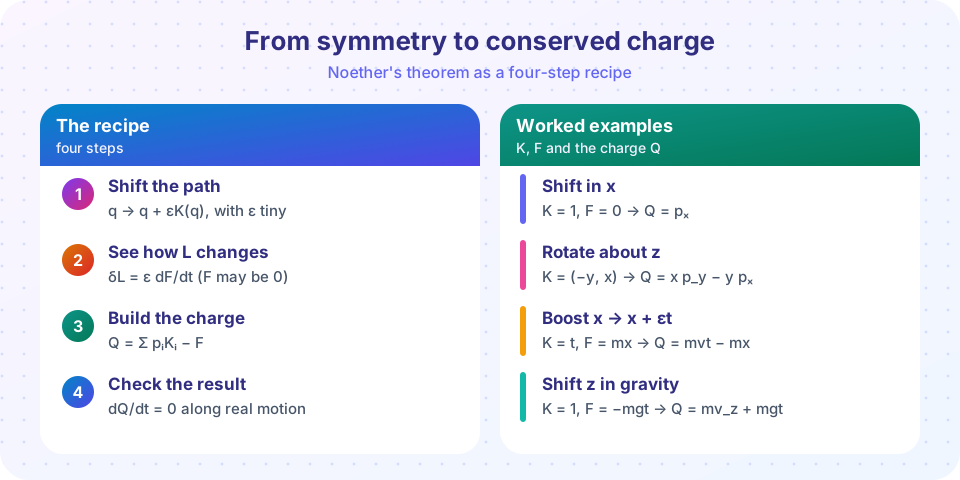
q(t) → q(t) + ε K(q, t)
Here K is a fixed recipe (shift by one unit in x, rotate about the origin, and so on) and ε is a tiny number. Because the velocity is the derivative of the position, the velocity changes too:
q̇ → q̇ + ε dK/dt
Now compute how the Lagrangian changes. To first order in ε:
δL = ε Σ ( ∂L/∂qᵢ · Kᵢ + ∂L/∂q̇ᵢ · dKᵢ/dt )
It is a symmetry if this change is a total time derivative: δL = ε dF/dt for some function F(q, t). The simplest case is F = 0: L does not change at all.
Noether's theorem and its proof
If
δL = ε dF/dt, thenQ = Σ pᵢ Kᵢ − Fis constant along every solution of the Euler-Lagrange equations.
Proof. On a real path, ∂L/∂qᵢ = dpᵢ/dt and ∂L/∂q̇ᵢ = pᵢ. Insert these into δL:
δL = ε Σ ( dpᵢ/dt · Kᵢ + pᵢ · dKᵢ/dt ) = ε d/dt ( Σ pᵢ Kᵢ )
This is by the product rule. But δL = ε dF/dt by assumption. Therefore
d/dt ( Σ pᵢ Kᵢ − F ) = 0
which is the theorem. Notice that the proof uses the equations of motion at only one point: replacing ∂L/∂q by ṗ. Symmetry alone does nothing; you need real motion.
Worked examples
1. Space translation. Shift x → x + ε. Then K = (1, 0, 0) and L = ½mv² − V is unchanged if V does not depend on x. So F = 0 and Q = pₓ. Momentum along a direction of symmetry is conserved.
2. Rotation about the z axis. Rotating by a small angle ε moves a point (x, y) to (x − εy, y + εx), so K = (−y, x, 0). For a central potential V(r), L does not change, F = 0, and
Q = pₓ(−y) + p_y(x) = x p_y − y pₓ = L_z
That is the z component of angular momentum.
3. Galilean boost. Move the frame at velocity ε: x → x + εt, so K = t. For a free particle L = ½mẋ², and ẋ → ẋ + ε, so δL = ε m ẋ = ε d(mx)/dt. Thus F = mx and
Q = p t − m x = m v t − m x
Since v is constant, Q = −m(x − vt). Conservation of Q says that x − vt is constant: the center-of-mass position moves in a straight line at constant velocity.
4. Uniform gravity. For L = ½mż² − mgz, shifting z → z + ε changes L by −mgε, which equals d(−mgεt)/dt. So F = −mgt, K = 1 and
Q = m ż + m g t
That is conserved: ż = v₀ − gt gives mż + mgt = mv₀. Notice that L itself changes under the shift. It is only a quasi-symmetry, and it still yields a conservation law.
5. Time translation. Use the velocity-dependent shift δq = ε q̇ (moving the whole motion along in time by ε). If L has no explicit time dependence then δL = ε dL/dt, so F = L and
Q = Σ pᵢ q̇ᵢ − L = h
The energy function falls out of the same recipe. (The theorem proof above allows K to depend on velocities; only the form of δq̇ changes.)
Limits of the theorem
- One charge per continuous symmetry. You get one conserved quantity for each independent parameter
ε. Rotation in three dimensions has three parameters, which gives three components ofL. - Discrete symmetries give nothing here. A mirror reflection is a symmetry of many systems but there is no small
ε, so no classical conserved charge appears. - Hidden symmetries exist. The Kepler problem conserves an extra vector (the Runge-Lenz vector, lesson on the Kepler problem). It comes from a less obvious symmetry of the Lagrangian.
- No symmetry, no guarantee. If you cannot find a symmetry, the quantity you want may not be conserved. Check numerically, as in the second TryIt.
Common misconceptions
- "A symmetry must leave
Lexactly unchanged." Not true. A change by a total derivativedF/dtdoes not alter the equations of motion and still gives a charge (uniform gravity, boosts). - "Noether's theorem proves momentum is always conserved." It says momentum is conserved when the space-shift is a symmetry. A particle in a central force has no such symmetry, and its linear momentum is not conserved.
- "The conserved charge is the same thing as the symmetry." The symmetry is a transformation; the charge is a number built from
p,KandF.
Try it
The first TryIt is a small Noether calculator in sympy. Give it a Lagrangian and a shift K, and it computes δL/ε and tests a candidate F. If the candidate works, it prints the charge Q. The last case is not a symmetry, and the calculator reports that.
Press Run (or Ctrl + Enter) to see the result here.
Program input · what you'd type while the program runs
Type the answers before you press Run, one per line. Each time the program reads a line (with input()), it gets the next line from this box.
The second TryIt tests the theorem by brute force. It follows a particle in an attractive inverse-square central force with m = 1 and k = 1 (arbitrary units). Case A has the rotation symmetry. Case B adds a uniform sideways force, which breaks the rotation symmetry but keeps energy conservation. The plots show the angular momentum L_z = x v_y − y v_x and the energy for both.
Press Run (or Ctrl + Enter) to see the result here.
Program input · what you'd type while the program runs
Type the answers before you press Run, one per line. Each time the program reads a line (with input()), it gets the next line from this box.
Check your understanding
Quick check · 5 questions
of 5 answered You scored / 5 · perfect!
-
1. A transformation changes L by ε dF/dt. What is the conserved charge?
From d/dt(Σ pK) = δL/ε = dF/dt we get d/dt(Σ pK − F) = 0. -
2. Which shift K gives the z component of angular momentum for a particle in the xy plane?
A small rotation moves (x, y) to (x − εy, y + εx). Then Σ pK = −y pₓ + x p_y = L_z. -
3. For L = ½mż² − mgz and the shift z → z + ε, which F works?
δL = −mgε = ε d(−mgt)/dt. The charge is Q = mż + mgt. -
4. What is the Noether charge for the time-translation symmetry of a time-independent L?
With δq = εq̇ and F = L, Q = Σ pq̇ − L = h. -
5. A particle moves in a central force. Is its linear momentum conserved?
The potential V(r) singles out a center, so shifting the system changes L. The momentum is not conserved, although angular momentum is.
Summary
- Nudge a path by
q → q + εK; ifδL = ε dF/dt, the quantityQ = Σ pK − Fis conserved. - The proof is two lines: replace
∂L/∂qbyṗ, use the product rule. - Translations give momentum, rotations give angular momentum, time shifts give
h, boosts give the straight-line motion of the center. - A symmetry may change
Lby a total derivative (uniform gravity), and it still works.
Next: Chapter 5 review
Track your progress
Create a free account to tick off lessons and pick up where you left off on any device.
of Classical Mechanics: Lagrangian and Hamiltonian lessons completed