


















Lesson 29 of 44 · Hamiltonian Mechanics
Chapter 6 Review: Hamiltonian Mechanics
Review of the Legendre transform, Hamilton's equations, phase space, Liouville's theorem, Poisson brackets and canonical transformations, with a recap table and quiz.
This review ties the four ideas of the chapter into one loop: start with a Lagrangian, transform it to a Hamiltonian, draw the flow in phase space and describe it with brackets. The picture below is worth keeping next to you while you work the problems later in the course.
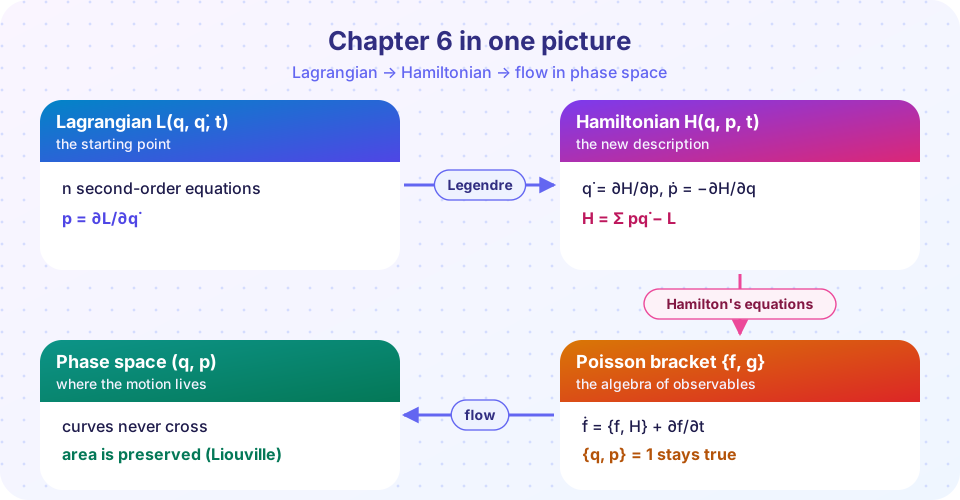
Recap table
| Idea | Key formula | One-line meaning |
|---|---|---|
| Conjugate momentum | p = ∂L/∂q̇ |
the variable that replaces the velocity |
| Hamiltonian | H = Σ pq̇ − L |
L seen as a function of (q, p) |
| Hamilton's equations | q̇ = ∂H/∂p, ṗ = −∂H/∂q |
2n first-order equations |
| Energy | dH/dt = ∂H/∂t |
conserved without explicit time dependence |
| Phase space | state = point (q, p) |
trajectories never cross |
| Liouville | ∂q̇/∂q + ∂ṗ/∂p = 0 |
area (volume) is preserved |
| Poisson bracket | ḟ = {f, H} + ∂f/∂t |
tests and computes change |
| Canonical map | {Q, P} = 1 |
keeps Hamilton's form |
| Generating function | F₁(q, Q): p = ∂F₁/∂q, P = −∂F₁/∂Q |
builds canonical maps |
Remember:
Hmust be written withqandponly.- A charged particle has
p = mv + qA. - Friction destroys Liouville's theorem: area shrinks as
e^(−γt). - Two conserved quantities give a third through their bracket (Poisson's theorem).
Two routes to the same motion
A good check on a derivation is to solve the Lagrange and the Hamilton equations independently. The TryIt below does that for a pendulum (m = 1 kg, l = 1 m, g = 9.81 m/s², starting at θ = 2 rad). The Lagrange route integrates one second-order equation; the Hamilton route integrates two first-order ones. The maximum difference should be at the level of the integration error.
Press Run (or Ctrl + Enter) to see the result here.
Program input · what you'd type while the program runs
Type the answers before you press Run, one per line. Each time the program reads a line (with input()), it gets the next line from this box.
Check your understanding
Quick check · 10 questions
of 10 answered You scored / 10 · perfect!
-
1. Which formula defines the Hamiltonian?
H = Σ pq̇ − L, written as a function of q, p and t. -
2. A system has 3 coordinates. How many Hamilton equations are there?
Each of the 3 coordinates and 3 momenta has a first-order equation. -
3. For a free particle, H = p²/2m. What is q̇?
q̇ = ∂H/∂p = p/m. -
4. A harmonic oscillator has H = p²/2m + kx²/2. What shape are its phase curves?
H = E is a quadratic equation in x and p with positive coefficients. -
5. Liouville's theorem says that Hamiltonian flow preserves...
Volume is preserved; shapes can stretch and shear. -
6. Which condition shows that f(q, p) with no explicit time is a constant of the motion?
df/dt = {f, H} when f has no explicit time dependence. -
7. What is {q, p}?
That is the fundamental bracket in this lesson's sign convention. -
8. The generating function F₁ = qQ gives which transformation?
p = ∂F₁/∂q = Q and P = −∂F₁/∂Q = −q. -
9. Which statement about damping is right?
With friction −γp the divergence is −γ and the area decays as e^(−γt). -
10. For a charged particle with vector potential A, H equals...
From L = ½mv² − qφ + qA·v: p = mv + qA, and H = (p − qA)²/2m + qφ.
Summary
H(q, p, t) = Σ pq̇ − Land Hamilton's equations give2nfirst-order equations.- Phase portraits are contour maps of
H; Liouville's theorem makes the flow incompressible. ḟ = {f, H} + ∂f/∂tis the universal evolution law; canonical transformations keep{Q, P} = 1.
Track your progress
Create a free account to tick off lessons and pick up where you left off on any device.
of Classical Mechanics: Lagrangian and Hamiltonian lessons completed