


















Lesson 6 of 44 · Newtonian Mechanics Revisited
Newtonian Mechanics Overview: The Vector Picture
A fast, careful review of Newton's laws, momentum, energy and angular momentum, and a map of chapter 2 on systems of particles, constraints and conservative forces.
Before we replace Newton's method we should know exactly what it says and where it strains. This chapter is a deliberate second look at the Newtonian picture: laws, systems of particles, constraints, work and energy. You probably saw it all before, but now we read it with an eye on what will carry over to Lagrange's version and what will not.
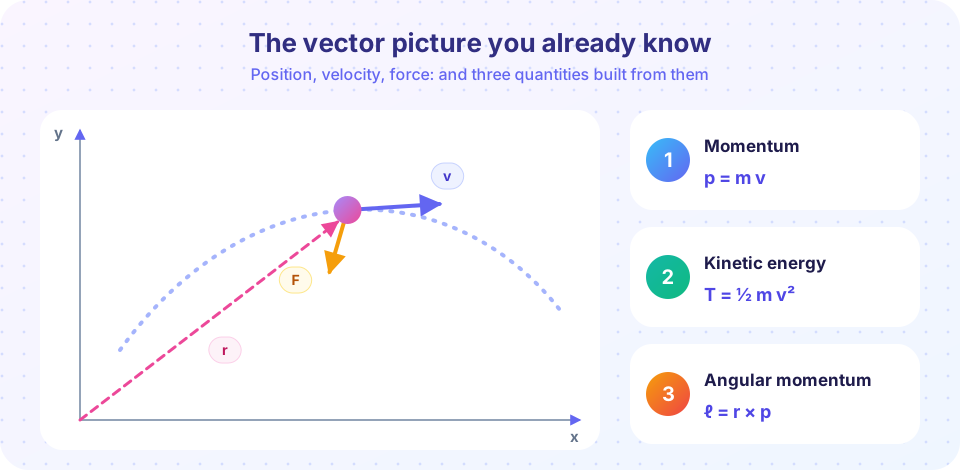
What you will learn
- The statements of Newton's three laws in the form we will reuse.
- How momentum, kinetic energy and angular momentum are defined from
r,vandF. - What each lesson of the chapter covers.
Key terms. Inertial frame: a frame in which Newton's first law holds. Momentum p = m v. Kinetic energy T = ½ m v². Angular momentum ℓ = r × p. Torque τ = r × F.
The three laws, in the form we will use
- First law. In an inertial frame a free particle moves at constant velocity.
- Second law.
F = dp/dt; for constant mass,m r̈ = F. - Third law. If body 1 pushes on body 2 with
f₂₁, body 2 pushes back withf₁₂ = −f₂₁along the line joining them (the strong form).
Newton's laws hold only in inertial frames, and the Lagrangian method assumes them too: the Lagrangian of a free particle L = ½ m v² is correct only for an inertial observer. Everything in this course uses inertial frames or adds fictitious forces explicitly.
Three derived quantities
From the second law you get:
- Work-energy theorem.
dT = F · dr; the work done on a particle equals its change in kinetic energy. - Angular momentum.
dℓ/dt = r × F = τ; if the torque vanishes,ℓis constant. - Momentum. If
F = 0,pis constant.
These are exactly the conserved quantities that chapter 5 will derive from symmetry, where Noether's theorem reveals why they exist.
Press Run (or Ctrl + Enter) to see the result here.
Program input · what you'd type while the program runs
Type the answers before you press Run, one per line. Each time the program reads a line (with input()), it gets the next line from this box.
Press Run (or Ctrl + Enter) to see the result here.
Program input · what you'd type while the program runs
Type the answers before you press Run, one per line. Each time the program reads a line (with input()), it gets the next line from this box.
What this chapter covers
- Systems of Particles: internal and external forces, the center of mass and total momentum.
- Constraints and the Pendulum: why unknown constraint forces make Newton's method laborious.
- Conservative Forces and Energy: potential energy, energy diagrams and turning points.
- Chapter 2 Review.
Check your understanding
Quick check · 4 questions
of 4 answered You scored / 4 · perfect!
-
1. Which law says that a body at rest stays at rest unless a net force acts?
That is the law of inertia, Newton's first law. -
2. A particle moves in a circle with no torque. What happens to its angular momentum about the center?
dℓ/dt = τ = 0, so ℓ is constant. -
3. Which expression gives work-energy theorem for a small displacement?
Work is the dot product of force and displacement. -
4. What is the kinetic energy of a 2 kg particle moving at 4 m/s?
T = ½ · 2 · 4² = 16 J.
Summary
- Newton's laws hold in inertial frames and give
m r̈ = F. - From them come momentum, kinetic energy (work-energy theorem) and angular momentum conservation.
- Chapter 2 revisits systems of particles, constraints and conservative forces to prepare for Lagrange's method.
Next: Systems of Particles
Track your progress
Create a free account to tick off lessons and pick up where you left off on any device.
of Classical Mechanics: Lagrangian and Hamiltonian lessons completed